Focus on Improving Conditions for Public Officials with 5 to 10 Years of Service
Adjustment Through Increased Position and Meal Allowances
First Salary Committee Meeting to Be Held on the Afternoon of the 30th
The public officials' union has called for a 6.6% increase in public officials' salaries next year and the establishment of a five-year plan to raise their pay to the same level as that of private sector workplaces. These demands are set to be discussed in earnest at the Public Officials' Salary Committee, where union representatives, experts, and government officials convene to deliberate on salary levels.
The Joint Struggle Committee for the Right to Livelihood of Public Officials and Teachers (the Joint Committee) held a press conference in front of the Presidential Office in Yongsan at 11 a.m. on June 19 and announced its "Public Officials' Wage Increase Proposal." The proposal includes: a 6.6% wage increase; a five-year plan to bring public officials' salaries to 100% of the level of private sector workplaces with 100 or more employees; a 30,000 won increase in the fixed meal allowance; a 35,000 won increase in the position allowance for officials at grade 6 and below; an increase in the reduction rate for overtime pay; and a 10% increase in the payment rate for regular bonuses.
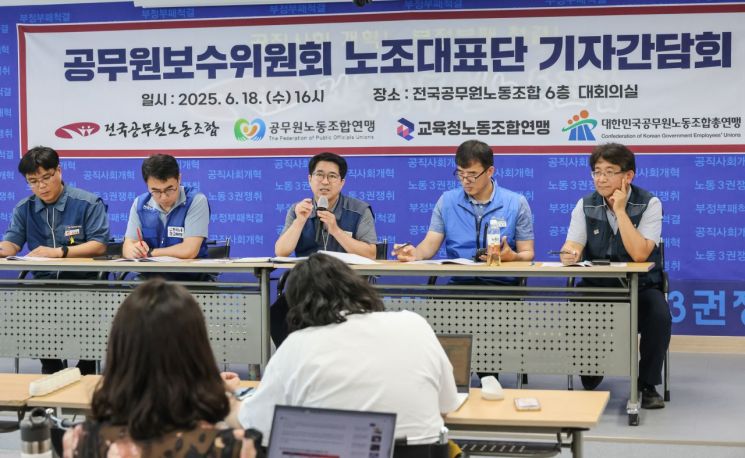 The union delegation of the Public Officials' Salary Committee held a press briefing on the 18th at the National Public Officials Labor Union conference room in Yeongdeungpo-gu, Seoul. Photo by Jeongongno
The union has focused this year on improving the treatment of mid-career public officials with 5 to 10 years of service. This is based on the perception that these employees have been relatively neglected, as public attention has recently centered on wage increases for less-experienced officials. This year, the government granted an additional 3.6% wage increase to entry-level grade 9 officials, resulting in their starting monthly salary exceeding 2 million won for the first time. Including allowances, the total reaches 2.69 million won, which is about 350,000 won higher than the monthly wage calculated at minimum wage. The salaries for grades 7 and 8 were also subject to an additional increase, but at 3.0% for step 1, which is lower than that for grade 9.
Chae Jeongil, Senior Vice Chairman of the Education Federation, said at the union delegation's press briefing for the Salary Committee on June 18, "If, over the past two to three years, wage increases for less-experienced public officials have exceeded 13% and reached a certain level of stability, the increase rate for officials with 5 to 10 years of service has remained stagnant. For this group, a fixed increase is desirable, but since the government side said this is not possible, we proposed increasing the regular bonus and holiday allowance as alternatives."
The dissatisfaction of mid-career public officials was also evident in the 2024 Public Service Life Survey. In response to a question about their intention to leave the job, 59.5% of those with 6 to 10 years of service answered "yes," the highest among all groups. The figure for those with 5 years or less was 54.6%.
However, Ahn Jeongseop, Senior Vice Chairman of the Korean Government Employees' Union Confederation, emphasized, "We are not opposed to additional increases for less-experienced public officials, but we are calling for securing additional funding." In the past, additional wage increases for less-experienced officials were covered by budget surpluses, but going forward, the union insists that separate funding should be secured for this purpose. Vice Chairman Chae stated, "Since the government has announced a plan to gradually increase the starting salary for grade 9 officials to 3 million won per month by 2027, it is only natural that this funding should be secured as a separate budget. Surplus funds should be used to improve the treatment of all public officials, such as increasing meal allowances and regular bonuses."
Ultimately, the union argues that public officials' salaries should be raised to 100% of the level of private sector workplaces. According to the union's estimate for this year, public officials' salaries are currently at 83.9% of those at private sector workplaces with 100 or more employees. Park Jungbae, Senior Vice Chairman of the National Public Officials' Union, said, "During the Kim Dae-jung administration, public officials' pay was so low that it was raised to 90% of the private sector level. However, real wages have been declining and are not keeping up with inflation, leading to widespread dissatisfaction among public officials. The government needs to come up with prompt measures."
The Public Officials' Salary Committee, which adjusts the salary increase rate for public officials, will hold its first meeting at 1 p.m. on June 30. Fifteen members, including union representatives, government officials, and experts, will discuss the treatment of public officials for next year. The committee determines agreements through voting, but the final decision depends on whether the Ministry of Economy and Finance implements the budget. Currently, the committee's decisions are only "recommendations" without legal force. The Joint Committee is pushing for the enactment of the "Public Officials' Wage Committee Act," which would allow public officials' pay to be determined through labor-management wage negotiations.
© The Asia Business Daily(www.asiae.co.kr). All rights reserved.
![Clutching a Stolen Dior Bag, Saying "I Hate Being Poor but Real"... The Grotesque Con of a "Human Knockoff" [Slate]](https://cwcontent.asiae.co.kr/asiaresize/183/2026021902243444107_1771435474.jpg)















