On June 19, iM Securities analyzed in its report "Fed: Four Pieces of Evidence for a September Rate Cut" that, despite the Federal Reserve (Fed) holding rates steady in June, there is a high likelihood that rate cuts will resume from September as previously expected by the market. In contrast, DB Securities, in its report "FOMC: Rate Cuts to Be Delayed as Much as Possible This Year," projected that the resumption of rate cuts would occur later than the market anticipates.
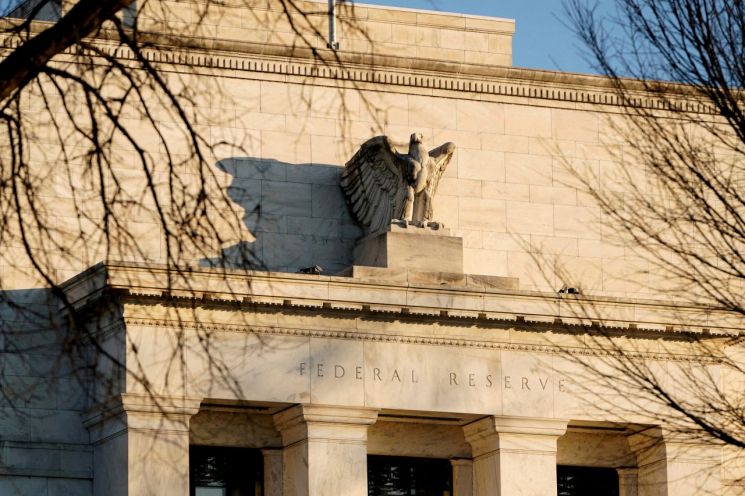
Previously, on June 18 (local time), the US Federal Reserve announced after its regular Federal Open Market Committee (FOMC) meeting that it would maintain its benchmark interest rate at the existing 4.25-4.50%. This marks the fourth consecutive hold, following decisions in January, March, and May.
The dot plot for rate expectations maintained its previous projection of two rate cuts. However, the projections for 2026 were raised from 3.4% to 3.6%, and for 2027 from 3.2% to 3.4%. The projected rate cut trajectory from 2024 to 2027 also changed from two cuts, two cuts, and one cut (five cuts in total) to two cuts, one cut, and one cut (four cuts in total).
The growth rate forecast for this year was revised downward by 0.3 percentage points, from 1.7% to 1.4%. The core PCE inflation forecast was raised by 0.3 percentage points to 3.1%, and the Fed projected that achieving the 2% inflation target by 2027 would be difficult. The unemployment rate forecast for this year was also slightly raised from 4.4% to 4.5%. The Fed noted that volatility in net exports has affected the data, but economic activity has remained solid. However, it pointed out that inflation remains high and uncertainty about the economic outlook is still elevated.
Regarding future rate adjustments, the Fed reiterated that it would "consider the magnitude and timing," without providing specific hints about the timing of subsequent rate cuts.
Kim Myungshil, an analyst at iM Securities, stated, "Despite the Fed's decision to hold rates, the dot plot for this year was not revised, contrary to market concerns," and added, "If the possibility of two rate cuts this year remains open, the most likely timing for the Fed to resume cuts appears to be September." She provided the following grounds for this assessment:
First, recently, Governor Waller stated that "price increases due to tariffs will likely be a one-off phenomenon," signaling openness to rate cuts. This illustrates that there are differences of opinion within the Fed regarding future monetary policy.
Second, the Fed emphasized, as it did in May, that it faces the dual challenge of responding to rising inflation expectations while also managing a slowdown in employment.
Third, the actual imposition of tariffs could have a greater impact on dampening consumer demand than on inflation. Signs of weakening demand have begun to appear even in the services sector, which has a low import share. If this situation continues, economic burdens will spread, and pressure from Trump on the Fed will inevitably intensify.
Fourth, after the Israel-Iran conflict, oil prices have risen sharply, increasing the possibility of stagflation, where inflation and GDP decline occur simultaneously. However, since the US has recently become an oil exporter, the impact of high oil prices on inflation and GDP is no longer unidirectional as in the past.
Hana Securities also projected that the Fed would implement two rate cuts within this year, starting in September, after confirming the short-term impact on inflation. Jeon Gyuyoun, an economist at Hana Securities, analyzed, "The unemployment rate projected by Fed members for this year is 4.5%, which is considerably higher than the natural rate of unemployment (4.2%). With labor supply and demand already close to equilibrium, a gradual slowdown in the labor market in the second half seems inevitable. Once inflation concerns ease, the path for rate cuts is likely to resume."
In contrast, DB Securities projected that the timing of rate cuts could be later than the market expects. Excluding survey-based expected inflation, medium- to long-term market-implied inflation expectations and retail gasoline prices remain generally stable. While tariffs and geopolitical tensions could temporarily increase inflation, medium- to long-term inflation expectations are not being shaken enough to affect monetary policy. Park Sungwoo, an analyst at DB Securities, stated, "Although there is significant division among Fed members, in the short term, it is likely that the Fed will take a more cautious stance on inflation," and added, "With inflation uncertainty likely to persist for some time, there is a risk that the timing of the Fed's policy rate cuts will be delayed compared to current market expectations."
© The Asia Business Daily(www.asiae.co.kr). All rights reserved.
![Clutching a Stolen Dior Bag, Saying "I Hate Being Poor but Real"... The Grotesque Con of a "Human Knockoff" [Slate]](https://cwcontent.asiae.co.kr/asiaresize/183/2026021902243444107_1771435474.jpg)
















