Trump Urges "Everyone Should Leave Tehran Immediately"
Hints at Possibility of Large-Scale Israeli Airstrikes
WTI and Brent Crude Rise Over 2% Amid Middle East Instability
U.S. Retail Sales Fall for Second Consecutive Month in May
Fed to Decide on Benchmark Interest Rate on the 18th... Hold Likely
On June 17 (local time), the three major U.S. stock indexes opened lower on the New York Stock Exchange, as escalating tensions in the Middle East weighed on investor sentiment. Investors are closely monitoring the armed conflict between Israel and Iran, which has now entered its fifth day, with heightened caution. International oil prices are surging by more than 2%. Additionally, unexpectedly sharp declines in retail sales last month are further dampening investor confidence.
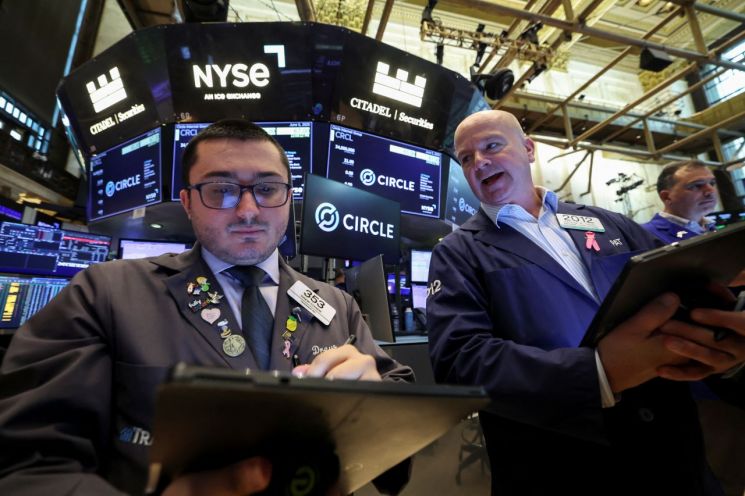
As of 10:17 a.m. on the New York Stock Exchange, the Dow Jones Industrial Average, which focuses on blue-chip stocks, was down 46.53 points (0.11%) at 42,468.56 compared to the previous trading day. The S&P 500 index, which tracks large-cap stocks, was down 10.73 points (0.18%) at 6,022.38, while the tech-heavy Nasdaq index had fallen 49.57 points (0.25%) to 19,651.65.
U.S. President Donald Trump stated the previous day on his self-created social media platform, Truth Social, that "Iran should have signed the agreement I told them to sign," and urged, "Everyone should leave Tehran immediately." He suggested the possibility of a large-scale Israeli airstrike against Iran by saying that his early return from the G7 summit was due to "something much bigger" than ceasefire negotiations between Israel and Iran. Later, in an interview with CBS aboard Air Force One on his way back to the U.S., President Trump said that Israel is unlikely to delay its airstrikes on Iran for the time being, adding, "We will know within the next two days."
Iran, now on the defensive, is reportedly seeking to initiate negotiations. The Wall Street Journal (WSJ) reported the previous day that Iran had conveyed, through Arab mediators, its willingness to halt hostile acts against Israel and to engage in talks regarding its nuclear program.
As instability in the Middle East intensifies once again, international oil prices are soaring. West Texas Intermediate (WTI) crude is trading at $71.96 per barrel, up $1.71 (2.43%) from the previous day, while Brent crude, the global oil price benchmark, is trading at $75.09 per barrel, up $1.86 (2.54%).
The contraction in U.S. retail sales is also dampening investor sentiment. According to the U.S. Department of Commerce, retail sales in May 2025 totaled $715.4 billion, down 0.9% from the previous month. Dow Jones experts had expected retail sales to decline by 0.6%, but the actual decrease was larger than anticipated. April retail sales were also revised downward, from a previously reported 0.1% increase to a 0.1% decrease. This marks the first time since late 2023 that retail sales have declined for two consecutive months, indicating that consumers are once again cutting back on spending. Households, which had increased spending on items such as automobiles ahead of the full implementation of tariffs, are now closing their wallets due to uncertainty over trade policy, making the contraction in consumer spending?which underpins the U.S. economy?a reality.
Chris Rupkey, chief economist at FwdBonds, commented, "Consumers are anxious about what will happen next," and diagnosed, "The economy is slowing as people choose to save rather than spend cash at stores and shopping malls."
Market attention is now focused on the outcome of the U.S. Federal Reserve's Federal Open Market Committee (FOMC) regular meeting, which begins today and will last for two days. The Fed will decide on the benchmark interest rate the following day. According to CME FedWatch, the federal funds futures market is currently pricing in a 99.8% probability that the Fed will keep the benchmark rate unchanged at 4.25-4.5% per year. If the Middle East conflict causes oil prices to rise further, the likelihood of a Fed rate cut in the future will decrease even more.
By stock, Microsoft (MS) is down 0.66%. Apple is down 0.31%, and Nvidia is down 0.11%. Alphabet, Google's parent company, and Meta, Facebook's parent company, are down 0.51% and 0.44%, respectively. Tesla is showing a 1.96% decline.
U.S. Treasury yields are flat. The yield on the 10-year U.S. Treasury, the global benchmark for bond yields, is at 4.43%, down 1 basis point (1bp = 0.01 percentage point) from the previous day. The yield on the 2-year Treasury, which is sensitive to monetary policy, remains at 3.96%, the same as the previous day.
© The Asia Business Daily(www.asiae.co.kr). All rights reserved.
![Clutching a Stolen Dior Bag, Saying "I Hate Being Poor but Real"... The Grotesque Con of a "Human Knockoff" [Slate]](https://cwcontent.asiae.co.kr/asiaresize/183/2026021902243444107_1771435474.jpg)
















