Around 2030, Labor Input to Become a Negative Factor for GDP Growth
Aging Population Leads to Declining Labor Force Participation and Slower Per Capita GDP Growth
Pension and Medical Expenditures Projected to Reach 20% of GDP by 2050, Increasing the Support Burden
An analysis has found that the "trend number of employed persons" in South Korea is expected to start declining from 2032. This means that even if the economy continues to grow at its potential growth rate, the actual number of employed persons could decrease. From this point onward, labor input is projected to become a negative factor for GDP growth.

On June 17, the Bank of Korea's Economic Research Department announced these findings in its report titled "BOK Issue Note: Projections and Implications for the Trend Number of Employed Persons Considering Demographic and Labor Market Structure."
The trend number of employed persons refers to the number of workers needed to maintain the natural rate of unemployment. This figure is calculated by considering structural changes on the supply side, such as the population growth rate and the labor force participation rate, regardless of the economic cycle. The trend number of employed persons increases as the population growth rate and labor force participation rate among those aged 15 and older rise, and as the natural unemployment rate falls. Major central banks estimate the growth in the trend number of employed persons and use it as a basis for assessing employment conditions. If the actual increase in the number of employed persons exceeds the trend increase, employment is considered robust; if it falls short, employment is considered weak.
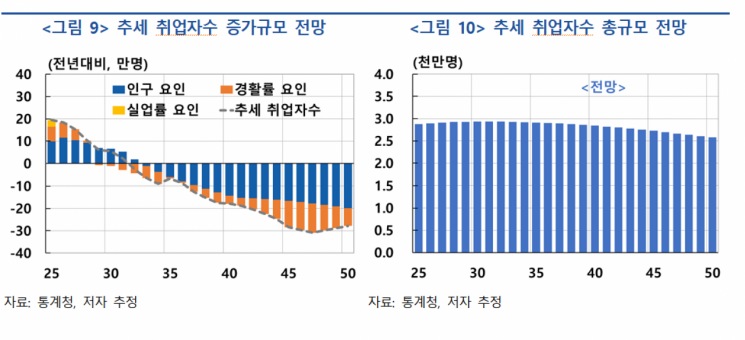
From a long-term perspective, the growth in the trend number of employed persons is expected to gradually slow and turn negative in 2032. Lee Youngho, head of the Employment Trends Team, explained, "The population aged 15 and older is expected to start declining from 2033, and the labor force participation rate, which has been on the rise, is projected to start falling around 2030. This means that even if the economy continues to grow at its potential rate, the actual number of employed persons could decrease." Afterward, the trend number of employed persons is expected to continue declining, with the total number of employed persons projected to remain at about 90% of last year's level by 2050.
During this process, the Korean economy is likely to bear significant economic costs, as the population decline will occur alongside an aging demographic structure. Lee emphasized, "From around 2030, when the trend number of employed persons begins to decrease, labor input will become a negative factor for GDP growth." Even if economic growth stagnates due to population decline, individual welfare could improve if per capita GDP increases. However, as the labor force participation rate starts to fall due to aging around 2030, the growth rate of per capita GDP is also expected to face structural downward pressure.
The growth rate of per capita GDP, assuming other factors such as productivity remain constant, is determined by the difference between the growth rates of the number of employed persons and the total population. As the proportion of the elderly population with low labor force participation increases, the number of employed persons is expected to decrease more rapidly than the total population. Lee stated, "If other factors such as the income replacement rate remain constant, the ratio of pension and medical expenditures to GDP will rise from the current 10% to 20% by 2050 due to aging and reduced economic activity, increasing the burden of support."
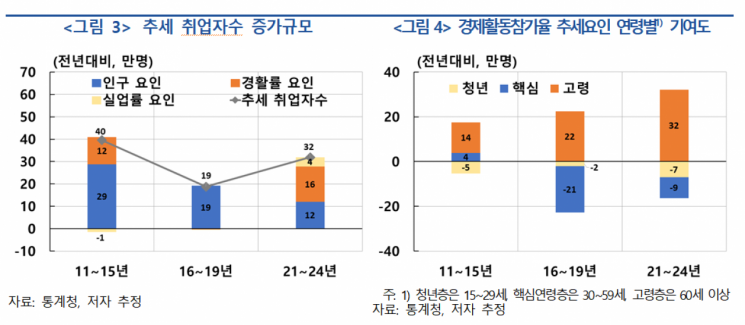
The trend number of employed persons in Korea increased by 400,000 annually from 2011 to 2015, then dropped to 190,000 from 2016 to 2019, before rising again to 320,000 from 2021 to 2024 following the spread of COVID-19. The decline in the population growth rate due to low birth rates has exerted persistent downward pressure on the trend number of employed persons. From 2016 to 2019, the male labor force participation rate also fell significantly?down to half the level of 2011 to 2015?due to the reduction of middle- and low-skilled jobs caused by technological advances and the deepening of job mismatches. However, after COVID-19, the expansion of flexible work arrangements and the increase in service sector jobs led to a significant rise in the labor force participation rates of women and the elderly, partially offsetting the downward pressure.
This year, the growth in the trend number of employed persons is estimated to be in the high 100,000s, as the upward trend in the labor force participation rate has slowed. Lee assessed, "In the first half of the year (January to May), the actual number of employed persons was slightly below the trend, and considering that the growth is expected to slow in the second half, the employment situation this year is somewhat sluggish."
To mitigate the negative impact of the slowdown in the trend number of employed persons due to population decline and aging, it is necessary to raise productivity and the labor force participation rate through structural reforms across the economy. Lee stated, "To increase the labor force participation rate, there needs to be a social consensus on continued employment measures to utilize the human capital of the retirement-age population, and structural barriers that restrict the economic activity of young people and women must also be removed."
Scenario analysis shows that if structural reforms are successful and the labor force participation rate rises by 4 percentage points above the baseline assumption by 2050, the timing of the decline in the number of employed persons will be delayed by about five years compared to the baseline scenario. By 2050, the number of employed persons will reach 95% of the 2024 level. The annual average growth rate of per capita GDP will be 0.3 percentage points higher, and the ratio of pension and medical expenditures to GDP in 2050 will be 1.3 percentage points lower.
Lee also emphasized, "Efforts to raise the birth rate must be pursued consistently," adding, "It is also necessary to consider ways to utilize foreign workers to fill labor shortages until the effects of higher birth rates materialize." Improving productivity across the economy is also an important task. He said, "Fostering new growth industries, reforming the education system to match these industries, addressing career interruptions, and continued employment for the retirement-age population will all contribute to raising the productivity of young people, women, and the elderly."
© The Asia Business Daily(www.asiae.co.kr). All rights reserved.
![Clutching a Stolen Dior Bag, Saying "I Hate Being Poor but Real"... The Grotesque Con of a "Human Knockoff" [Slate]](https://cwcontent.asiae.co.kr/asiaresize/183/2026021902243444107_1771435474.jpg)

















