Deep-Sea Polymetallic Nodule Mining
Reduced Raw Material Supply Risks Amid U.S. FEOC Regulations
Korea Zinc has announced an investment in The Metals Company (TMC), a Nasdaq-listed U.S. company, as part of its strategy to respond to the weaponization of resources by various countries, including export controls on strategic minerals and rare earth elements. This move is aimed at proactively and stably securing promising sources of resources amid intensifying global competition for resource acquisition. It is also expected to significantly contribute to supply chain cooperation and economic security between South Korea and the United States.
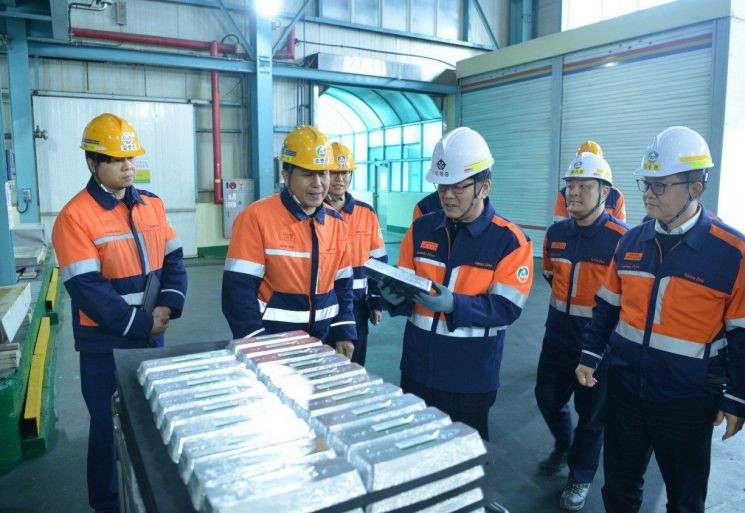 Lee Jejung, CTO and Vice Chairman of Korea Zinc, is visiting the indium plant within the Korea Zinc Onsan Smelter to inspect the produced products. Photo by Korea Zinc
On June 17, Korea Zinc stated that it has signed an agreement to acquire approximately a 5% stake in TMC, which is listed on the U.S. Nasdaq. The company invested about $85 million (116.5 billion KRW) based on TMC’s closing price on the day before the contract was finalized. The contract also includes an option to purchase additional shares at a set price if TMC’s market value and growth potential are confirmed in the future.
TMC is preparing to mine polymetallic nodules containing nickel, cobalt, copper, and manganese from the deep sea. The company aims to secure and develop key materials used in electric vehicles, renewable energy, and advanced industries. Through this investment, Korea Zinc plans to strengthen business linkages and cooperation, such as refining resources extracted by TMC both domestically and internationally. Additionally, the two companies will discuss further collaborations, including investments in facilities within the United States.
Recently, following an executive order signed by the Trump administration to curb China’s resource monopolization and strengthen resource security, TMC is aiming to obtain mining permits within this year and is regarded as contributing to the United States’ efforts to achieve supply chain independence. Accordingly, Korea Zinc’s equity investment in TMC is expected to positively impact resource security cooperation between South Korea and the United States and enhance the South Korean government’s negotiating power with the U.S.
With this investment, Korea Zinc expects to secure a stable supply of polymetallic nodules containing not only nickel but also copper, cobalt, and manganese, which can be supplied to its own smelters.
Currently, through its secondary battery subsidiary KEMCO, Korea Zinc is constructing an all-in-one nickel smelter with the goal of starting commercial operations in 2027. Securing TMC as one of the raw material suppliers for this smelter is also significant.
It is noteworthy that the United States is striving to establish a supply chain for key battery minerals that is independent from China’s dominance. Through this investment, Korea Zinc can serve as a key player in the non-China supply chain.
TMC also considers its partnership with Korea Zinc, which possesses non-Chinese capital and technology, to be of great importance. The two companies plan to initially process products through Korea Zinc’s all-in-one nickel smelter after commencing resource production, and later pursue the construction of a nickel smelter within the United States.
Meanwhile, this investment is significant in that it greatly contributes to increasing supply chain independence for key secondary battery materials while minimizing risks such as the U.S. government’s designation of “Foreign Entity of Concern (FEOC)” and exclusion from tax benefits. The U.S. government has been imposing disadvantages, such as excluding IRA benefits, on key minerals involving countries like China and Russia through the FEOC designation. This is part of efforts to strengthen U.S. technological independence by excluding supply chains involving competing countries such as China.
Nickel, a key raw material for electric vehicle batteries, is dominated by China as the largest producer in the global market, and Indonesia, the second-largest producer, also has significant Chinese capital involvement. Therefore, establishing a supply chain completely free from the U.S. government’s FEOC designation is not easy. In this context, the cooperation between Korea Zinc and TMC is considered meaningful and competitive, as it enables the establishment of a supply chain that is not subject to the U.S. government’s FEOC regulations.
The Korea Zinc management stated, “Expanding refining capacity is particularly important in the process of building a strategic mineral supply chain in the United States. The new partnership between Korea Zinc and TMC is significant in that it provides an independent and reliable nickel supply platform for U.S. businesses and consumers, and it is also expected to greatly strengthen Korea Zinc’s presence in the United States.”
© The Asia Business Daily(www.asiae.co.kr). All rights reserved.
![Clutching a Stolen Dior Bag, Saying "I Hate Being Poor but Real"... The Grotesque Con of a "Human Knockoff" [Slate]](https://cwcontent.asiae.co.kr/asiaresize/183/2026021902243444107_1771435474.jpg)















