Iran Warns of Possible Blockade of the Strait of Hormuz
70% of South Korea's Crude Oil Imports Depend on the Middle East...
Potential Impact if the Strait Is Closed
Blockade Could Backfire on Iran as Well...
Experts Say Prolonged Closure Is Unlikely
As military clashes between Israel and Iran target key energy infrastructure in the Middle East, concerns are mounting over the possibility of a blockade of the Strait of Hormuz, a vital chokepoint for global oil shipments. If the strait is indeed closed and global energy supplies are disrupted, there are growing fears that a sharp spike in international oil prices could reignite inflation worldwide. South Korea, which relies heavily on the Middle East for imports of crude oil and liquefied natural gas (LNG), could also face a complex economic shock, including instability in energy supply, rising consumer prices, and a worsening trade balance.
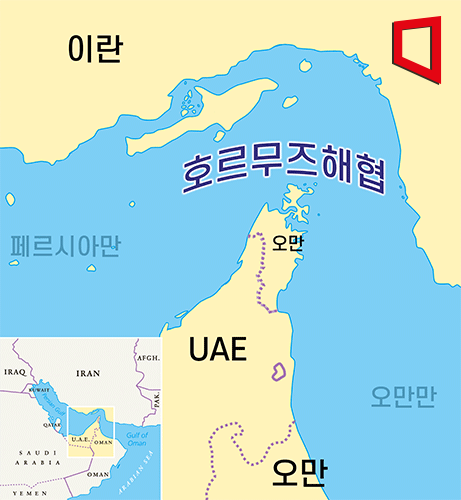
According to the Wall Street Journal (WSJ) on June 15 (local time), the two countries escalated military tensions over the weekend by attacking each other's oil refineries and gas infrastructure. Israel bombed a refinery and fuel storage facility in Tehran, the capital of Iran, while Iran launched missiles at the Bazan oil refinery near Haifa, Israel. Iranian authorities also claimed that the South Pars facility, a giant natural gas field in the southern Persian Gulf, was attacked by drones.
As the conflict intensified, Esmail Kowsari, a commander of Iran’s Islamic Revolutionary Guard Corps (IRGC), warned that they are "considering blocking the Strait of Hormuz, through which one-third of the world's oil passes." This is seen as an attempt to disrupt the core route for global oil and LNG shipments, shake up the global energy market, and put pressure on the world economy through soaring oil prices and a resurgence of inflation.
The Strait of Hormuz is a key maritime route for exporting crude oil and LNG from major Middle Eastern oil-producing countries such as Saudi Arabia, Iran, Kuwait, and the United Arab Emirates (UAE) to the rest of the world. About one-third of the world's crude oil and about one-quarter of LNG are transported through the Strait of Hormuz.
Signs of potential disruptions in oil shipments are already emerging. According to market research firm Kpler, many oil tankers bound for Kharg Island, Iran's largest oil export terminal, have experienced delays in docking since June 13. The WSJ reported that this is seen as a warning signal that could lead to actual supply disruptions.
If the strait is blocked, more than 20 million barrels of oil shipments per day could be disrupted, and there are concerns that international oil prices could exceed $100 per barrel. On June 13, when Israel launched its attack on Iran, the price of West Texas Intermediate (WTI) crude oil in the United States surged 7.3% in a single day to $73 per barrel, the highest in four months. Jorge Leon, head of geopolitical analysis at energy consulting firm Rystad Energy, stated, "If Iran disrupts oil shipments through the Strait of Hormuz, or attacks energy infrastructure or US military facilities in the region, international oil prices could jump by more than $20 per barrel."
There are also concerns that a surge in oil prices could fuel global inflation. When international oil prices rise, the cost of gasoline, diesel, logistics, electricity, and raw materials all increase, leading to an overall rise in prices. These higher costs raise business expenses, which eventually result in higher prices for goods and services, causing a "reignition of inflation" for consumers worldwide. MarketWatch warned that fears over a blockade of the strait could push inflation up to 5%.
The New York Times (NYT) also reported that "if Iran closes the strait, global supply chains will be paralyzed, which will directly hit consumers and businesses around the world." Although the United States is reducing its dependence on Persian Gulf oil, crude oil produced in the region is traded on the global market, which determines international oil prices, so there could still be a broad impact on global prices.
If this route is actually blocked, a massive shock is expected not only to the global energy market but also to the Korean economy. South Korea relies on the Middle East for about 70% of its total crude oil imports and more than 40% of its LNG imports, with most of these resources coming through the Strait of Hormuz. The Korea Institute for Industrial Economics and Trade estimated in May last year that "if the Strait of Hormuz is blocked, production costs across all Korean industries will rise by 3.02%, 5.19% in manufacturing, and 1.39% in services," and analyzed that industries highly dependent on energy, such as refining, chemicals, and transportation, would be hit the hardest.
The US Energy Information Administration (EIA), under the Department of Energy, also reported that "in 2023, 83% of the crude oil and condensate passing through the Strait of Hormuz was destined for Asian markets (including China, South Korea, and Japan)," highlighting that South Korea is one of the countries most dependent on the strait and that its energy supply stability could be threatened if the strait is blocked.
However, some experts believe that a complete blockade of the strait is unlikely, considering the potential economic blowback to Iran and possible opposition from China. Helima Croft, head of global commodity strategy at RBC Capital Markets, told the Financial Times (FT) that, given the presence of the US Navy's Fifth Fleet stationed in Bahrain, it would be "extremely difficult" for Iran to completely block the Strait of Hormuz for an extended period.
This is because such a move would not only affect other countries but would also block Iranian oil exports to China, ultimately backfiring and causing damage to Iran itself.
© The Asia Business Daily(www.asiae.co.kr). All rights reserved.
![Clutching a Stolen Dior Bag, Saying "I Hate Being Poor but Real"... The Grotesque Con of a "Human Knockoff" [Slate]](https://cwcontent.asiae.co.kr/asiaresize/183/2026021902243444107_1771435474.jpg)















