Attending the G7 Summit as an Observer for a Three-Day, One-Night Visit from June 16 to 18
Focusing on Filling the Diplomatic Gap After the December 3 Martial Law
A Rapid Debut Just 12 Days After Inauguration... Launching Pragmatic, National Interest-Centered Diplomacy
Participating in Global Discussions on Supply Chains and AI... Confirming Status as a "G7 Plus Country"
President Lee Jaemyung will visit Canada from June 16 to 18 for a three-day, one-night trip to attend the Group of Seven (G7) Summit. This marks his first overseas trip just 12 days after taking office, and is expected to serve as the starting point for the restoration of summit diplomacy, which had been suspended since the December 3 Martial Law. Compared to his predecessors?former President Yoon Suk-yeol traveled abroad 49 days after taking office, former President Moon Jae-in after 51 days, and former President Park Geun-hye after 70 days?this is an exceptionally rapid move.
The Presidential Office also stated that this summit will be the new government's first stage to deliver the message to the international community that "Democratic Korea is back" following the restoration of democracy. They emphasized that it will serve as an opportunity to fully implement a pragmatic, national interest-centered diplomacy. In particular, by actively participating in discussions on global issues such as supply chains and artificial intelligence (AI), the government expects to solidify South Korea's international standing as a true "G7 Plus country."
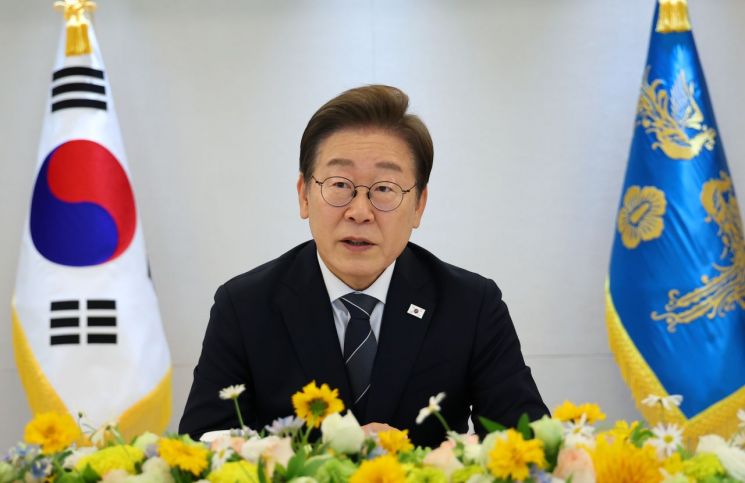
On the first day, June 16, President Lee will arrive in Calgary, Canada, and begin his schedule with bilateral meetings with the leaders of invited countries that are not G7 members. On June 17, he plans to attend the G7 expanded session and deliver two speeches on "diversifying energy supply chains" and "AI-energy linkage." Wi Sunglak, Chief of the National Security Office, stated in a briefing at the Presidential Office in Yongsan on June 15, "In his remarks, President Lee will present Korea's vision for cooperation to stabilize energy systems and supply chains, and will also explain Korea's role in building a global AI ecosystem." The G7 expanded session will be held in the form of a working luncheon focused on energy security.
The G7 is a consultative body where the leaders of the United States, Japan, Germany, France, the United Kingdom, Italy, and Canada gather to discuss economic and security issues comprehensively. Since its launch in 1975, it has become a symbolic stage for global leadership. The theme of this year's summit, marking its 50th anniversary, is: ▲ Enhancing community safety and global security ▲ Creating prosperity through energy security and digital transformation ▲ Partnerships for the future. President Lee is attending as an invited leader, and in addition to Korea, leaders from seven other countries?including Australia, India, Brazil, and Ukraine?as well as international organizations, have been invited.
The agenda for this summit includes numerous sensitive issues, such as the prolonged Russian invasion of Ukraine, the Iran-Israel conflict in the Middle East, and checks on China's non-market industrial policies. The diplomatic messages President Lee delivers are expected to have a significant impact on South Korea's diplomatic identity and strategic direction going forward.
Will Korea-US and Korea-Japan bilateral summits take place? If realized, they will likely be the first working-level negotiations between the leaders.
Bilateral meetings with the leaders of major countries are also drawing attention. A Presidential Office official stated that meetings with the United States and Japan are "being coordinated," and that "talks have progressed to a fairly concrete stage." However, the official also noted, "Due to the variable nature of bilateral meetings within multilateral summits, it is difficult to make a definitive announcement." If a Korea-US summit is realized, it is expected to provide momentum for working-level negotiations on key issues, including the Korea-US tariff deferral talks?which are set to expire on July 8?and the defense cost-sharing issue. The official explained, "If a summit between the leaders is held, it could provide strong impetus to working-level negotiations."
The Korea-Japan summit is also a closely watched event. A Presidential Office official explained, "During his recent phone call with Japanese Prime Minister Ishiba Shigeru, the two agreed to build a future-oriented relationship in celebration of the 60th anniversary of diplomatic ties and the 80th anniversary of liberation." The official added, "If this summit is realized, discussions will continue along those lines." However, President Lee will not attend the 60th anniversary reception in Seoul on June 16, and is considering issuing a separate congratulatory message.
Regarding the possibility of a Korea-US-Japan trilateral summit, the Presidential Office stated that their position "remains open." Since his candidacy, President Lee has consistently emphasized that a strong Korea-US alliance, Korea-Japan cooperation, and Korea-US-Japan trilateral security cooperation will form the foundation of his foreign and security policy.
Complex issues such as the war in Ukraine and instability in the Middle East abound... Dialogue with Ukrainian President Zelensky also being coordinated
This summit will also require Korea to establish its position on complex international issues such as the war in Ukraine, the situation in the Middle East, and strategies regarding China. With the possibility of Ukrainian President Volodymyr Zelensky attending the summit, it has been reported that President Lee is also coordinating a dialogue opportunity between the two leaders. Korea has provided over $2.5 billion in aid to Ukraine. A Presidential Office official stated, "Ongoing support will continue, but at present, additional aid is not under consideration."
The host country, Canada, reportedly extended the G7 summit invitation to Korea in consideration of the post-election political schedule. The Presidential Office assessed that this invitation reflects the international community's recognition and expectations regarding the restoration of Korean democracy. Attending the G7 summit is also linked to President Lee's campaign pledge to participate in the "G7 Plus." A Presidential Office official stated, "Korea is already regarded as a country on par with the G7 in terms of industrialization, economic scale, and contributions to the international community," adding, "Our goal at this summit is to clearly demonstrate our presence and commitment to contributing."
Meanwhile, regarding direct communication with Russian President Vladimir Putin, a Presidential Office official maintained a cautious stance, saying, "We are making a comprehensive judgment, taking into account precedent and the international context." Regarding the possibility of messages aimed at checking China emerging from the G7 summit, the official stated, "While we share values with the United States and other G7 countries, we also do not wish to worsen our relations with China or Russia."
© The Asia Business Daily(www.asiae.co.kr). All rights reserved.
![Clutching a Stolen Dior Bag, Saying "I Hate Being Poor but Real"... The Grotesque Con of a "Human Knockoff" [Slate]](https://cwcontent.asiae.co.kr/asiaresize/183/2026021902243444107_1771435474.jpg)















