More Than Half of Successful Applicants at Sogang, University of Seoul, and Sungkyunkwan Are Science-Track Students
Standardized Score Structure Favors Science-Track Applicants
This year, more than half of the successful applicants to humanities departments at major universities in Seoul and the metropolitan area were science-track students who chose either "Calculus" or "Geometry" as their mathematics elective. As science-track students increasingly apply to humanities departments through regular admissions, it is becoming more difficult for humanities students to predict their chances of acceptance.
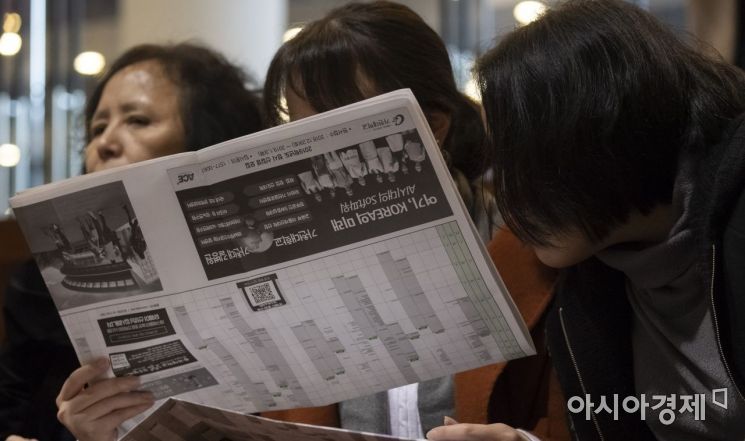 Parents and examinees attending the entrance exam academy briefing session are carefully checking the placement chart.
According to data released by Jongro Academy on June 15, an analysis of 340 humanities departments at 17 major universities in Seoul for the 2025 regular admissions cycle showed that 55.6% of successful applicants had selected "Calculus" or "Geometry," both science-track mathematics subjects.
The phenomenon known as the "liberal arts invasion" has emerged since the introduction of the integrated College Scholastic Ability Test (CSAT) system in 2022. This is because, even with the same raw scores, differences in standardized scores arise between elective subjects due to variations in subject difficulty and the abilities of the test-taking groups.
This trend stems from the integrated CSAT system introduced in the 2022 academic year. The differences in standardized scores between elective subjects have created a structure in which students who choose science-track subjects receive relatively higher scores. In fact, over the past four academic years, the highest standardized scores for "Calculus" and "Geometry" have been 3 to 11 points higher than those for "Probability and Statistics." For the 2025 academic year, the highest scores for these two subjects were 5 points higher than for "Probability and Statistics."
Jongro Academy estimated that, excluding Seoul National University and Korea University, which do not disclose the proportion of successful applicants by mathematics elective, 55.6% of successful applicants at 17 universities were science-track students.
Among successful humanities applicants at Hanyang University, 87.1% had chosen science-track mathematics subjects. The figures were also high at Sogang University (86.6%), Konkuk University (71.9%), University of Seoul (66.9%), Sungkyunkwan University (61.0%), Ewha Womans University (60.3%), and Chung-Ang University (53.8%), with more than half being science-track students. The proportions were 50.3% at Yonsei University, 48.1% at Hankuk University of Foreign Studies, and 46.6% at Kyung Hee University. There are even 21 humanities departments where the proportion of science-track students reaches 100%.
Lim Seongho, CEO of Jongro Academy, pointed out, "As science-track students increasingly apply to humanities departments, it is becoming more and more uncertain for humanities students to predict their chances of acceptance in regular admissions." He also noted, "The fact that score differences between elective subjects are not disclosed in the CSAT grading results further reduces the ability to make accurate predictions."
© The Asia Business Daily(www.asiae.co.kr). All rights reserved.
![Clutching a Stolen Dior Bag, Saying "I Hate Being Poor but Real"... The Grotesque Con of a "Human Knockoff" [Slate]](https://cwcontent.asiae.co.kr/asiaresize/183/2026021902243444107_1771435474.jpg)















