Mandatory Regular Inspections for 44 and 20 Harmful Substances, Results to Be Disclosed
Companies to Bear Testing Costs: 4 Billion Won Annually, Estimated 33.6 Billion Won Over 10 Years
Synthetic Nicotine Excluded from Disclosure; Definition Needs Revision
The government is set to implement a system that regularly inspects and discloses the harmful substances contained in tobacco products. The aim is to guarantee smokers' right to know and their right to health, while also institutionalizing a management system for harmful substance information targeting tobacco leaf-based products. Although synthetic nicotine products remain unregulated, this measure is also being evaluated as a potential foundation for future legislative discussions.
According to the Ministry of Food and Drug Safety and related industries on June 15, the Ministry has issued an administrative notice for the enactment of the "Regulations on the Harmfulness of Tobacco, etc." and will mandate regular inspections of harmful substances in all tobacco products starting in November. This notice is a subordinate regulation of the "Act on the Management of Harmfulness of Tobacco." It requires manufacturers and importers to regularly test and inspect harmful substances in each product and submit the results to the government.
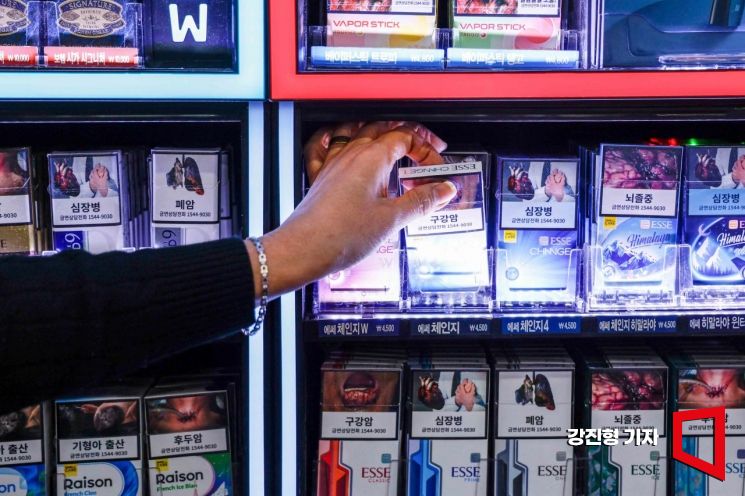 Starting today, new warning phrases and images such as "The Road to Lung Cancer" and "The Road to Blindness" will be included on cigarette pack packaging. This follows the final decision made through a revision of the official notice in June to significantly increase the severity of the warning images and phrases on cigarette packs. The photo shows a cigarette display at a convenience store in Seoul on the 23rd. Photo by Kang Jinhyung
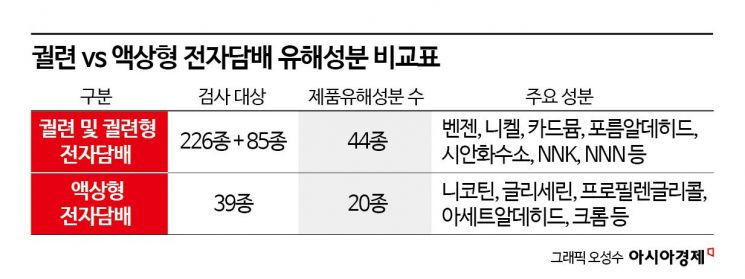
The inspection items will differ depending on the product type. For conventional cigarettes and heated tobacco products, a total of 44 harmful substances will be inspected, while for liquid-type electronic cigarettes, 20 substances will be subject to inspection. The list includes Group 1 carcinogens designated by the World Health Organization (WHO) and the International Agency for Research on Cancer (IARC) such as benzene, cadmium, nickel, lead, and formaldehyde. It also includes highly toxic and addictive chemicals such as hydrogen cyanide, nitrosonornicotine ketone (NNK), and nitrosonornicotine (NNN).
The inspections will not be conducted directly by the government; instead, companies must commission testing at institutions designated by the Ministry of Food and Drug Safety. The companies will also bear the costs. According to the Ministry's regulatory impact analysis, the cumulative cost to the industry for inspections over the next 10 years is estimated at approximately 33.6 billion won, with annual costs expected to reach about 4 billion won.
There are currently about 350 tobacco products distributed in Korea, including 226 types of conventional cigarettes, 85 types of heated tobacco products, and 39 types of liquid-type electronic cigarettes. Since dozens of harmful substances per product must be analyzed using expensive precision equipment in accordance with international standards, companies are expected to face a considerable burden.
Decline in Conventional Cigarettes, Surge in E-cigarettes... New Tobacco Products Undermine Smoking Cessation Policies
According to the "2024 Tobacco Product Distribution and Smoking Behavior Survey" commissioned by the Ministry of Health and Welfare and conducted by the Korean Society for Smoking Cessation, conventional cigarette sales decreased by 4.2% from about 64 billion sticks in 2018 to 62 billion sticks in 2023. During the same period, sales of heated tobacco products nearly doubled from 6.5 billion sticks to 12 billion sticks. Market research firm Euromonitor projects that the domestic heated tobacco market will reach 5.2 trillion won by 2028.
The rapid market growth is attributed to the influx of new tobacco products that combine odor-reducing technology and various flavor additives. In particular, these products are considered more accessible to the younger generation and female smokers compared to traditional cigarettes. In fact, last year's smoking rate survey showed that the conventional cigarette smoking rate among men in their 50s and women in their 20s rose by 9.6 percentage points and 6.3 percentage points, respectively. Researchers point out that the spread of new tobacco products is weakening the effectiveness of existing smoking cessation policies.
However, synthetic nicotine products are excluded from this regular inspection of harmful substances. The new regulation applies only to products legally classified as "tobacco." Products that are not considered tobacco under current law, such as those containing synthetic nicotine, are not subject to the regulation, leaving a regulatory gap.
Under the current Tobacco Business Act, "tobacco" is limited to products made from tobacco leaves. Liquid-type electronic cigarettes using laboratory-synthesized nicotine are not legally recognized as tobacco. As a result, synthetic nicotine products are exempt from tobacco taxes and health promotion levies, and their distribution is permitted online. They can also be sold at unmanned stores without ID verification, effectively leaving youth access unregulated.
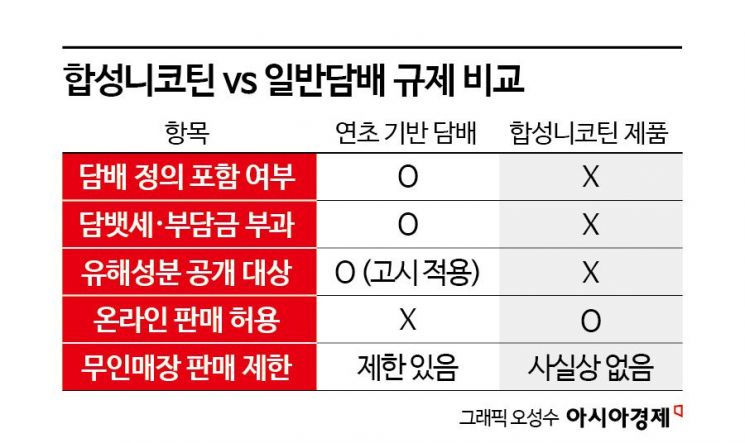
In a report released on June 11, the National Assembly Research Service recommended expanding the definition of tobacco to "products manufactured using nicotine as a raw material" and making adult verification devices mandatory in unmanned stores. Related bills have been discussed three times in the Economic and Finance Subcommittee of the National Assembly's Planning and Finance Committee, but they remain pending in the legislature.
Debate Reaches the Courts... "Smoking is a Choice" vs. "Addiction is a Disease"
The debate over regulating the harmfulness of tobacco continues in the courts. In 2014, the National Health Insurance Service filed a claim for 53.3 billion won in damages against three tobacco companies: KT&G, Korea Philip Morris, and BAT Korea. The purpose was to hold the manufacturers responsible for the medical costs of lung and laryngeal cancer patients borne by the Service. However, in the first trial in 2020, the court dismissed the claim, stating that "other risk factors besides smoking cannot be ruled out." The case is currently under appeal. The tobacco companies argue that "smoking is a personal choice and the freedom to quit should also be guaranteed."
In contrast, the WHO recently submitted an opinion to the court, stating that "nicotine addiction is a disease, and addicts find it difficult to quit without external support." Neil Schluger, Dean of New York Medical College, who attended the "2025 National Health Insurance Global Forum" held in Seoul on June 12, also emphasized that "the causal relationship between smoking and lung cancer is already scientifically clear," and that "there are already court rulings in the United States recognizing the legal liability of tobacco companies for fraudulent practices."
© The Asia Business Daily(www.asiae.co.kr). All rights reserved.
![Clutching a Stolen Dior Bag, Saying "I Hate Being Poor but Real"... The Grotesque Con of a "Human Knockoff" [Slate]](https://cwcontent.asiae.co.kr/asiaresize/183/2026021902243444107_1771435474.jpg)

















