The Korea Electrotechnology Research Institute (KERI) and the Navy Power Analysis Test and Evaluation Group are joining forces to develop next-generation ships powered by batteries.
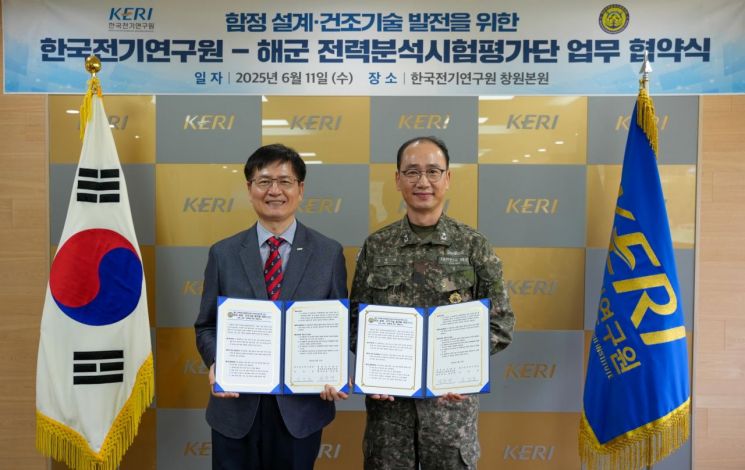 Namkyun Kim, President of the Korea Electrotechnology Research Institute (left), and Dongrae Kim, Commander of the Navy Power Analysis Test and Evaluation Group, signed a business agreement on the 11th to promote technology development and exchange in the field of next-generation ship electrification and are posing for a commemorative photo.
The two organizations held a signing ceremony for a business agreement on June 11 at the KERI Changwon headquarters to promote technology development and exchange in the field of electrification. Both sides will collaborate on research to advance ship electrification design and construction technologies, exchange data and information, and activate exchanges through academic conferences and seminars.
An electric propulsion system operates by driving propulsion motors using power stored in batteries or supplied by generators. Compared to conventional diesel engines, electric propulsion systems for ships offer a variety of advantages. They are environmentally friendly, have lower fuel costs, produce less noise and vibration, and allow for flexible installation locations, providing greater design flexibility. They also offer superior maneuverability compared to diesel-powered vessels.
Electric propulsion systems are also necessary to enhance power capabilities. By sharing large amounts of electricity with future weapon systems such as railguns, which consume significant power, these systems enable the installation of new weapons and facilitate the construction of ICT systems for automation, unmanned operations, and networking.
Since 2015, KERI has led the development of submarine and ship technologies based on electric propulsion systems through the operation of the Land Based Test Site (LBTS), which was the first facility of its kind in Korea and the third in the world after the United States and the United Kingdom. Building on this expertise, KERI plans to successfully drive the development of next-generation ships that will strengthen the Republic of Korea's naval power through its collaboration with the Navy Power Analysis Test and Evaluation Group.
Namkyun Kim, President of KERI, stated, "The electrification and advancement of ships can greatly enhance survivability and operational capability," and added, "Through cooperation between the two organizations, we will strive to shorten the design and construction period for next-generation ships, reduce related costs, and make a significant contribution to strengthening the Navy's capabilities."
© The Asia Business Daily(www.asiae.co.kr). All rights reserved.