"Interest in GLP-1, ADC, and AI-Driven Drug Development Expected to Continue"
Samsung Biologics, Hanmi Pharmaceutical, Galux, and Others Participate in the Expo
The key topics expected to dominate the 2025 BIO International Convention (BIO USA), the world's largest pharmaceutical and biotech expo held in Boston, USA from June 16 to 19 (local time), include antibody-drug conjugates (ADC), glucagon-like peptide-1 (GLP-1) receptor, and artificial intelligence (AI). Korean companies such as Samsung Biologics, Hanmi Pharmaceutical, and Galux are also participating in the expo, showcasing their achievements in these fields.
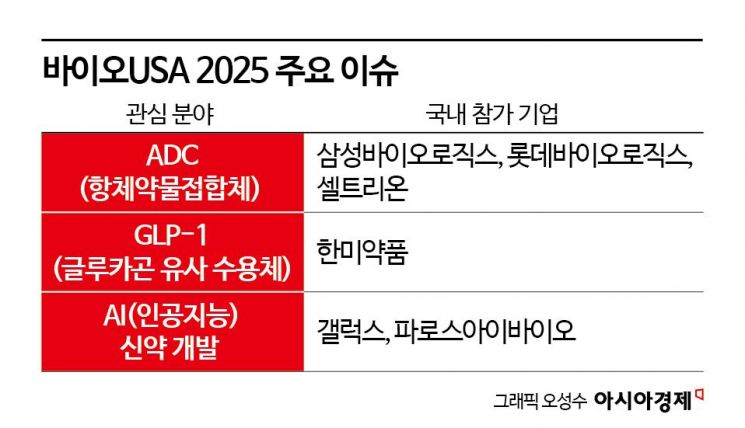
On June 12, industry insiders in the pharmaceutical and biotech sectors agreed that interest in GLP-1, ADC, and AI-driven drug development will continue at BIO USA. Lee Seungkyu, Executive Vice Chairman of the Korea Biotechnology Industry Organization, stated, "GLP-1, which has gained attention as an obesity treatment, and ADC, which requires continuous pipeline development, will attract the most interest." Lee Hyunwoo, Head of the Global Division at the Korea Pharmaceutical and Bio-Pharma Manufacturers Association, predicted, "At this year's BIO USA, in addition to traditional issues such as general anticancer drugs, GLP-1, ADC, and AI-driven drug development will be in the spotlight."
ADC is emerging as a core modality in the global anticancer drug market. It is a complex biopharmaceutical in which a cytotoxic drug is linked to a targeted antibody via a linker. The antibody precisely recognizes cancer cells, and the cytotoxic drug, attached via the linker, is released inside the cell to destroy the cancer. ADCs are attracting attention as next-generation anticancer drugs with higher efficacy and selectivity compared to existing anticancer therapies.
Samsung Biologics, Lotte Biologics, and Celltrion are representative companies emphasizing their competitiveness in ADC. In December last year, Samsung Biologics completed an ADC production facility equipped with a 500-liter conjugation reactor and one purification line, and began full-scale operation in March this year. The company is expected to focus on promoting this expansion of its CDMO portfolio at BIO USA.
Lotte Biologics plans to showcase its differentiated CDMO capabilities by presenting the blueprint for Plant 1 at its Songdo Bio Campus, scheduled for commercial production in 2027, alongside the full-scale operation of its ADC production facility at the Syracuse Bio Campus in New York, USA. Celltrion is also seeking to expand its new drug pipeline, including ADCs, by exploring collaborations with potential partners.
GLP-1 is the main active ingredient in obesity treatments such as Wegovy and Ozempic. The GLP-1 hormone is a naturally occurring substance released when we eat, regulating appetite and digestion. It stimulates nerves to create a false sense of fullness, even without food intake. GLP-1 receptors are highly distributed in the upper hypothalamic nuclei of the brain, which control energy metabolism, and artificially activating (increasing) these receptors has been shown to create a false sense of satiety, causing immediate cessation of eating.
Among Korean companies, Hanmi Pharmaceutical is participating in BIO USA with its GLP-1-based obesity treatment. As a latecomer, the company is focusing on securing clear differentiation in terms of sustained efficacy and formulation.
One of the most notable fields in AI-driven drug development is AI-based protein structure prediction and design. In particular, de novo antibody design technology, a type of AI drug development technology, enables the prediction of three-dimensional structures from protein amino acid sequences and allows for the design of proteins with specific functions 'from scratch.' This technology enables the design of entirely new antibodies that have never existed before. Currently, the system requires direct, random screening of numerous proteins.
In Korea, AI drug development companies such as Galux and Pharos iBio plan to showcase their technologies at BIO USA. Galux utilizes its protein design AI platform, 'GaluxDesign,' which has learned the physicochemical principles of protein structures. It is one of only three companies worldwide to have succeeded in de novo antibody design. Pharos iBio possesses an innovative anticancer drug candidate for leukemia, 'PHI-101,' discovered through its proprietary AI drug development platform, 'Chemiverse.'
© The Asia Business Daily(www.asiae.co.kr). All rights reserved.