Japanese Government: "Two Chinese Aircraft Carriers Cross the Second Island Chain for the First Time"
China Expands Its Maritime Defense Line 'Island Chains'...
Intensifying Power Struggle With the US
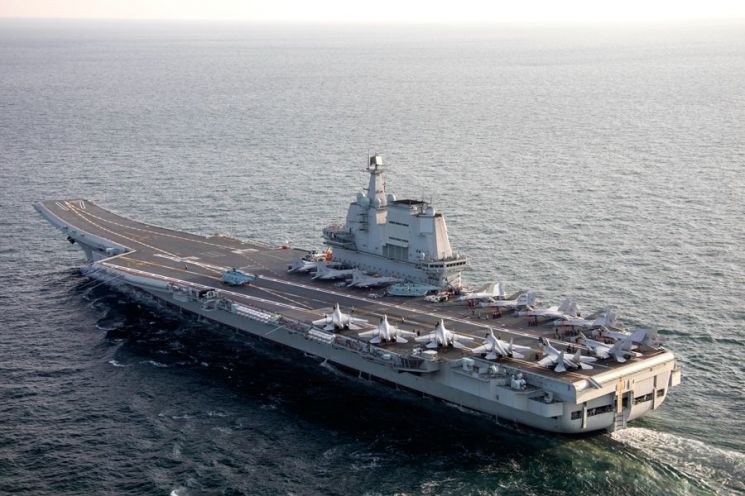 The second aircraft carrier of China, the Shandong. On the 8th, the Japanese government announced that it had spotted the Shandong conducting training near the east of the Ogasawara Islands, located 1200 km from Tokyo. Photo by Yonhap News
For the first time, a Chinese aircraft carrier fleet has advanced into the so-called "second island chain" region, located within the western Pacific to the east of Japan, and conducted training exercises there. This area is regarded as both China's maritime defense line and the United States' containment line against China, making it a frontline zone between the two countries. As the conflict between the US and China over the Taiwan Strait spreads across the entire western Pacific region, there are growing expectations that the arms race among East Asian countries will intensify even further.
Japanese Government: "Two Chinese Aircraft Carriers Cross the Second Island Chain for the First Time"
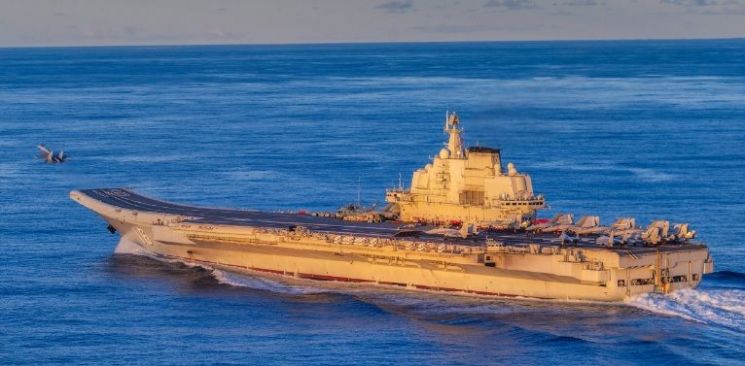 The Chinese aircraft carrier Liaoning conducting fighter jet takeoff training. The Japanese government announced on the 8th that the Liaoning and Shandong were observed conducting training around the Ogasawara Islands in Japan. Chinese People's Liberation Army Navy website
The Japan Maritime Self-Defense Force confirmed that on June 7 and 8, the Chinese aircraft carriers Liaoning and Shandong, along with their fleets, conducted training within Japan’s Exclusive Economic Zone (EEZ) near Minamitorishima, at the easternmost edge of Japan. This area, known as the second island chain, stretches from Japan's Ogasawara Islands to the US territory of Guam. It is the first time that Chinese aircraft carriers have been observed conducting exercises in this region.
China has also acknowledged that its two carrier fleets conducted training in the western Pacific. The state-run Global Times reported, "The Liaoning and Shandong carrier groups recently carried out training to test their capabilities in blue-water defense and joint operations in the western Pacific and other waters," and asserted, "These are routine exercises organized according to the annual plan, in compliance with international law and customary practice, and are not aimed at any specific country or target."
However, the US government has expressed opposition to the Chinese aircraft carriers' exercises in the second island chain and announced plans to strengthen deterrence against China in the Pacific region together with its allies. US Secretary of Defense Pete Hegseth stated at a US House hearing on June 10, "China is the main threat in our priority region, the Indo-Pacific," emphasizing, "That is why I have visited the Indo-Pacific twice to meet with our allies and partners, and they are also responding to our strategic shift."
China Expands Its Maritime Defense Line 'Island Chains'... Intensifying Power Struggle With the US
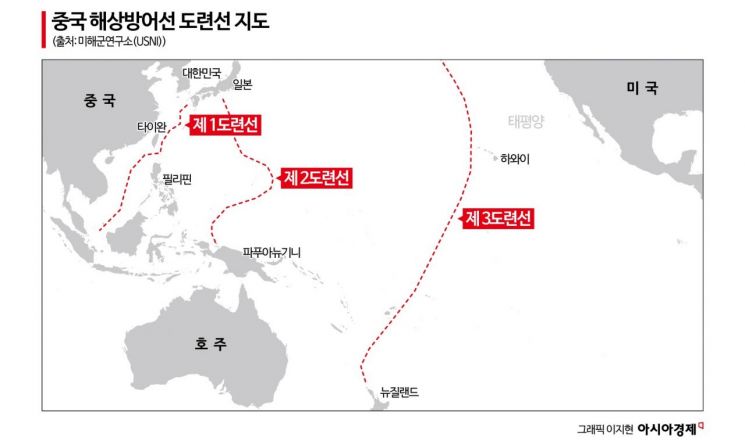
The second island chain, which Chinese aircraft carriers have crossed for the first time, is considered both China's maritime defense line and the United States' containment line to strengthen its deterrence against China. It is a region where Pacific islands are connected like a chain. This concept was established in 1982 by Admiral Liu Huaqing, then commander of the Chinese Navy, when he set the operational range of the Chinese Navy in the Pacific.
The island chains are classified into three in total. The first island chain refers to the area near the Chinese mainland, stretching from Japan to the western islands of Taiwan and the Philippines. The second island chain is located further east, connecting Japan's Ogasawara Islands, the US territories of Guam and Saipan, and Papua New Guinea. The third island chain extends from the Aleutian Islands in the central Pacific, passing through Hawaii to the area around New Zealand.
Analysts predict that as China has rapidly strengthened its naval power and established aircraft carrier fleets since the 2000s, it will likely intensify its military activities not only within the second island chain but also in the third island chain. Newsweek reported, "The Chinese Navy aims to control the first island chain in the 2000s, the second island chain in the 2020s, and the third island chain in the 2040s, ultimately achieving global naval power."
Japan's Jiji Press also analyzed, "China views the second island chain as one of the defense lines to block US military access in the event of a contingency," and added, "China appears to be seeking to improve its aircraft carrier operational capabilities and conduct carrier operations in distant waters."
The United States is strengthening the deployment of strategic assets to countries within the first island chain to deter China's island chain expansion policy. Malcolm Davis, senior analyst at the Australian Strategic Policy Institute, told the South China Morning Post (SCMP), "The United States is seeking to deploy various strategic weapons, such as the B-1B strategic bomber, which was forward-deployed to Japan in April, to the first island chain," and explained, "The Donald Trump administration will focus all efforts on containing China's maritime capabilities, even if it means reducing support for Europe and the North Atlantic Treaty Organization (NATO)."
© The Asia Business Daily(www.asiae.co.kr). All rights reserved.
![Clutching a Stolen Dior Bag, Saying "I Hate Being Poor but Real"... The Grotesque Con of a "Human Knockoff" [Slate]](https://cwcontent.asiae.co.kr/asiaresize/183/2026021902243444107_1771435474.jpg)

















