Joo Homin Refutes Distortion of Appellate Court Ruling
Says "Secret Recording" Was Not Accepted as Evidence
Emphasizes Importance of Supreme Court Decision for Protecting Vulnerable Individuals
Webtoon artist Joo Homin has issued a statement regarding the acquittal of a special education teacher, who was accused of emotionally abusing his son, in the appellate court. He emphasized that the "secret recording" was not accepted as evidence and thus could not determine whether abuse had occurred, stressing that interpreting this as "legitimate educational activity" is a distortion.
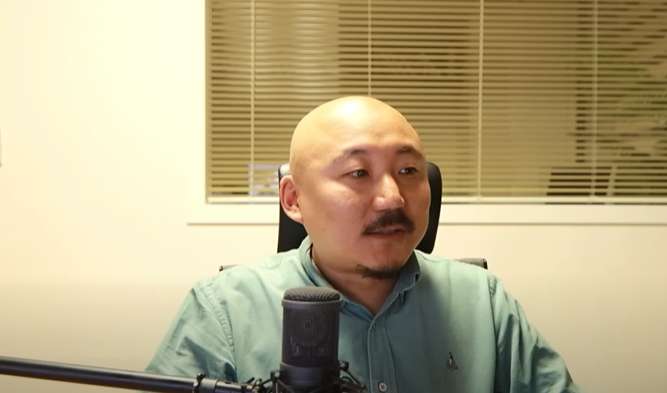 Webtoon artist Joo Homin is reporting the first trial verdict regarding a special education teacher on his YouTube channel in February last year. Joo's YouTube
On June 10, through his YouTube channel, Joo stated, "In the first trial, the special education teacher was found guilty of child abuse, but in the second trial, the teacher was acquitted. Many people seem to think that the appellate court ruled the teacher's actions were legitimate educational activities rather than abuse. As a result, there were many sarcastic comments like 'Congratulations, your son wasn't abused.' But that is not true."
He continued, "The appellate court did not determine whether the teacher's remarks constituted abuse or not. This is because the evidence of those remarks could not be used due to the Protection of Communications Secrets Act. Simply put, the court saw the evidence as 'illegally obtained' and was unable to even review its content, resulting in an acquittal."
Joo stated, "However, some people are claiming as if the actions were recognized as legitimate educational activities, which is a clear distortion. The reason the prosecution has appealed to the Supreme Court is precisely related to this. The prosecution is arguing, 'The recording was made to protect the child, and the teacher's remarks were one-sided verbal abuse, not protected under the communications secrecy law. Therefore, the recording should be admissible as evidence.' He added, "The appellate court's decision to mechanically exclude the evidence is a violation of the law."
He also wrote, "There are many people who cannot accurately convey their own situation. In that case, how can we uncover abuse against people with developmental disabilities or elderly people in nursing homes? Even if we do uncover it, if such evidence cannot be accepted in court, won't that abuse end up being buried without punishment?"
Additionally, Joo emphasized, "That is why I believe the Supreme Court's decision in this case is extremely important. This is not simply about my child's case, but could set a standard for how children and other vulnerable individuals, who have difficulty speaking up for themselves, can be protected in the future."
Special education teacher A, who was accused of emotionally abusing Joo's son, was indicted for making abusive remarks such as "You're really annoying," "You have very bad manners," and "I hate you so much. I don't like you either" to Joo's son (then 9 years old) in a customized learning class at an elementary school in Yongin, Gyeonggi Province, on September 13, 2022.
It is known that Joo and his wife secretly placed a recorder in their child's bag and recorded the class, then reported teacher A to the police for child abuse based on the recording.
The first trial recognized the admissibility of the "secret recording," which was the main issue in the case, and in February last year, gave teacher A a suspended sentence with a fine of 2 million won. However, the appellate court overturned the original verdict and acquitted teacher A. The appellate court ruled that the secretly recorded audio file could not be accepted as evidence. As the prosecution appealed the verdict, the case will now be reviewed by the Supreme Court.
© The Asia Business Daily(www.asiae.co.kr). All rights reserved.
![Clutching a Stolen Dior Bag, Saying "I Hate Being Poor but Real"... The Grotesque Con of a "Human Knockoff" [Slate]](https://cwcontent.asiae.co.kr/asiaresize/183/2026021902243444107_1771435474.jpg)















