Debate Over Applicability of the Law
The Minimum Wage Commission, which is responsible for determining next year's minimum wage, held its first meeting since the launch of the new administration. During the meeting, labor and management expressed differing views regarding the expansion of minimum wage coverage to subcontracted workers, including those in special forms of employment.
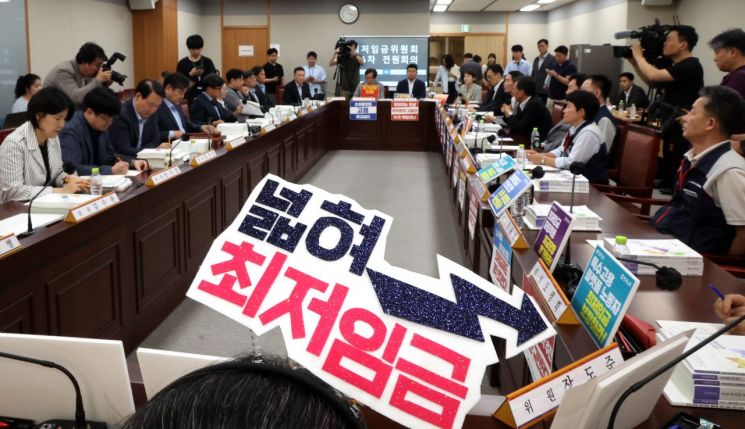 On the 10th, the 4th plenary meeting of the Minimum Wage Commission is being held at the Government Complex Sejong. Photo by Yonhap News
On June 10, the Minimum Wage Commission held its 4th plenary meeting at the Government Complex Sejong to discuss the level of next year's minimum wage. At the meeting, business and labor representatives continued their heated debate over expanding the application of the minimum wage, just as they had in the previous meeting.
The business community once again opposed the expansion of the minimum wage. Ryu Kijeong, Executive Director of the Korea Employers Federation, stated, "The employer representatives believe it is inappropriate for the Minimum Wage Commission to set a separate minimum wage for workers in special forms of employment." He also argued, "The New York delivery rider example cited by labor is a minimum compensation for business owners, not a minimum wage," and added, "The case of strawberry farm workers in the UK does not apply to all workers in a specific occupation either."
Lee Myungro, Director of Human Resources Policy at the Korea Federation of SMEs, also said, "The Minimum Wage Act specifies that its scope applies to workers as defined by the Labor Standards Act, and the established position of the courts is that worker status must be recognized by confirming a subordinate relationship with the employer." He further stated, "Ensuring a minimum standard of living for non-employees, such as those in special forms of employment, goes beyond the scope of the Minimum Wage Act," and added, "This issue should be resolved through social dialogue at the Economic, Social and Labor Council and the legislative process in the National Assembly."
The labor side countered that such application is possible under the current law. Jung Moonjoo, Director of the Central Research Institute at the Federation of Korean Trade Unions, explained, "There are provisions in the Minimum Wage Act that allow for the application to special forms of employment, platform, and freelance workers," and added, "If the criteria are interpreted proactively, it is possible to apply it immediately." He also said, "Raising wages stimulates consumption and serves as a source for economic recovery," and insisted, "The minimum wage should be raised to the level of a living wage, and its coverage should be expanded."
Lee Miseon, Vice Chair of the Korean Confederation of Trade Unions, also argued, "Article 32 of the Constitution specifies that all citizens have the right to work and to receive fair wages," and added, "This cannot be limited only to workers as defined by the Labor Standards Act; it means the state has an obligation to guarantee adequate income to all working people." She further emphasized, "A social consensus must be reached to expand the application of the minimum wage to platform workers."
© The Asia Business Daily(www.asiae.co.kr). All rights reserved.
![Clutching a Stolen Dior Bag, Saying "I Hate Being Poor but Real"... The Grotesque Con of a "Human Knockoff" [Slate]](https://cwcontent.asiae.co.kr/asiaresize/183/2026021902243444107_1771435474.jpg)















