Representative Kim Hyun Jung Proposes LBO Regulation Bill
Representative Kim Nam Geun Cites EU's AIFMD
Chief Presidential Secretary Kang Hoon Sik's Public Tender Offer Bill as Lawmaker
President Lee Jae Myung's Key Campaign Pledge... High Likelihood of Implementation

Regulatory legislation targeting private equity fund (PEF) management companies is continuing, primarily led by the ruling party. President Lee Jae Myung also pledged to regulate PEFs during his candidacy, so related legislative efforts are expected to gain momentum.
According to the investment banking (IB) industry and other sources on June 11, Kim Hyun Jung, a member of the Democratic Party of Korea, on June 4 sponsored a bill to amend the Act on the Capital Market and Financial Investment Business, which would reduce the borrowing limit for PEFs from 400% of the fund's net assets to 200%. The bill was prompted by the Homeplus incident.

Representative Kim explained the rationale for the proposal by stating, "Excessive borrowing through leveraged buyouts (LBOs) imposes a significant interest burden on the target companies," and "by triggering asset sales and deteriorating financial structures, it ultimately exposes target companies to bankruptcy risk and causes social disruption."
Opinions in the industry were divided. The head of one PEF management company said, "It is rare for acquisitions to be financed up to the full 400% borrowing limit in the first place," and added, "While there is a risk of share price decline if acquisition financing is secured with listed company shares as collateral, there are few mergers and acquisitions (M&A) involving listed companies in Korea, so the overall market impact would be limited."
On the other hand, another IB industry insider expressed concern about the growing influence of foreign PEF management companies. He explained, "If the borrowing limit is reduced, domestic PEFs will be able to acquire far fewer companies, which may result in the market being ceded to foreign PEFs with larger capital bases."
In addition, it has been reported that Kim Nam Geun's office in the Democratic Party is also considering introducing new LBO-related regulatory provisions into the Capital Markets Act. In particular, there is a growing call for introducing a system modeled after the European Union's Alternative Investment Fund Managers Directive (AIFMD).
The AIFMD includes regulations that restrict asset sales, dividend payouts, and capital recovery by private equity funds within a certain period after an acquisition. For example, for 24 months after acquiring a company, measures such as high dividend payouts, share buybacks, and capital reductions are prohibited, and even recapitalizations (capital structure adjustments) are difficult without regulatory approval.
This is interpreted as a call to regulate the practice of PEFs raising additional stock-collateralized loans from acquired companies to recover their investments in the form of dividends ahead of schedule.
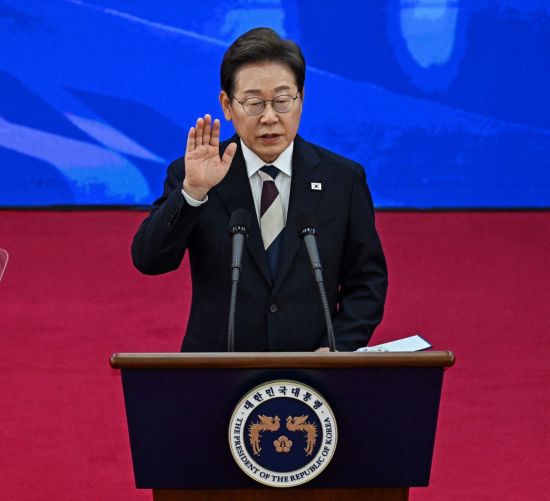 President Lee Jae Myung is taking the oath of office for the 21st president at the National Assembly in Yeouido, Seoul on June 4, 2025. Photo by Kim Hyun Min
There is also discussion of regulations that would require mandatory tender offers in M&A transactions. Kang Hoon Sik, Chief Presidential Secretary, during his time as a Democratic Party lawmaker, proposed an amendment to the Capital Markets Act that would require anyone seeking to become the largest shareholder by acquiring 25% or more of a listed company's shares to purchase 100% of the shares through a public tender offer. This was a key campaign pledge of President Lee and was also pursued by the previous administration, so its likelihood of implementation is considered high.
The industry believes that the introduction of a 100% mandatory tender offer requirement would significantly increase the difficulty of M&As involving listed companies. Previously, transactions were often conducted by acquiring only the controlling stake of 30-40% at a management premium, but now, in order to secure management control, all listed shares would have to be acquired at a premium.
In the PEF industry, which accounts for more than half of management control transactions, it is expected that much larger amounts of capital will be needed for management buyouts than before. As a result, only mega-sized PEFs may be able to participate in such deals, or PEFs may withdraw from investing in listed companies altogether.
© The Asia Business Daily(www.asiae.co.kr). All rights reserved.
![Clutching a Stolen Dior Bag, Saying "I Hate Being Poor but Real"... The Grotesque Con of a "Human Knockoff" [Slate]](https://cwcontent.asiae.co.kr/asiaresize/183/2026021902243444107_1771435474.jpg)
















