A Total of 198.6 Billion KRW Including Launchers
Hanwha Aerospace has signed a prototype development contract for the L-SAM-II (Long-range Surface-to-Air Missile System). The contract, which covers system integration and verification as well as launchers, totals 198.6 billion KRW.
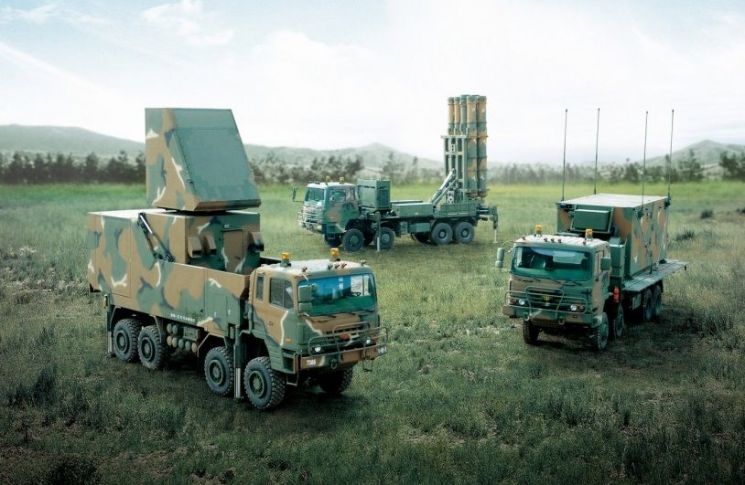
According to Hanwha Aerospace on June 10, the company has signed a contract with the Agency for Defense Development to develop the L-SAM-II, a core interception system for the Korea Air and Missile Defense (KAMD) system, with the goal of completing development by 2028.
The L-SAM-II is a weapon system designed to intercept ballistic missiles at altitudes higher than the existing L-SAM interception altitude (below the stratosphere). The L-SAM-II high-altitude interceptor missile project, which will invest approximately 1.0664 trillion KRW from 2024 to 2032, aims to secure a domestically developed high-altitude interceptor with a higher interception altitude than the existing L-SAM. Compared to the L-SAM, it can expand the air defense coverage area by three to four times. It is expected to enhance deterrence against North Korea's missile attacks. The significance lies in participating in the development of a guided missile system capable of intercepting ballistic missiles at altitudes exceeding the stratosphere (10?50 km).
Last year, Hanwha Aerospace participated in the development of the L-SAM anti-ballistic missile (ABM) system with the Agency for Defense Development, successfully completing development and preparing for mass production. The core technologies of the L-SAM-II missile are the Divert and Attitude Control System (DACS) and the propulsion system. The DACS precisely controls the kill vehicle using ten thrust control valves, enabling it to directly intercept (hit-to-kill) ballistic missiles.
This technology is possessed by only a handful of countries, including the United States and South Korea. The propulsion system must also reach altitudes comparable to the U.S. Terminal High Altitude Area Defense (THAAD) system, requiring greater thrust to reach the interception altitude faster than the L-SAM.
A Hanwha Aerospace official stated, "Globally, demand for multi-layered air defense networks is rapidly increasing," adding, "By securing core technologies, we will contribute to strengthening South Korea's national defense capabilities and play a leading role in exporting the K-air defense network."
© The Asia Business Daily(www.asiae.co.kr). All rights reserved.
![Clutching a Stolen Dior Bag, Saying "I Hate Being Poor but Real"... The Grotesque Con of a "Human Knockoff" [Slate]](https://cwcontent.asiae.co.kr/asiaresize/183/2026021902243444107_1771435474.jpg)















