Smuggling Synthetic Drugs from South Korea to Japan
Previously Caught Attempting to Smuggle Gold in 2018
A famous Japanese music producer has been arrested on charges of smuggling synthetic drugs from South Korea to Japan. On June 9, Japanese media outlets such as the Sankei Shimbun reported that police in Kumamoto Prefecture had arrested music producer Morita Masanori (48), who resides in Shibuya, Tokyo, on suspicion of violating the Narcotics and Psychotropic Control Act. According to local reports, Morita is suspected of smuggling synthetic drugs, including MDMA, commonly known as "Ecstasy," by checking in a suitcase containing the drugs on a flight departing from Seoul and arriving at Kumamoto Airport.
 Japanese media reported that a famous Japanese music producer was arrested in Korea on charges of smuggling synthetic drugs to Japan. Photo is unrelated to the article. Asia Economy DB
After arriving at Kumamoto Airport, Morita was found to be in possession of 0.24 grams of MDMA and 0.21 grams of ketamine during a customs inspection, leading Kumamoto police to arrest him on the spot. Morita is known as a prominent producer who has worked on songs for numerous popular artists, including the Japanese duo Kimaguren and the four-member male hip-hop and reggae group Ketsumeishi.
The police have not disclosed specific details about whether Morita has admitted to the charges, his motives, or how he obtained the drugs, citing concerns that it could hinder the investigation. Notably, Morita has previously been arrested on smuggling charges. In March 2018, he was caught attempting to smuggle about 4 kilograms of gold into Japan and was charged with violating customs law. Following that incident, his wife, model Takagaki Reiko, issued a public apology.
As seen in the case of the Japanese producer, South Korea, once referred to as a "drug-free country," has now become a "global major drug distribution hub." Last year, one out of every three drug offenders apprehended in the country was a drug supplier. There is growing concern that South Korea could become a key distribution point for drugs, as drugs can be sold easily and at high prices through social networking services (SNS) and other platforms.
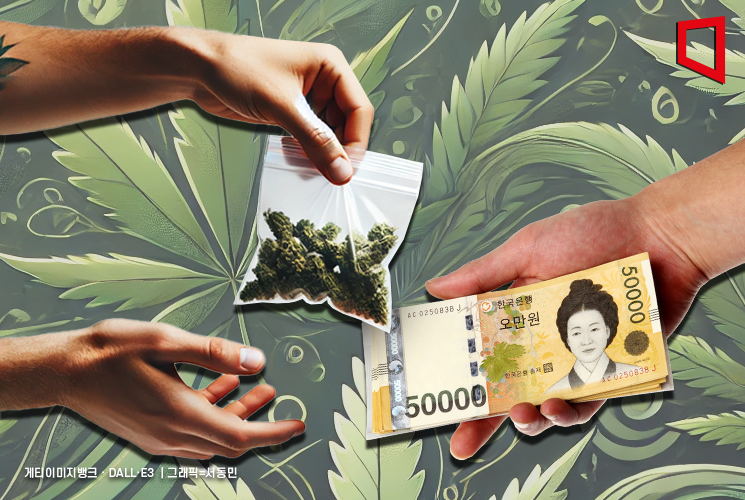 Meanwhile, South Korea, once known as a "drug-free country" as seen in the case of the Japanese producer mentioned earlier, has fallen into a "global major drug distribution hub." Last year, one out of every three drug offenders caught in the country was a drug supplier. Asia Economy
According to an announcement by the Supreme Prosecutors' Office on April 16, the number of drug suppliers apprehended last year for illegal production, smuggling, and trafficking was 7,738. The total number of drug offenders in 2024 was 23,022, with suppliers accounting for 33.6%. This figure is higher than in 2023, when a surge in drug-related investigations following the "Burning Sun Gate" scandal resulted in 27,611 total drug offenders and 9,145 suppliers, with suppliers making up 33.1%. It is also more than double the rate from 2004, when suppliers accounted for 16.0%. The rising proportion of drug suppliers in South Korea is attributed to the high price of drugs compared to neighboring countries and the ease of non-face-to-face transactions.
South Korea, along with Japan, is considered one of the most expensive regions for drugs in Asia. According to the United Nations Office on Drugs and Crime (UNODC), as of 2022, the retail price for 1 gram of methamphetamine (Philopon) in South Korea was $300 (about 430,000 won), which is dozens of times higher than the price in Southeast Asian countries such as Myanmar ($10.39) or Thailand ($19.13).
Due to these high prices, South Korea has emerged as a major market for drug dealers from Southeast Asia and China since the resumption of trade after COVID-19. As border controls tightened during the pandemic, traffickers stockpiled drugs and are now distributing them in large quantities to the high-profit South Korean market. In fact, the number of foreign drug offenders apprehended in South Korea increased more than threefold from 948 in 2018 to 3,232 in 2023.
Non-face-to-face transactions using SNS and virtual assets have become a core channel for drug distribution in South Korea. In practice, numerous "drug rooms" operate on anonymous messengers such as Telegram, where drugs are bought and sold using virtual assets. Sellers, who receive payment in virtual assets that are hard to trace and easy to launder, typically hide the drugs in residential areas or secluded locations, allowing buyers to retrieve them later?a method known as "throwing." The number of young suppliers familiar with non-face-to-face transactions is rapidly increasing. According to the Supreme Prosecutors' Office, the proportion of drug offenders under the age of 30 was 49.1% in 2019, 51.6% in 2020, 59.6% in 2021, 59.7% in 2022, and 59.9% in 2023, steadily rising to 63.4% last year. This means that two out of every three drug suppliers are under the age of 30.
© The Asia Business Daily(www.asiae.co.kr). All rights reserved.
![Clutching a Stolen Dior Bag, Saying "I Hate Being Poor but Real"... The Grotesque Con of a "Human Knockoff" [Slate]](https://cwcontent.asiae.co.kr/asiaresize/183/2026021902243444107_1771435474.jpg)
















