Performance-based products yield 9.96% return
Top performers choose performance-based management
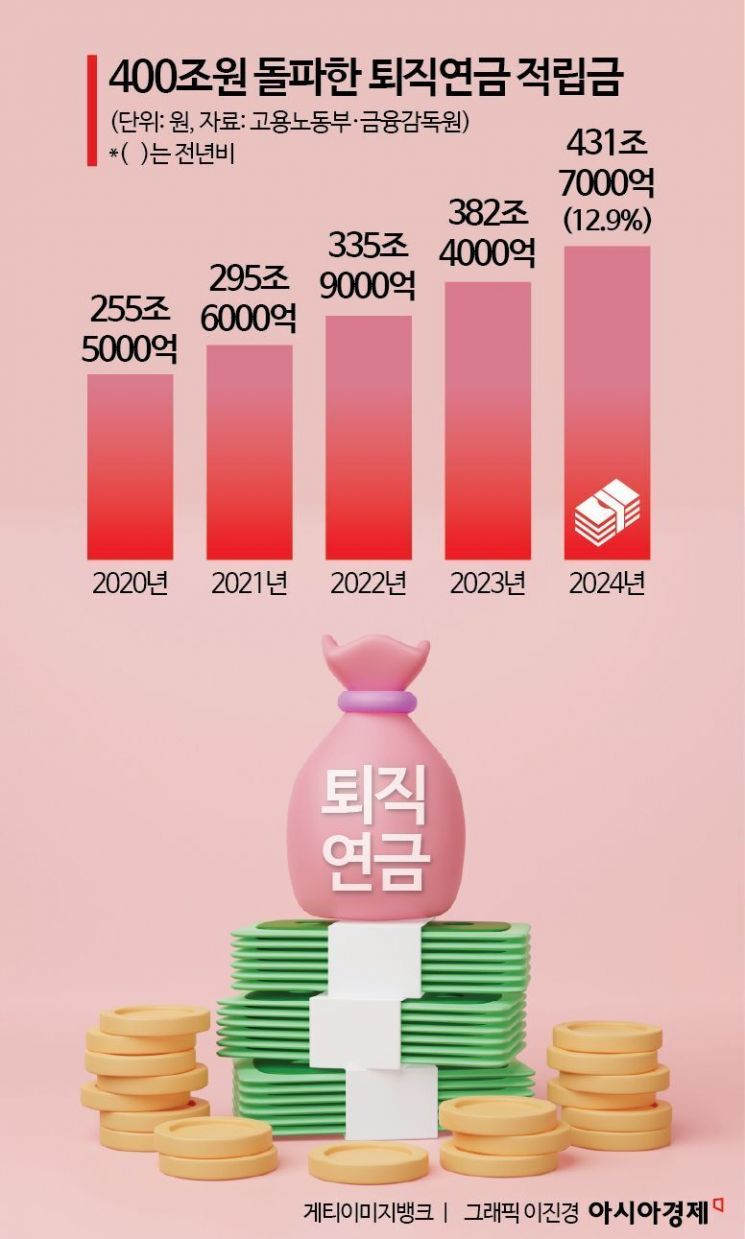
Last year, retirement pension reserves reached 431.7 trillion won, surpassing the 400 trillion won mark for the first time since the introduction of the retirement pension system. It is also notable that there has been a paradigm shift from saving to investing, as the amount invested in performance-based products increased by more than 53%. The rate of return was 4.77%, a decline from the previous year.

Performance-based management on the rise...TDF products lead investments
On June 9, the Ministry of Employment and Labor and the Financial Supervisory Service announced that as of the end of last year, retirement pension reserves stood at 431.7 trillion won, an increase of 49.3 trillion won (12.9%) compared to the previous year. This is the first time since the introduction of the retirement pension system that reserves have exceeded 400 trillion won.
By system type, the reserves were as follows: defined benefit (DB) plans held 214.6 trillion won, defined contribution and corporate IRP (DC) plans held 118.4 trillion won, and individual IRP (IRP) plans held 98.7 trillion won. The shares of DC and IRP were 27.4% and 22.9%, respectively, continuing their upward trend.
By management method, principal-guaranteed products (including idle funds) accounted for 356.5 trillion won, while performance-based products accounted for 75.2 trillion won, representing 82.6% and 17.4% of the total, respectively. Although principal-guaranteed products still make up the majority, the proportion of performance-based management is increasing, especially among DC and IRP plans.
Looking at investments in performance-based products, target date funds (TDFs) ranked at the top among funds and have become the main product for retirement pensions. TDFs are funds that adjust the allocation of investment assets according to the target date (retirement) and are managed accordingly.
In addition, for exchange-traded funds (ETFs), which are seeing an increase in investment share, there was a tendency to focus investments on overseas markets rather than the domestic market. In particular, products tracking U.S. stock market indices such as the S&P 500 and the Nasdaq 100 stood out.
13% of subscribers choose annuity payments over lump-sum withdrawal
Last year, the annual rate of return for retirement pensions was 4.77%, down 0.49 percentage points from the previous year. However, compared to the five-year and ten-year compound annual rates of return of 2.86% and 2.31%, respectively, it was at a favorable level. By management method, the rate of return was 3.67% for principal-guaranteed products and 9.96% for performance-based products.
By system, the rates of return were 4.04% for DB, 5.18% for DC, and 5.86% for IRP. Systems in which individuals, rather than companies, are the main operators, and those with a higher proportion of performance-based products, recorded relatively higher rates of return.
In fact, when examining the asset composition of subscribers in the top 10% by rate of return at major companies in the banking, securities, and insurance sectors, the proportion of performance-based products was more than three times higher than the sector average. In particular, among top IRP subscribers at banks and securities firms, 84% and 92%, respectively, managed their reserves with performance-based products.
By sector, based on the combined DC and IRP plans, most subscribers in the banking and insurance sectors (84.7% for banks and 77.6% for insurance) fell into the rate of return range below 4%. In contrast, in the securities sector, the rates of return were more evenly distributed, with 31.7% of subscribers achieving an annual rate of return exceeding 10%.

Among the 573,000 accounts of subscribers aged 55 or older who began receiving retirement pension payments last year, 13.0% (74,000 accounts) chose to receive payments as an annuity over an extended period, rather than as a lump sum. This figure represents an increase of 2.6 percentage points compared to the previous year.
In terms of amount, out of the total 19.2 trillion won paid out, 10.9 trillion won (57.0%) was received as annuity payments, surpassing the share of lump-sum withdrawals. The average annuity payment per account was 146.94 million won, while the average lump-sum payment per account was 16.54 million won. The trend shows that the smaller the reserve, the more likely it is to be withdrawn as a lump sum.
© The Asia Business Daily(www.asiae.co.kr). All rights reserved.
![Clutching a Stolen Dior Bag, Saying "I Hate Being Poor but Real"... The Grotesque Con of a "Human Knockoff" [Slate]](https://cwcontent.asiae.co.kr/asiaresize/183/2026021902243444107_1771435474.jpg)

















