Some Ministries Have Finished Preparing Work Briefings... Focus Shifts to Vice Minister Appointments
All Eyes on Selection of National Policy Tasks and Organizational Restructuring
Tension Rises Over Planned Division and Downsizing of Economic Ministries
Local Governments Enter Election Mode... Concerns Over Factionalism and Political Maneuvering
Tension has begun to permeate the public sector following the launch of the Lee Jae Myung administration. Central government ministries, which had been in a state of virtual standstill due to martial law and the impeachment crisis, are now closely watching the presidential office as they prepare for the appointment of ministers and vice ministers, as well as upcoming work briefings and the selection of national policy tasks. In local political circles, there is also a visible shift to preparing for local elections immediately after the presidential election.
According to government sources on the 5th, social ministries such as the Ministry of the Interior and Safety, the Ministry of Gender Equality and Family, and the Ministry of Education have begun discussions on work briefings and the setting of national policy tasks prior to the formation of the new cabinet. Multiple ministry officials explained that they are either preparing or finalizing their work briefings. Since the Lee administration does not have a presidential transition committee, it must derive its national policy tasks through coordination with ministries after the government launch, similar to the Moon Jae In administration. Previously, after his inauguration, former President Moon established the State Affairs Planning Advisory Committee, received reports from ministries, and announced national policy tasks.
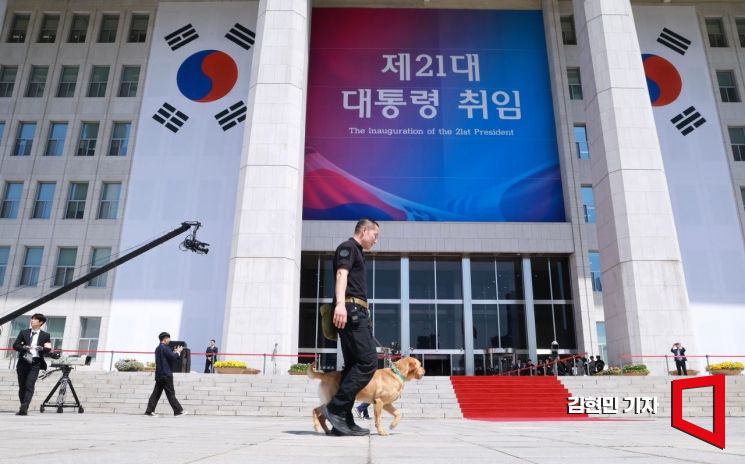 On June 4, police special forces are on guard duty around the National Assembly main building where President Lee Jae Myung's inauguration ceremony will be held. 2025.6.4 Photo by Kim Hyunmin
"Work briefings nearly complete... Vice ministers leading operations"
The Ministry of Education, which oversees many policies initiated during the Yoon Suk Yeol administration such as Neulbom Schools and AI textbooks, may refine the details of these initiatives. An official from the Ministry of Education said, "Since President Lee has his own pledges and this is a new administration, we will likely retain some continuity with previous policies, but we expect to reset tasks during the work briefing process."
For the Ministry of the Interior and Safety and the Ministry of Gender Equality and Family, the impact of cabinet formation is expected to be relatively minor. The ministries are expected to be operated for the time being with a focus on appointing vice ministers, positions that do not require confirmation hearings. These ministries are already being led by vice ministers in the absence of ministers. In particular, if vice ministers are promoted internally, their high level of policy understanding could contribute to greater stability in the early stages of the administration. A Ministry of the Interior and Safety official stated, "Even if the vice minister changes, if someone from within the ministry is promoted, they are already familiar with the policies, so there will not be significant changes."
The momentum for organizational restructuring is accelerating. The Ministry of Gender Equality and Family, which had been the subject of abolition debates, is expected to be expanded and reorganized into the Ministry of Gender Equality and Family, reflecting President Lee's inauguration. An official from the Ministry of Gender Equality and Family commented, "There are no concrete details being reviewed internally yet regarding the reorganization."
The Ministry of the Interior and Safety, which is administratively responsible for organizational restructuring, is also expected to become busier. An official from the ministry stated, "The Organization Bureau is considering various restructuring scenarios, and since the presidential office, the National Assembly, and individual ministries each have their own ideas, we will need to gather and review all of them."
Ministry of Economy and Finance may be split... Some ministries may be relocated
The Ministry of Economy and Finance, which President Lee has repeatedly emphasized as needing a "significant decentralization of power," is on high alert. During the presidential race, the Democratic Party strongly advocated for separating the ministry's budget formulation function, and as a result, it is expected to be the top priority for restructuring under the new administration. If reorganized, the Ministry of Economy and Finance could be split into the Ministry of Planning and Budget, which would handle budget formulation, and the Ministry of Finance and Economy, which would oversee taxation and the national treasury. There is concern within and outside the ministry that, in this scenario, budget authority could be transferred to the Prime Minister's Office, inevitably diminishing the ministry's status.
At the same time, there is also anticipation about the new positions that may arise if the ministry is split in two. With an increase in minister, vice minister, and senior executive positions, some of the current personnel bottlenecks could be alleviated. The National Assembly Budget Office has projected that if the Ministry of Economy and Finance is divided into the Ministry of Planning and Budget and the Ministry of Finance and Economy, a total of 87 new positions would be created, including one minister, one vice minister, and staff for secretarial and administrative support organizations.
Officials at the Ministry of Oceans and Fisheries are now faced with the prospect of relocating their current Sejong headquarters to Busan, in line with President Lee's pledge to "definitely move the ministry to Busan." Although relocating the ministry to Busan has been a recurring presidential campaign pledge, it has repeatedly failed to materialize. In 2002, Lee Hoi Chang, the Grand National Party candidate, promised to move the ministry to Busan but was not elected. In 2013, former President Park Geun Hye resolved conflicts between Busan and Incheon by relocating the ministry to Sejong instead of Busan.
However, this time, the prevailing sentiment in government circles is that things may be different. President Lee achieved a record 40.14% of the vote in Busan, the highest ever for a Democratic Party presidential candidate, thanks to region-specific policies such as the relocation of the Ministry of Oceans and Fisheries to Busan, attracting HMM's headquarters, and developing the Arctic shipping route. As a result, the relocation to Busan could proceed rapidly in the early stages of his term.
However, there are concerns about work efficiency if the ministry is relocated to Busan, as ministry officials would have to travel greater distances to the National Assembly in Seoul and to other related ministries in Sejong. There are also doubts about whether simply having approximately 600 ministry officials commute to Busan would be enough to revitalize the local economy.
Some ministries are concerned that the creation of new ministries could reduce their original functions. The new administration plans to separate the "climate" functions from the Ministry of Environment and the "energy" functions from the Ministry of Trade, Industry and Energy, and integrate them into a new Ministry of Climate and Energy. This ministry would be responsible for overseeing carbon neutrality and energy transition policies. Lee So Young, a Democratic Party lawmaker with a background in environmental organizations, is being mentioned as a candidate for minister.
However, there are concerns within the Ministry of Trade, Industry and Energy that energy policy could become a lower priority, given the new ministry's name. The ministry's trade functions could also be transferred to the Ministry of Foreign Affairs, reflecting the increased importance of responding to issues such as the US-China trade conflict during the Trump era. As a result, the role of the Ministry of Foreign Affairs could be strengthened. Kim Hyun Jong, former second deputy director of the National Security Office who oversaw trade under the Roh Moo Hyun and Moon Jae In administrations, is being considered as a candidate for foreign minister in this context.
 President Lee Jae Myung is drinking water while attending the 21st Presidential Inauguration Commemorative Luncheon held at Sarangjae, the National Assembly in Yeouido, Seoul on June 4, 2025. Photo by Kim Hyun Min
Local governments enter local election mode... Candidates awaiting nominations seek recognition
Local governments, including the Seoul Metropolitan Government, have shifted to local election mode. As the elections for governors, superintendents of education, mayors, county heads, and metropolitan and basic council members will be held simultaneously, and with the Democratic Party succeeding in changing the administration in this presidential election, significant changes are expected.
In the case of Seoul, Mayor Oh Se Hoon is aiming for a fifth term. After announcing he would not run for president, Mayor Oh distanced himself from the political scene and focused solely on city affairs. This was to solidify his own policy vision and achieve results from long-term projects. According to the Local Autonomy Act, the Seoul mayor cannot serve more than four consecutive terms, so after a fifth term, Mayor Oh is expected to run in the 2030 presidential election.
The Democratic Party is aiming to reclaim the Seoul mayoralty. Now that it holds power, the party intends to align the capital's policies with those of the central government. In April of last year, the Democratic Party established the "New Seoul Preparation Special Committee" under the Seoul mayor's office to evaluate Mayor Oh's policies and present the party's vision and policy alternatives for Seoul. The committee is chaired by lawmaker Park Jumin.
The situation is similar in local political circles. While heads of local governments were unable to actively campaign, they focused on local issues during the presidential election and encouraged voter participation. In particular, candidates from both the ruling and opposition parties who are awaiting nominations used the campaign period to raise their profiles and organize their teams. This is because a candidate's contribution to the presidential election is often reflected in the local election nomination process. A Democratic Party official stated, "It will be noticeable that new talent discovered during the presidential election will run in the local elections, and as the administration has changed, shifts in local public sentiment may also be reflected in the results of local government head elections."
Civil servants are also facing complex emotions. For those responsible for policies shaped by the direction of local government heads, it has become increasingly difficult to establish medium- and long-term plans. Toward the end of the year, there may also be dissatisfaction due to local government heads favoring their own allies, as seen in last-minute promotions and appointments of agency heads before leaving office. A local government official commented, "Problems such as civil servants aligning themselves with factions, reading the mood, and a decline in discipline are issues that recur every time there is a change in local government leadership. At times like this, it is especially important for the political community to step up and encourage proper management."
© The Asia Business Daily(www.asiae.co.kr). All rights reserved.
![Clutching a Stolen Dior Bag, Saying "I Hate Being Poor but Real"... The Grotesque Con of a "Human Knockoff" [Slate]](https://cwcontent.asiae.co.kr/asiaresize/183/2026021902243444107_1771435474.jpg)
















