EV Trend Korea Opens
"Electric Vehicle Market Expected to Improve This Year"
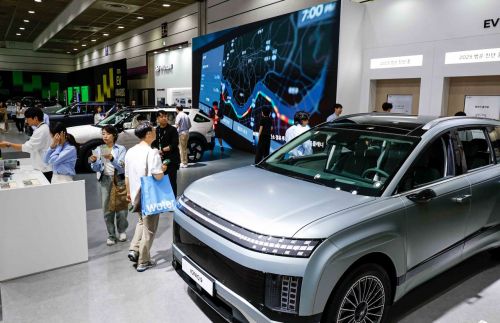 On June 4, 2025, visitors attending 'EV Trend Korea' held at COEX in Gangnam-gu, Seoul, are viewing various electric vehicles displayed at the event venue. Photo by Kang Jinhyung
As of May this year, the domestic electric vehicle (EV) market has shown signs of recovery, recording growth in the 40% range.
According to the Ministry of Environment on June 4, a total of 72,450 electric vehicles were sold in Korea from January to May this year. This represents a 46% increase compared to the 49,617 units sold during the same period last year. It is also about a 13% increase compared to the 64,088 units sold during the same period in 2023. This growth is attributed both to the base effect from last year's contraction in the EV market and to the expansion of the market base due to the launch of affordable electric vehicles.
At the 'EV360˚ Conference,' a side event of the EV Trend Korea exhibition held at COEX on this day, Ryu Pilmu, Director of the Future Air Strategies Division at the Ministry of Environment, stated, "Electric vehicles at reasonable price points, such as the EV3 and Casper, are being chosen by customers," adding, "We expect EV sales performance to improve this year." By vehicle type, 61,368 units were passenger cars, 967 units were vans, and 10,108 units were trucks.
From January to May this year, 37,637 EV chargers were installed, bringing the cumulative total to 452,323 chargers. Of these, 51,098 were fast chargers, and 401,225 were slow chargers, with slow chargers making up the majority.
The Ministry of Environment emphasized that it plans to promote supply support policies focusing on high-performance eco-friendly vehicles going forward. Director Ryu explained, "We will encourage the market to avoid low-performance electric vehicles and batteries that are heavy and lack safety," adding, "We are reviewing various policies, including battery energy density." Currently, subsidies are already applied differentially based on driving range per charge, charging speed, and battery energy density.
The emphasis on battery weight is a response to anticipated regulations on non-exhaust environmental charges, such as brake wear particles, under standards like Euro 7.
Meanwhile, the cumulative number of hydrogen vehicles supplied from January to May this year was only 1,123 units. Of these, 711 were hydrogen passenger cars and 412 were hydrogen vans. The Ministry of Environment plans to encourage the number of hydrogen vans supplied to reach the level of electric vans. Director Ryu stated, "The number of hydrogen vans remained at 700 until 2023, but surpassed 1,000 last year," adding, "We expect to see significant changes this year."
Starting next year, the Ministry of Environment plans to move away from a subsidy-centered policy and expand policies that support the voluntary adoption of zero-emission vehicles such as EVs and hydrogen vehicles by the private sector through financial support. The ministry is reviewing measures such as zero-emission vehicle conversion loan programs, zero-emission vehicle charging infrastructure funds, and zero-emission vehicle safety insurance.
© The Asia Business Daily(www.asiae.co.kr). All rights reserved.
![Clutching a Stolen Dior Bag, Saying "I Hate Being Poor but Real"... The Grotesque Con of a "Human Knockoff" [Slate]](https://cwcontent.asiae.co.kr/asiaresize/183/2026021902243444107_1771435474.jpg)















