Separation of Investigation and Prosecution, Strengthening the CIO, and Expanding Access to Trials
Pushing for Constitutional Amendments and Martial Law Act Revisions
Will Judgment Complaints and the Cho Hee Dae Special Prosecutor Be Pursued?
Attention on Implementation of Judicial and Prosecutorial Reform Pledges
With the election of Lee Jae Myung (61, 18th Judicial Research and Training Institute class), the Democratic Party of Korea candidate, as the 21st president, there is growing attention on whether he will fulfill his various pledges related to the legal field.
President-elect Lee has pledged to separate investigation and prosecution as a core task of prosecutorial reform. He announced plans to enact an “Investigation Procedure Act” to mitigate the excessive concentration of prosecutorial power and to ensure the expertise and neutrality of investigative agencies. The main points include: introducing a judicial review process before requesting search and seizure warrants (pre-warrant interrogation system), enacting investigative guidelines into law, strengthening penalties for public disclosure of suspects’ information, and establishing new regulations for punishing evidence fabrication by investigative agencies and special statutes of limitations. In addition, he plans to expand the unified legal profession system by shifting prosecutor appointments to focus on experienced legal professionals.
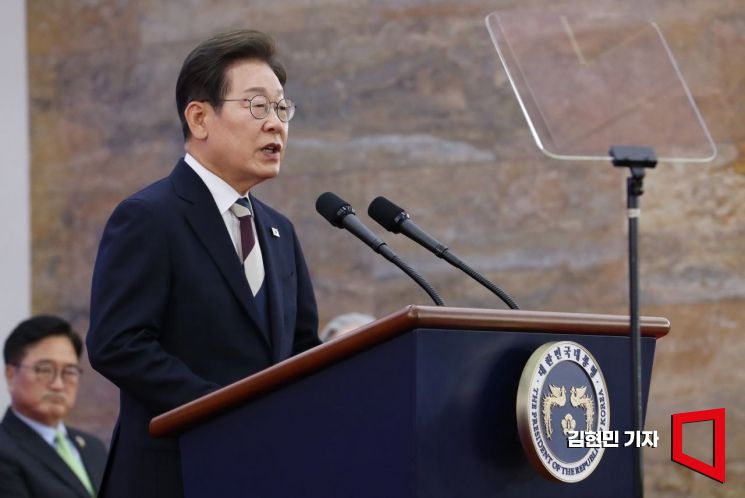 President Lee Jae Myung is delivering the inauguration speech for the 21st president at the National Assembly in Yeouido, Seoul on the 4th.
The Corruption Investigation Office for High-ranking Officials (CIO), which was once at risk of being abolished, is now expected to see its status strengthened. Although not explicitly included in his pledges, it is anticipated that the organization will be reinforced through the addition of investigative personnel and improvements to relevant laws as a means to check prosecutorial power. On April 15, Lee stated on the YouTube channel of the Roh Moo Hyun Foundation, “I intend to significantly strengthen the CIO.”
Judicial reform to enhance the speed and accessibility of trials will also be pursued. Lee plans to guarantee practical rights to speedy trials by increasing the recruitment of judicial researchers and strategically assigning first-instance trial panels. He also aims to improve public access to trials through the expansion of summary trials and the introduction of online trials. Additional pledges include expanding citizen participation trials, broadening the scope of judgment disclosure, establishing a judge evaluation committee, and increasing the number of Supreme Court justices.
Although not included in his pledges, a proposed amendment to the Constitutional Court Act that would allow for constitutional complaints against court judgments (hereafter “judgment complaints”) has been submitted, drawing attention to Lee’s stance on the issue. The Constitutional Court has submitted its opinions on this amendment to the National Assembly twice.
The Democratic Party may also pursue a special prosecutor act to investigate judicial abuse by Chief Justice Cho Hee Dae and others (“Cho Hee Dae Special Prosecutor Act”). On June 2, Lee commented in an interview with the YouTube program “Kim Eo Jun’s News Factory” regarding the Supreme Court’s decision to remand his violation of the Public Official Election Act for a guilty verdict, saying, “Of all the things I have experienced, this was the most absurd.”
Improvement of the public defender system has also been identified as a key task. Lee plans to pilot the public defender system in civil cases as well as criminal cases and to implement a more realistic compensation structure for public defenders. Additional measures to be pursued in parallel include the introduction of a statement recording system, a document submission order system, expanded citizen participation in the Supreme Court Sentencing Commission, conditional release at the warrant stage, and the introduction of an independent confiscation system and income-proportional fines.
To create a judicial environment focused on livelihood and human rights, Lee has pledged to introduce a Korean-style discovery (evidence disclosure) system. As part of efforts to improve the attorney system, he plans to grant disciplinary authority over attorneys to a separate committee to enhance the public interest and accountability of lawyers and to enact attorney-client privilege (Attorney-Client Privilege, ACP) into law.
Lee has also expressed his intention to amend the Constitution. He aims to specify the spirit of the May 18 Democratization Movement in the preamble, and to pursue constitutional amendments that would strengthen direct democracy and expand fundamental rights. In particular, he has identified the introduction of a four-year presidential term with the possibility of re-election, strengthening the requirements for declaring martial law, and tightening the requirements for exercising the presidential veto as major tasks for restructuring the power structure.
Amendments to the Martial Law Act will also be pursued. Lee plans to legislate provisions to guarantee the functions of the National Assembly during the declaration of martial law and to stipulate that if the National Assembly demands the lifting of martial law, it will be automatically lifted even if the government does not comply. Measures will also be introduced to clarify the authority of the martial law commander, guarantee the right of lawmakers to attend plenary sessions, and require mandatory reporting to the National Assembly as part of martial law oversight. The scope of military courts’ jurisdiction over civilians during emergency martial law will be reduced, and after the lifting of martial law, jurisdiction will automatically be transferred to ordinary courts.
Kim Ji Hyun, Law Times Reporter
Woo Bin, Law Times Reporter
※This article is based on content supplied by Law Times.
© The Asia Business Daily(www.asiae.co.kr). All rights reserved.
![Clutching a Stolen Dior Bag, Saying "I Hate Being Poor but Real"... The Grotesque Con of a "Human Knockoff" [Slate]](https://cwcontent.asiae.co.kr/asiaresize/183/2026021902243444107_1771435474.jpg)















