'Dirt spoon child laborer,' 'outsider,' 'general from the periphery'...
The labels attached to President Jae Myung Lee have always set him apart from the mainstream. He is a politician with a story of overcoming hardship and adversity. In the end, he achieved his ultimate dream of becoming President of South Korea. Although he failed to realize this dream in his presidential bids in 2017 and 2022, the public did not turn away from the sweat, tears, and effort of politician Jae Myung Lee.
Many people who lived through the 1960s experienced the shadow of poverty. Among politicians, there are quite a few who have overcome poverty in their life stories. Even among these, President Jae Myung Lee's life story stands out as particularly dramatic. Carrying the deep shadow of poverty for many years, he continued to move forward by overcoming difficulties.
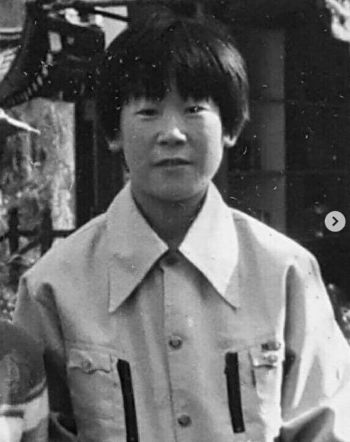 President Jae Myung Lee during his youth as a child worker at the baseball glove factory 'Daeyang Silup' in 1978. Photo by President Lee's Facebook
Born in Andong, North Gyeongsang Province, he spent most of his teenage years working in factories due to poverty. While working at a factory, his arm was caught in a machine, resulting in a permanent disability. He also suffered from an industrial accident that left him with a diminished sense of smell due to severe exposure to chemicals. His family was so poor that he could not even afford a proper school uniform. He had to complete both his middle and high school education by passing qualification exams.
According to those close to him, his "extremely impoverished" childhood became the driving force that gave politician Jae Myung Lee his tenacity and competitive spirit. In order to fight off sleep and study for the university entrance exam, he scattered thumbtacks on his desk to keep himself awake. As a result of his determination, President Lee was admitted to the law department of Chung-Ang University in 1982.
At one point, President Lee considered a career as a judge or prosecutor. However, during his training, he attended a lecture by former President Roh Moo-hyun, who said, "A human rights lawyer can make a living without missing three meals a day." This inspired him to pursue a career as a human rights lawyer. Returning to Seongnam, known as the "city of workers," he opened his own law office in 1989. In 1994, he participated in founding the Seongnam Citizens' Coalition (now Seongnam Participation Solidarity), marking his entry into civic activism.
President Lee's political philosophy can be summarized by the keywords 'fairness' and 'pragmatism.' He is also keenly aware of issues related to vested interests and inequality. Notably, he has chosen a pragmatic path that pursues both welfare and economic growth.
In particular, in 2004, he led a campaign to establish the Seongnam Municipal Medical Center. Despite securing the consent of 20,000 residents, the project was ultimately thwarted by opposition from the Seongnam City Council, which was then dominated by the Grand National Party. This event became the decisive turning point that led President Lee to enter politics. The following year, in 2005, he joined the Uri Party. After losing the Seongnam mayoral election in 2006, he finally began his political journey by being elected as the fifth popularly elected mayor of Seongnam in 2010 with 51.2% of the vote.
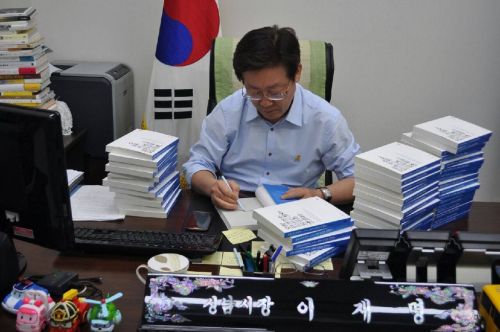
After his election, he became the first local government head to declare a moratorium in order to pay off the debt that had accumulated under his predecessor. Within three years, he repaid all 457.2 billion won of debt. Ultimately, he was re-elected as mayor of Seongnam in 2014 with 55.1% of the vote. He drew attention by ushering in a new paradigm in local politics, implementing three major free welfare policies: youth dividends, postpartum care, and free school uniforms.
After running for president in 2017, President Lee became known nationwide. In the 2018 local elections, he was elected as the 35th governor of Gyeonggi Province with 56.4% of the vote. From his time as mayor of Seongnam to governor of Gyeonggi, he played a key role in popularizing local currency.
In the 20th presidential election in 2022, he received 47.83% of the vote, narrowly losing to former President Yoon Suk-yeol by a margin of 0.73 percentage points. Just two months after his defeat, in June 2022, he ran in the by-election for the Gyeyang district in Incheon and won. That August, he became leader of the Democratic Party. In the 22nd general election, many pro-Lee (pro-Myung) figures entered the National Assembly, making his faction the mainstream within the party. During the nomination process, a large number of non-Lee (anti-Myung) members were excluded, leading to the so-called 'Bimyeong Hoengsa' controversy.
However, during the party primary for this presidential election, internal factional conflict did not surface. In fact, President Lee was selected as the candidate with an overwhelming 89.77% of the vote, and the Democratic Party effectively faced the election as a unified front. Reporter Moon Hyewon
© The Asia Business Daily(www.asiae.co.kr). All rights reserved.
![Clutching a Stolen Dior Bag, Saying "I Hate Being Poor but Real"... The Grotesque Con of a "Human Knockoff" [Slate]](https://cwcontent.asiae.co.kr/asiaresize/183/2026021902243444107_1771435474.jpg)
















