Implemented Just Five Days After Announcement... No Time to Prepare Countermeasures
Industry: "Abnormal Measure, Relying on Government Negotiations"
Government and Steel Association Form a 'One Team'... Strategic Item Response
The U.S. steel industry has been thrown into unprecedented turmoil after the Donald Trump administration raised tariffs on steel products imported into the United States from 25% to 50%. The measure was implemented just five days after the announcement, leaving domestic steelmakers with far too little time to prepare practical countermeasures. The industry views this tariff hike as an abnormal action that deviates from the normal order of trade, and plans to actively participate in and rely on the government's negotiations with the United States rather than responding solely at the corporate level.
According to industry sources on June 4, the Trump administration decided to raise tariffs on all steel and aluminum imported into the United States to 50%, effective from 1:01 p.m. Korean time on the same day. The domestic steel industry has been unable to hide its confusion. One industry insider said, "Even the 25% tariff was difficult to bear, but 50% is essentially a move to block exports altogether," adding, "The decision was made so abruptly that it is difficult to come up with a response." Another source commented, "There are so many changes and the direction is so unpredictable that the entire industry is in a state of panic."
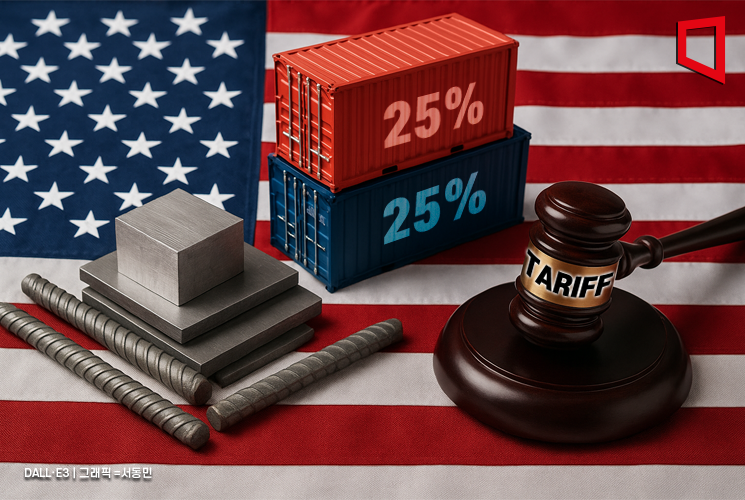
This tariff hike took effect just five days after U.S. President Donald Trump suddenly announced on May 30 that he would raise tariffs on steel and aluminum from the existing 25% to 50%. It is also an additional increase that comes just over two months after a 25% tariff was imposed without exception on all steel and aluminum imports in March.
The Trump administration has cited "protection of American industry" as the reason for the tariff hike. However, the domestic industry sees things differently. They argue that this cannot be considered normal trade under the pretext of protection. The basis for this view is that the United States imported about 28 million tons of steel annually as of last year, making it difficult to replace this volume with domestic production alone. An industry official said, "It is impossible to expand steel production in the short term," and added, "For certain products, there is no domestic production base in the United States at all."
Observers inside and outside the industry believe that the actual impact of this tariff hike will be felt with a time lag. Since it typically takes four to five months from export contracts to production and customs clearance, export volumes will not be cut off immediately. As a result, the effects of this tariff increase are expected to begin impacting each company's performance in earnest from the second half of this year.
Going forward, the industry plans to work with the government to respond, as this issue cannot be resolved at the corporate level alone. The strategy is to minimize losses through close cooperation with the government's negotiation team, while restructuring export portfolios to focus on strategic items that are difficult to substitute within the U.S. market. An industry official said, "Item-by-item responses will become increasingly important," adding, "There are some items that are still viable, and we will develop export strategies by closely analyzing the U.S. market." With the inauguration of a new government following the June 3 presidential election, there are also growing expectations for stronger negotiating power than before. Another industry insider remarked, "We are watching to see the new administration's direction," and added, "With the change in administration, we hope our response capabilities will be somewhat stronger."
Previously, on the morning of June 2, the Ministry of Trade, Industry and Energy held an emergency meeting at the Korea Iron & Steel Association in Songpa-gu, Seoul, with representatives from the steel and non-ferrous metals industries to assess the impact of the U.S. tariff hike on major exporters and to seek countermeasures. It is reported that officials from POSCO, Hyundai Steel, Dongkuk Steel, SeAH Steel, and others attended the meeting to share their views. Even at that time, the industry reportedly agreed to respond to the tariff hike in close consultation with the government going forward.
© The Asia Business Daily(www.asiae.co.kr). All rights reserved.
![Clutching a Stolen Dior Bag, Saying "I Hate Being Poor but Real"... The Grotesque Con of a "Human Knockoff" [Slate]](https://cwcontent.asiae.co.kr/asiaresize/183/2026021902243444107_1771435474.jpg)















