Economic Stimulus and Korea Discount Resolution Seen as Positive Factors
Holding Companies, Securities, Banks Recommended... Small and Mid-Cap Stocks Also in Focus
KOSPI Expected to Enter 3,000-Point Era if Valuation Improves
Fueled by expectations for the launch of the new administration, the KOSPI opened sharply higher and surpassed the 2,750 mark for the first time in 10 months. Market experts predict that the inauguration of the Lee Jaemyung administration will have a positive impact on the stock market. There is anticipation for positive effects on industries highlighted in the administration’s policy pledges, and some analysts suggest that small and mid-cap stocks also warrant attention.
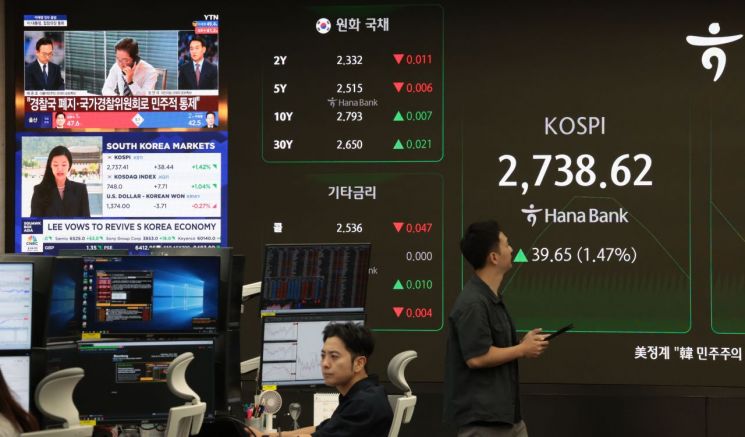
As of 10:00 a.m. on June 4, the KOSPI was trading at 2,757.45, up 58.48 points (2.17%) from the previous session. The KOSDAQ was at 750.38, up 10.09 points (1.36%).
In the Seoul foreign exchange market, the won-dollar exchange rate opened at 1,375.0 won, up 1.9 won from the previous trading day.
Securities analysts assessed that the launch of the new administration would be positive for the stock market. Lee Woongchan, a researcher at iM Securities, stated, “The new government’s policies are positive for the stock market. The essence of the Lee Jaemyung administration’s policies will be characterized by strong fiscal spending and government-led industrial policies. While the fiscal deficit may later translate into debt or tax burdens, the immediate stimulus will support the stock market and domestic demand. Sectors expected to benefit from industrial policy and governance reform are likely to see significant gains.” He added, “I believe the two factors that will define the domestic stock market in the second half are policy-driven domestic demand stimulus and export slowdown originating from the United States. The index is likely to reflect expectations for new government policies and stimulus measures first, showing strong performance from the end of the second quarter to the beginning of the third quarter. As the second half progresses, as signs of weakening U.S. consumption and exports become evident, the market is expected to gradually stagnate.”
Attention should be paid to sectors that will benefit from the new government’s policies. Kim Yonggu, a researcher at Yuanta Securities, said, “The core of the Lee Jaemyung administration’s economic and financial policies is to revitalize domestic demand through aggressive fiscal stimulus, foster new growth engines such as artificial intelligence (AI), semiconductors, biotechnology, K-content, and renewable energy, and normalize the stock market (addressing the Korea Discount) based on amendments to the Commercial Act. Given that the new administration’s policies are accompanied by concrete measures that enforce immediate structural improvements, the positive effects on the Korean economy and stock market are expected to be significant.” He further recommended, “The new government’s policy response is expected to have a positive impact on stocks related to securities, holding companies, semiconductors, electrical equipment, defense, telecommunications, construction, media and entertainment, food and beverages, cosmetics, and the AI and security value chain.”

Stocks expected to benefit from resolving the Korea Discount (the undervaluation of the Korean stock market) are also anticipated to perform strongly. Han Jiyeong, a researcher at Kiwoom Securities, said, “The market will now focus on whether President Lee Jaemyung’s campaign pledges, such as passing the Commercial Act amendment and implementing the mandatory share buyback and cancellation law within two to three weeks after the presidential election, will be fulfilled. The market will assess the feasibility of resolving the Korea Discount and the possibility of the KOSPI reaching 5,000 points. In the medium term, the stock environment surrounding leading beneficiaries of the Korea Discount resolution, such as holding companies, banks, and securities firms, is expected to be favorable. Even though their stock prices have surged recently, their current 12-month forward price-to-book ratios (PBR) do not indicate significant valuation pressure.”
There are also opinions that small and mid-cap stocks, which are likely to receive relatively more support, deserve attention. Kim Daejun, a researcher at Korea Investment & Securities, analyzed, “The Lee Jaemyung administration may show a tendency to support small and medium-sized enterprises more than large corporations. From a stock market perspective, this could be a favorable factor for small and mid-cap stocks, which are likely to be exposed to support rather than regulation. After the 21st presidential election, the stock market may see small and mid-cap stocks attracting increased attention.”
There are also projections that if the KOSPI’s valuation improves, it could enter the era of 3,000 points. Lee Kyungmin, a researcher at Daishin Securities, said, “If Korea’s economic recovery and capital market advancement measures are pursued, the likelihood of valuation improvement is high. The KOSPI is expected to break out of undervalued territory and enter the 3,000-point era simply through valuation normalization.”
© The Asia Business Daily(www.asiae.co.kr). All rights reserved.
![Clutching a Stolen Dior Bag, Saying "I Hate Being Poor but Real"... The Grotesque Con of a "Human Knockoff" [Slate]](https://cwcontent.asiae.co.kr/asiaresize/183/2026021902243444107_1771435474.jpg)
















