Record Number of Test-Takers Since 2011...
Key Variables Include the "Satam Run" Phenomenon
The 2026 academic year National Joint Academic Assessment, which was postponed by one day due to the presidential election, will be held on June 4.
The June mock exam, administered by the Korea Institute for Curriculum and Evaluation (KICE), which also creates the questions for the College Scholastic Ability Test (CSAT), is the first test of the year in which N-susaeng (repeaters and graduates) participate. It is conducted in an environment most similar to the actual CSAT. Key variables for this June mock exam include a significant increase in the number of N-susaeng, despite the number of medical school admissions being adjusted back to pre-expansion levels, and the acceleration of the so-called "Satam Run" phenomenon, in which science track students take social studies subjects for the test.
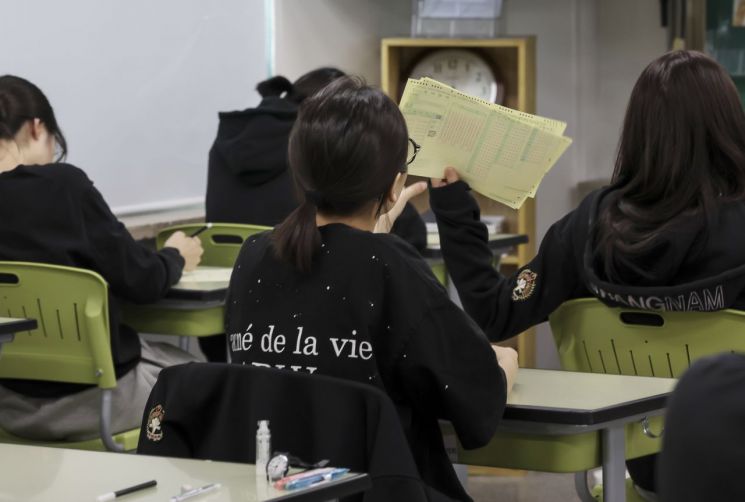
According to KICE, the June mock exam will be conducted simultaneously at 2,119 high schools and 511 designated private academies nationwide on this day.
The total number of test-takers is 503,572, the highest since 2011, when official statistics began to be released.
This is due to an increase of 28,250 in the number of third-year high school students born in 2007, the Year of the Golden Pig (413,685 students, 82.2%) compared to last year, as well as an increase of 1,189 in the number of graduates and GED holders (89,887 students, 17.8%), despite the return of the 2026 medical school quota to 3,058 students.
This mock exam was originally scheduled for June 3, but was postponed by one day due to the early presidential election. The nature of the test, the test sections, and the number of questions are all identical to those of the CSAT to be held on November 13. The Korean and mathematics sections are administered in a "common subject + elective subject" structure. All test-takers must take the common subject in Korean or mathematics, while for each section, they only need to take the elective subject they have chosen. In the social studies and science inquiry sections, students can choose up to two subjects out of 17, and in the vocational inquiry section, up to two subjects out of six.
KICE announced that, as stated in the "2026 CSAT June Mock Exam Implementation Plan" released in March, the EBS linkage rate was maintained at about 50% based on the number of questions in each section and subject. KICE also stated that questions advantageous to students who have repeatedly practiced problem-solving techniques at private academies were excluded, and that questions of appropriate difficulty were evenly distributed so that students could demonstrate their abilities based solely on content covered in public education.
A notable feature of this June mock exam is the pronounced trend of science inquiry (Gwatam) students choosing social studies inquiry (Satam) subjects. As universities have relaxed restrictions on subject selection, allowing students who took Satam to apply to natural science departments, the "Satam Run" phenomenon is accelerating. According to KICE, the number of test-takers who chose Satam in the June mock exam was 368,018, an increase of 96,342 from last year, while the number of Gwatam test-takers was 248,642, a decrease of 3,623.
KICE stated, "In sections with elective subjects, we aimed to minimize any advantages or disadvantages arising from subject selection in the test design."
The correct answers will be officially announced at 5 p.m. on June 17, and the scores will be released on July 1.
© The Asia Business Daily(www.asiae.co.kr). All rights reserved.
![Clutching a Stolen Dior Bag, Saying "I Hate Being Poor but Real"... The Grotesque Con of a "Human Knockoff" [Slate]](https://cwcontent.asiae.co.kr/asiaresize/183/2026021902243444107_1771435474.jpg)















