Differences from the Yoon Administration’s Market-Driven Approach
Aggressive Fiscal Stimulus and Government-Led Growth Take Center Stage
“Economic Circulation” and Local Currency Initiatives as Key Strategies
Comprehensive COVID-19 Debt Relief and Support for Small Businesses
Long-Term Vision: “3-3-5” Strategy for AI, Defense, and K-Culture
Inclusive and Fair Growth over Trickle-Down Economics
Strong Pro-Labor Reforms Including the Yellow Envelope Law
Roadmap for Productivity: Extended Retirement Age and Reduced Working Hours
The core of President Lee Jaemyung's economic policy is economic growth through expanded fiscal spending. Unlike the Yoon Suk-yeol administration, which prioritized "market economy" and "deregulation," President Lee's approach puts "expansionary fiscal policy" and "government-led growth" at the forefront. In the short term, the plan is to revitalize the sluggish economy by increasing fiscal spending. In the long term, the government intends to strengthen its role in fostering advanced industries such as artificial intelligence (AI) and the defense industry, thereby creating new engines for growth. The administration's strategy is to first focus on aggressive stimulus measures to revive the faltering economy, and then roll out mid- to long-term reform policies to break the cycle of entrenched low growth. This economic stance is expected to be concretely reflected in the economic policy direction for the second half of the year, which will be announced in July or August, as well as in next year's budget proposal.
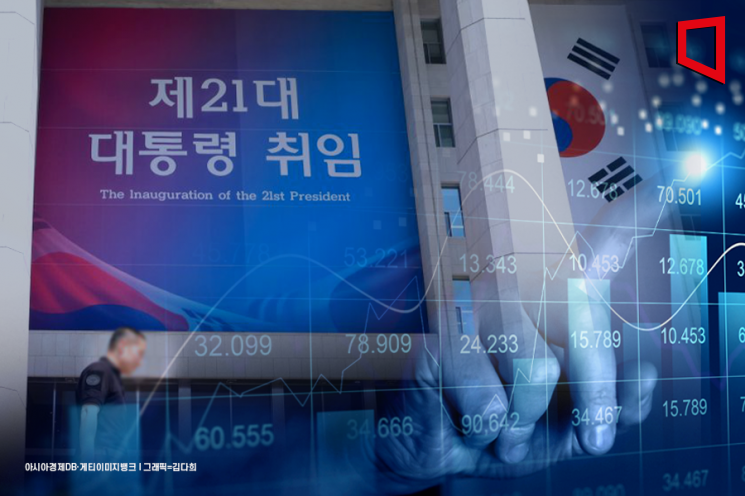
With his inauguration on this day, President Lee launched an emergency economic response task force (TF), and the countdown began for the formation of a second supplementary budget (extra budget). Observers expect that the government will move swiftly to finalize the supplementary budget process this month, aiming for passage at the National Assembly's plenary session early next month. During the presidential campaign, President Lee indicated that the supplementary budget would be at least 35 trillion won. It is expected that the largest portion of this spending will be allocated to "livelihood recovery" measures aimed at boosting sluggish domestic demand. President Lee stated during the campaign that the supplementary budget would focus on domestic demand recovery and support for ordinary citizens. In this context, signature policies of President Lee, such as local currency initiatives, are likely to take center stage.
The key concept that runs through the Lee Jaemyung administration's economic philosophy is the theory of economic circulation. President Lee emphasized that if money circulates, the economy can enter a virtuous cycle of growth, and he pledged to greatly expand the issuance of local currency (such as local gift certificates) with government funding. The administration expects that injecting local currency issued by local governments will increase sales for small business owners and the self-employed by more than 30% compared to previous levels. In connection with this, the government will establish a comprehensive COVID-19 loan response plan, providing phased special measures for 71 trillion won in COVID-19 loans, ranging from debt restructuring to debt forgiveness. The administration will also announce support measures for small business owners affected by the December 3 Martial Law. To fund these pledges, the administration has proposed tax and expenditure adjustments.
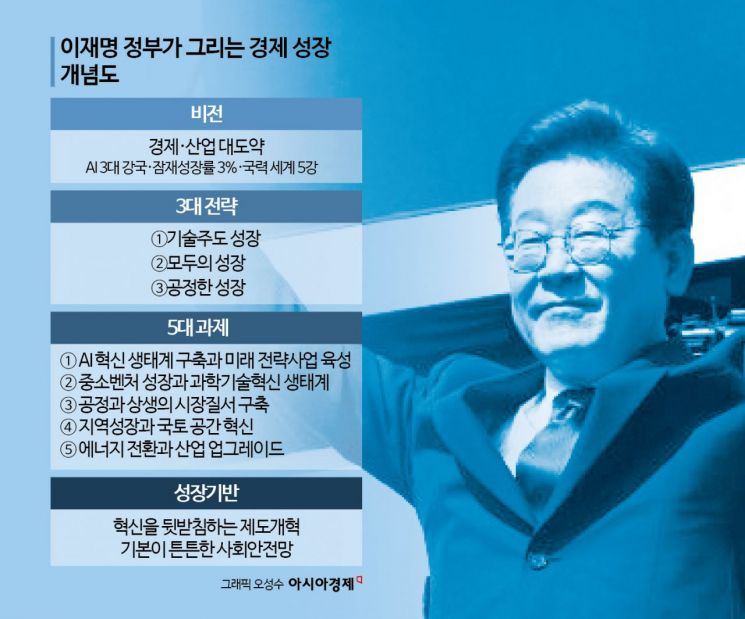
The Lee Jaemyung administration's long-term growth strategy is summarized as "3-3-5." During the presidential campaign, President Lee unveiled the framework of the 335 strategy, which includes making Korea one of the world's top three AI powerhouses, achieving a 3% potential growth rate, and joining the world's top five economies (G5). The goal is to reverse the declining trend in potential growth by focusing on national strategic industries such as AI, defense, and K-culture, and ultimately to join the G5. The administration has also presented a blueprint for achieving this national vision through a concrete roadmap: technology-driven growth by nurturing strategic industries for the future; inclusive growth that enables small and medium-sized enterprises, ventures, non-metropolitan regions, small business owners, and the self-employed to develop their capabilities and participate; and fair growth without the abuse of power by large corporations.
The Yoon Suk-yeol administration focused on revitalizing the market through tax cuts for the wealthy and deregulation, based on the belief in the trickle-down effect-that as companies grow, national income will naturally increase. The Lee Jaemyung administration, however, is skeptical of the trickle-down effect. In corporate policy, it emphasizes fairness over freedom. The administration has set out to enhance the bargaining power of small and medium-sized enterprises so that they receive fair value, improve systems to prevent technology theft, and strengthen the bargaining power of franchisees, agency owners, subcontractors, and online platform vendors.
To prevent the fruits of growth from being concentrated in only a few groups, the administration has also put forward a strong set of pro-labor pledges. The revision of Articles 2 and 3 of the Trade Union Act (the so-called Yellow Envelope Law), a long-standing demand of the labor community, is a core labor pledge of President Lee. The Yellow Envelope Law, which was blocked by the previous administration's veto power, includes provisions that allow subcontracted workers to demand collective bargaining from the primary contractor and limit claims for damages arising from illegal strikes. The administration also plans to move swiftly on measures such as codifying the ban on comprehensive wage systems, which the business community has opposed, gradually extending the retirement age to 65, introducing exceptions to the 52-hour workweek, and presenting a roadmap to reduce actual working hours for the adoption of a 4.5-day workweek-all of which are linked to improving national productivity.
© The Asia Business Daily(www.asiae.co.kr). All rights reserved.
![Clutching a Stolen Dior Bag, Saying "I Hate Being Poor but Real"... The Grotesque Con of a "Human Knockoff" [Slate]](https://cwcontent.asiae.co.kr/asiaresize/183/2026021902243444107_1771435474.jpg)
















