"Submit Your Final Offer by Today," Says U.S. Letter
Little Time Left for Proposal Review
U.S. Steel Tariffs Raised from 25% to 50%
Major Exporters Like Korea Expected to Suffer
President Lee Jaemyung was immediately confronted with the need to respond to U.S. President Donald Trump's trade pressure upon taking office. On June 3 (local time), the White House sent letters to all countries currently engaged in trade negotiations, demanding that they submit their 'best offers' related to the negotiations by June 4. On the same day, President Trump also signed an executive order doubling tariffs on imported steel and aluminum from the existing 25% to 50%. The Korean government, which has just begun the transition of power and has not yet finalized its cabinet, now faces the burden of making swift decisions on critical trade issues with the United States.
White House spokesperson Karoline Leavitt confirmed the contents of the letter in response to a request from Reuters, stating, "I can confirm the contents of the letter," and added, "The United States Trade Representative (USTR) sent this letter to all our trading partners as a friendly reminder that the deadline is approaching."
Earlier, Reuters reported that the USTR had sent letters to major negotiating countries, demanding their final offers by June 4, and planned to analyze the scope for agreement based on each country's response. Given that spokesperson Leavitt referred to 'all trading partners,' it is believed that the Korean government also received this letter.
The Trump administration is accelerating efforts to reach agreements with major countries before the July 8 deadline for reciprocal tariff suspensions. Leavitt emphasized, "This letter is simply a reminder to these countries that the deadline is approaching, and the President is expecting a good deal."
The situation has become urgent for Korea. Since the transition of power and cabinet formation after the June 3 presidential election takes time, it is difficult to make immediate policy decisions or formulate a trade negotiation strategy and respond to the United States. President Lee Jaemyung's term began at 6:21 a.m. KST on June 4, leaving him with only about one day to review the proposal. In effect, he faces a diplomatic test of responding to Trump's trade pressure immediately upon taking office.
Japan's Nihon Keizai Shimbun (Nikkei) reported, "Korea has typically operated a transition committee for two to three months after a presidential election, during which the prime minister nominee is named, Blue House appointments are made, and policies are coordinated. However, this time, the new government is being launched immediately after the election." The UK's Financial Times (FT) noted that the Trump administration is imposing high tariffs on Korean steel and automobiles, and reported that President Lee may declare an 'economic wartime system' and engage in trade negotiations with the United States.
Immediately upon President Lee Jaemyung's inauguration, the U.S. tariffs on steel and aluminum were also doubled. On this day, President Trump signed a proclamation raising tariffs on imported steel and aluminum from 25% to 50%. The increased tariffs will take effect at 12:01 a.m. on June 4 (1:01 p.m. KST on June 4).
In the proclamation, President Trump stated, "The increased tariffs will more effectively prevent foreign countries from continuing to flood the U.S. market with low-priced, excess steel and aluminum, which weakens the competitiveness of our domestic industries."
Since March 12, the Trump administration has imposed a 25% tariff on foreign steel and aluminum products based on Section 232 of the Trade Expansion Act. With this measure, if the tariff rate is raised to 50%, significant damage is expected for major exporting countries, including Korea, in their steel and aluminum exports to the United States.
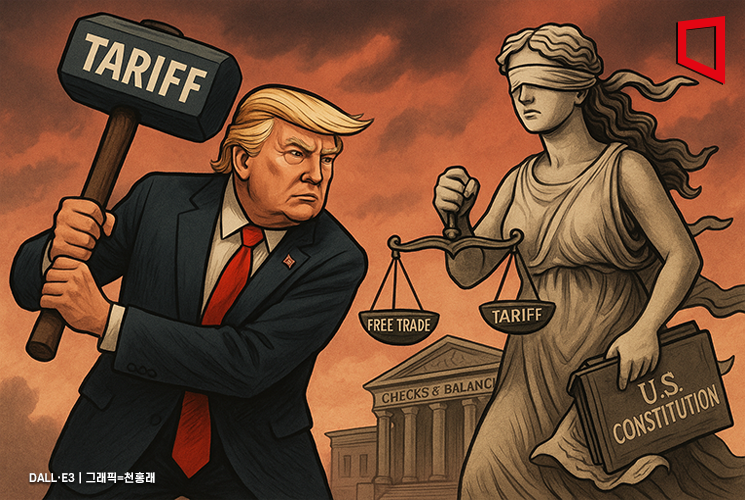
The Trump administration is embroiled in legal disputes over most of the tariffs, which were imposed based on the International Emergency Economic Powers Act (IEEPA). However, the tariffs on steel and aluminum were implemented under different legal authority and are therefore not affected by these legal disputes.
The New York Times (NYT) reported, "President Lee will face difficult challenges immediately after taking office," adding, "With the economic recession dragging on, he must begin tariff negotiations with President Trump. In particular, the Trump administration is imposing high retaliatory tariffs on Korean steel and automobiles and is even considering expanding the 25% 'reciprocal tariff.'"
© The Asia Business Daily(www.asiae.co.kr). All rights reserved.
![Clutching a Stolen Dior Bag, Saying "I Hate Being Poor but Real"... The Grotesque Con of a "Human Knockoff" [Slate]](https://cwcontent.asiae.co.kr/asiaresize/183/2026021902243444107_1771435474.jpg)
















