KCCI: "Leadership Needed to Unite National Capabilities"
KEF: "Revitalize Corporate Vitality Through Regulatory Reform and Labor Flexibility"
FKI: "Urgent Need to Rebuild K-Manufacturing and Foster Advanced Industries"
Korea Federation of SMEs: "Industrial Innovation with AI Integration and National Interest-Centered Trade Diplomacy Needed"
KITA: "Minimize Trade Risks... Expand Investment in Advanced Technologies"
On June 4, the five major economic organizations simultaneously issued statements urging President Lee Jaemyung to open a path for economic resurgence amid complex domestic and international crises. At a time when the country faces overlapping structural challenges?including entrenched low growth, sluggish domestic demand, supply chain crises, and the spread of protectionism?each organization identified a shift toward pragmatic policies, the strengthening of trade diplomacy, and regulatory reform as common priorities.
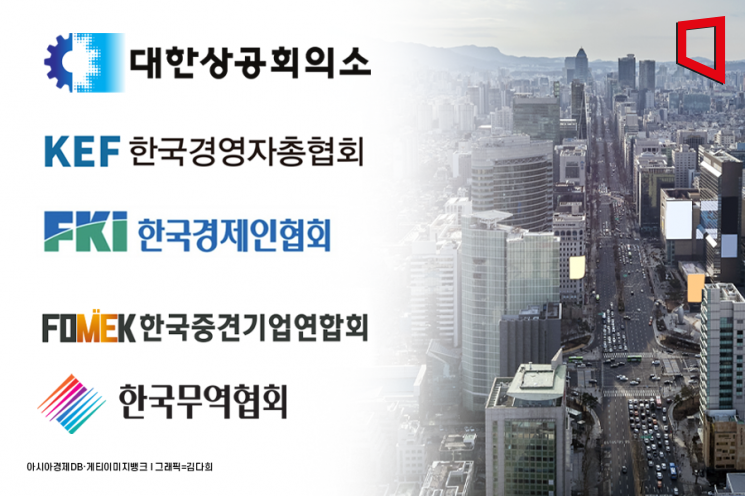
The Korea Chamber of Commerce and Industry called for leadership that unites national capabilities to drive economic resurgence. Emphasizing the need for an all-out national response amid protectionism and technological hegemony competition, the chamber also pledged that the business community would support the new administration’s successful governance.
The Korea Employers Federation stressed the importance of invigorating the private sector to respond to global supply chain restructuring and the artificial intelligence (AI) revolution. The federation specifically requested bold improvements to regulations that hinder corporate growth, the creation of a flexible labor market, and the establishment of stable labor-management relations. It also called for national and social integration.
The Federation of Korean Industries highlighted the necessity of shifting to pragmatic, results-oriented policies. In its statement, it said that revitalizing growth engines through the development of advanced industries and the rebuilding of “K-manufacturing” is urgent, adding that stabilizing livelihoods and restoring industrial competitiveness are key to overcoming the crisis.
The Korea Federation of SMEs identified thorough national interest-centered diplomacy, restoring export competitiveness, and boosting domestic demand as its top priorities. It specifically called for comprehensive advancement across new industries, including the integration of manufacturing and AI, as well as ICT, bio, and content sectors. The federation also urged a shift in perceptions regarding corporate regulation and the reform of systems to match those of advanced economies.
The Korea International Trade Association set proactive responses to trade risks as its highest priority. The association stated that the government should mobilize all trade diplomacy capabilities across ministries to pursue a pragmatic negotiation strategy. It also emphasized the need to eliminate regulations, expand investment in advanced industries, and support the training of key talent in order to revitalize the export sector as a whole.
The five major economic organizations commonly identified pragmatism, the strengthening of trade capabilities, and regulatory reform as key economic tasks for the new administration. They agreed that only by creating conditions that fully harness the capabilities of businesses and the private sector can the Lee Jaemyung administration lay the groundwork for a new leap forward in the economy.
© The Asia Business Daily(www.asiae.co.kr). All rights reserved.
![Clutching a Stolen Dior Bag, Saying "I Hate Being Poor but Real"... The Grotesque Con of a "Human Knockoff" [Slate]](https://cwcontent.asiae.co.kr/asiaresize/183/2026021902243444107_1771435474.jpg)















