Aiming for "Zero Poverty" and Appointing a "Vice Minister for Loneliness"
No Clear Direction Yet for Pension Reform
Fiscal Solutions Remain a Challenge
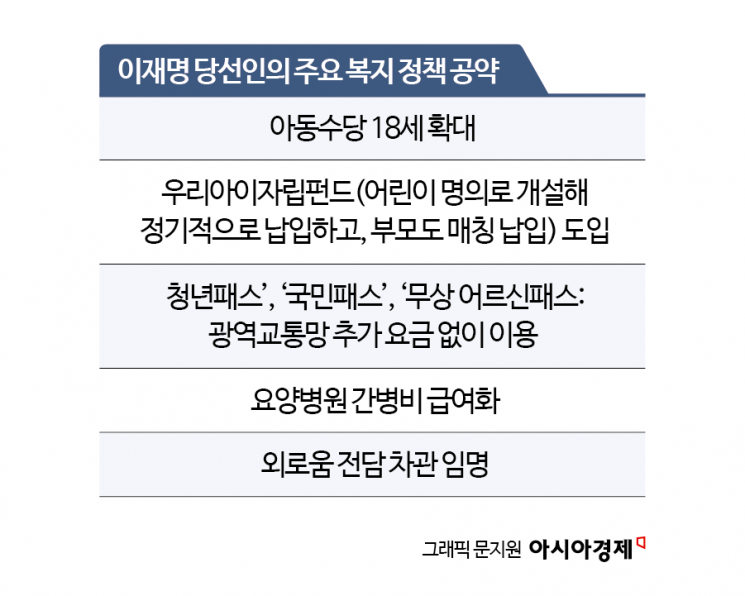
As of June 4, President Lee’s policy pledges include these welfare expansion measures. President Lee has proposed strengthening income security throughout the entire life cycle, including child allowances, youth savings, and reductions in caregiving expenses.
Cash support for children and adolescents will be greatly expanded. The current child allowance, which provides KRW 100,000 per month in cash to all children under the age of 8, will be gradually expanded to cover those up to 18 years old. However, since this expansion is premised on a gradual approach, it is expected that the target age group will be increased in stages. According to the National Assembly Budget Office, expanding the child allowance from those under 8 to those under 18 would require approximately KRW 35.5 trillion over five years from 2026 to 2030.
The “Our Children’s Independence Fund” will also be introduced to support children’s growth. Under this system, the government will open a fund in the child’s name and make regular contributions, with parents able to contribute through a matching system. Withdrawals will be prohibited until adulthood, and the accumulated funds may only be used for educational expenses and independence funds. Financial income generated by the fund will receive tax benefits. To address the low birth rate, support for childbirth will also be strengthened. This includes loans for newlywed couples to support marriage and childbirth, as well as differentiated principal and interest reductions based on the number of children born.
The government will also seek to expand resources for old-age security. The aim is to reduce the private caregiving burden, currently estimated to reach KRW 10 trillion annually, and improve the quality of caregiving services. However, given the already tight financial situation of the national health insurance, questions have been raised about the feasibility of these plans. President Lee believes that resources can be secured by controlling unnecessary expenditures such as medical shopping, but experts argue that improving fiscal efficiency alone will not be sufficient.
Easing the eligibility criteria for basic living allowances and abolishing the means test for family support obligations are also key policies to address elderly poverty. The goal is to strengthen the final social safety net so that no one falls below the poverty line under any circumstances, ultimately realizing a “zero poverty society.” This involves adjusting the criteria for the National Basic Livelihood Security System to reduce welfare blind spots. In the area of transportation welfare, the administration will introduce the “Youth Pass,” “National Pass,” and “Free Senior Pass.” These passes will allow unlimited use of metropolitan transportation networks without additional distance-based charges for a fixed fee.
Specific plans for pension reform have not been presented. Proposals include improving the current system, which reduces national pension payments for working seniors, and expanding credits or premium support for low-income groups. However, the reduction of pension payments for working seniors only applies when the recipient’s monthly income exceeds KRW 4.11 million, so this issue is considered somewhat peripheral in the context of pension reform. President Lee has not yet presented concrete solutions for fiscal sustainability beyond the level of the national pension reform implemented in March. The policy platform includes only general statements about restructuring the relationships among the National Pension, Retirement Pension, and Basic Pension, and establishing a multi-layered old-age income security system.
An original policy to address “loneliness” will also be pursued. President Lee has announced the appointment of a vice minister dedicated to loneliness response policies, with plans to develop tailored policies for key groups such as adolescents, young adults, middle-aged people, seniors, and single-person households. The approach includes various measures to improve quality of life, such as alleviating social isolation, providing mental health counseling, distributing emergency response devices, and expanding infrastructure for independent living. However, as with other policies, only broad directions have been presented, with no specific plans yet for which ministries will be responsible for implementation.
© The Asia Business Daily(www.asiae.co.kr). All rights reserved.
![Clutching a Stolen Dior Bag, Saying "I Hate Being Poor but Real"... The Grotesque Con of a "Human Knockoff" [Slate]](https://cwcontent.asiae.co.kr/asiaresize/183/2026021902243444107_1771435474.jpg)















