HKUST Reports Dozens of Inquiries from Harvard International Students
Hong Kong Authorities Encourage Talent Recruitment Efforts
Xi Jinping Leadership's Strategy: Bringing U.S. Talent Back, Preventing Brain Drain from China
As the Donald Trump administration intensifies pressure on Harvard University, universities in Hong Kong are announcing strategies to attract international students in succession, aiming to secure top talent. According to Japan’s Nikkei newspaper on June 2, this move is underpinned by a strategy from Xi Jinping’s leadership to draw talent from the United States and prevent brain drain from mainland China.
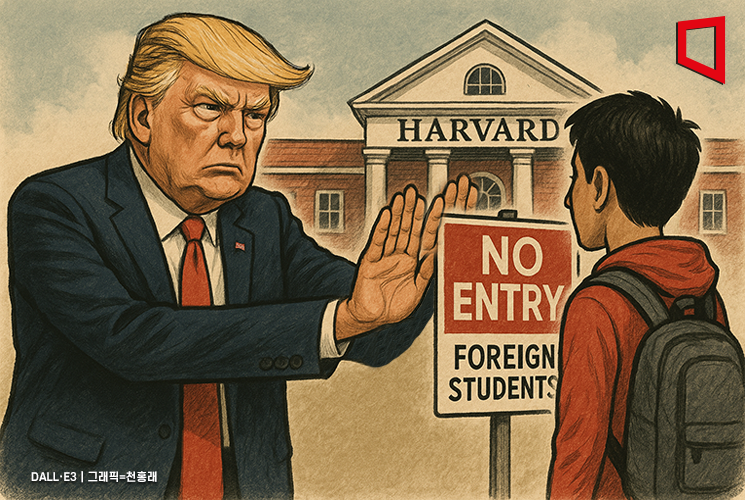
According to Nikkei, the Hong Kong University of Science and Technology (HKUST), a national university in Hong Kong, has already received inquiries from dozens of international students at Harvard. In particular, students and prospective students from mainland China and Hong Kong have been reaching out to express concerns about “anxiety over possible interruption of their studies.”
On May 22 (local time), the Trump administration notified Harvard that its Student and Exchange Visitor Program (SEVP) certification would be revoked. The following day, it announced plans to block the registration of foreign students. In particular, it stated that it would cancel the visas of Chinese students.
After these announcements, HKUST declared that it would “accept international students unconditionally,” and would also provide support for transfer procedures and student life. The university also stated that it would accept outstanding students studying not only at Harvard but also at other universities in the United States. This move is interpreted as a response to the possibility that the Trump administration’s actions against Harvard could spread to other schools in the U.S.
The University of Hong Kong (HKU) also sent emails to Harvard students and researchers, offering preferential treatment such as scholarships and credit recognition for those who transfer. Meanwhile, Hong Kong Polytechnic University (PolyU) plans to form a special team to provide scholarships and facilitate transfer procedures.
The Hong Kong authorities are also encouraging universities to actively recruit international students. John Lee, Chief Executive of the Hong Kong government, stated on May 27 that “we will do our utmost to support students facing discrimination and unfair treatment in the United States so that they can come to Hong Kong to study,” and added that the government is also considering expanding the quota for international students.
According to Harvard, of the total 10,158 international students and foreign researchers, 2,126 are Chinese nationals, making them the largest group. As soon as the Trump administration announced measures targeting Chinese students, Chinese Foreign Ministry spokesperson Mao Ning criticized the move, emphasizing that “the legitimate rights and interests of Chinese students and scholars overseas will be resolutely protected.”
Nikkei pointed out that Hong Kong authorities’ active efforts to attract and support international students go beyond simply protecting Chinese students. As the technological hegemony competition between the U.S. and China intensifies, Xi Jinping’s leadership is placing great emphasis on securing top talent under a policy of “self-reliance and self-strengthening.” The return of top overseas talent is one of Xi Jinping’s key priorities, and Hong Kong is playing a leading role in absorbing such talent. Considering that outstanding minds are leaving mainland China due to concerns over shrinking academic freedom, the Trump administration’s tightening of U.S. universities is described as a golden opportunity for China to attract talent.
Nikkei stated, “From China’s perspective, the turmoil in the United States serves as an opportunity to stem brain drain and bring talent back,” and assessed that universities in Hong Kong are particularly well-positioned to accommodate talented individuals from leading U.S. universities. This is attributed to the English-based education and research system established during the British colonial era, as well as the presence of many globally renowned universities.
According to the 2025 World University Rankings published by the British education magazine Times Higher Education (THE), HKU ranked 35th, the Chinese University of Hong Kong ranked 44th, and HKUST ranked 66th, with a total of five Hong Kong universities in the top 100. In contrast, Japan had only two universities in the top 100: the University of Tokyo and Kyoto University.
However, there are concerns that the unique political and social climate of China, which has led to a contraction of academic freedom, may pose an obstacle to attracting talent. June 30 marks the fifth anniversary of the implementation of the Hong Kong National Security Law, which strengthened social control. Citing a local university professor, Nikkei reported that “research topics involving criticism of or raising issues about China are increasingly difficult to get approved by university authorities.”
© The Asia Business Daily(www.asiae.co.kr). All rights reserved.
![Clutching a Stolen Dior Bag, Saying "I Hate Being Poor but Real"... The Grotesque Con of a "Human Knockoff" [Slate]](https://cwcontent.asiae.co.kr/asiaresize/183/2026021902243444107_1771435474.jpg)















