The Spirit of Volunteer Soldiers Passed Down Through Three Generations Becomes the "Soul of Uiseong"
Uiseong, the Land of Righteousness, Inheriting the DNA of Loyalty
In commemoration of 'Volunteer Army Day' (June 1), which honors the noble spirit of the volunteer soldiers who rose up and risked their lives to defend the nation in times of crisis, the loyalty of the father and son volunteer soldiers from Uiseong, Gyeongbuk?Kwon Huisun and Kwon Sugyeong?is being revisited.
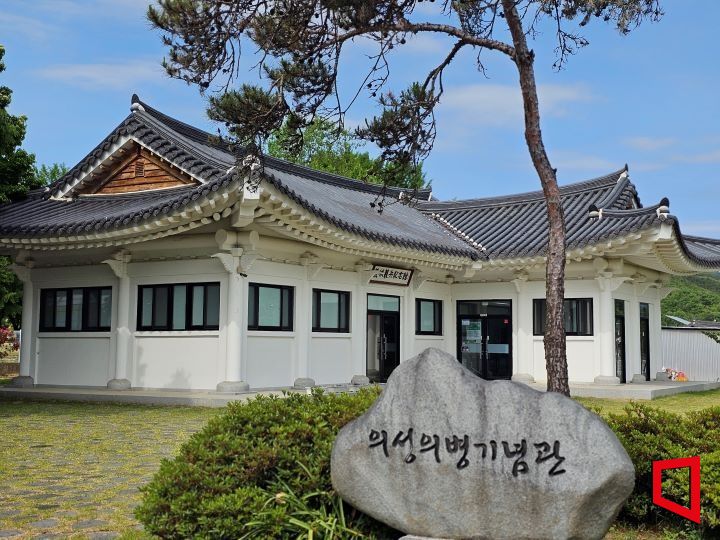 A view of the Uiseong Volunteer Army Memorial Hall in Sachonri, Jeomgokmyeon, Uiseong County, Gyeongbuk. This place is the birthplace of the volunteer army that resisted Japan's invasion ambitions on the continent 120 years ago. Photo by Byunggeon Kwon
The Uiseong Volunteer Army Memorial Hall, located in Sachonri, Jeomgokmyeon, Uiseong County, Gyeongbuk, served as the central base for volunteer soldiers who fought against the Japanese invasion more than 120 years ago. It is both a living classroom for the spirit of self-sacrifice for the nation and a symbolic space where descendants reflect on the meaning of loyalty.
'Volunteer Army Day' is a national memorial day designated by converting April 22 of the lunar calendar, the date when General Gwak Jaewoo first raised a volunteer army during the Imjin War in 1592, to the solar calendar. In 2008, bereaved families and organizations of volunteer soldiers across the country petitioned the National Assembly to establish the memorial day, and in 2010, it was officially designated as June 1 after passing the plenary session of the National Assembly.
◆ The father and son volunteers who saved the nation... "A loyalist accomplished in both civil and military affairs"
Kwon Huisun (1548?1598), a volunteer soldier, was born in Sachonri, Jeomgokmyeon, Uiseong County, Gyeongbuk, in the third year of King Myeongjong's reign. From a young age, he excelled in both literary and martial arts, and was well-versed in astronomy, geography, military science, and mathematics. He passed the local civil service examination three times and succeeded in the military service examination in the 16th year of King Seonjo's reign.
After serving as Seonjeongwan, Hullyeonwon Cheomjeong, and Naegeumwi Byolsi, he was appointed as the commander of Uiseong during the outbreak of the Imjin War in 1592, at a time when local magistrates were abandoning their posts and fleeing. He was recommended by Kim Reuk, a household steward. Kwon Huisun distinguished himself in battle, commanding troops alongside Gyeongsang Left Army Commander Seong Yunmun, and was recognized for Uiseong County's significant contribution to the war effort.
Even after being struck by a stray bullet during combat, he concealed his injury to encourage his soldiers, but ultimately succumbed to his wounds in 1598 at the age of 51. His achievements are recorded in the "Dongsa" (Eastern History), and his tomb is located in Jidong, Yoonamri, Jeomgokmyeon, Uiseong County, Gyeongbuk.
◆ Uprising again during the Jeongmyo and Byeongja Wars... The resistance of his son, Kwon Sugyeong
His son, Kwon Sugyeong (1584?1659), was born in Sachonri, Jeomgokmyeon, Uiseong County, Gyeongbuk, in the 17th year of King Seonjo's reign. His courtesy name was Jajeong, and his pen names were Jaraktang and Sajedang. He served as the leader of the volunteer army in Gyeongsang Left Province during the Jeongmyo and Byeongja Wars.
Kwon Sugyeong hailed from the Bujeonggong branch of the Andong Kwon clan, a family renowned for loyalty, descending from his grandfather Kwon Museong and father Kwon Huisun, and was the 24th-generation descendant of Kwon Haeng, a Grand Master of Goryeo. Upholding the spirit of the Imjin War, he reorganized the volunteer army and led the resistance once again, earning respect as a leader of volunteer soldiers in the late Joseon period.
◆ Uiseong, the "Land of Righteousness"... A tradition of loyalty passed down through generations
Uiseong, Gyeongbuk, is one of only four places in the country with the character 'Ui' (righteousness) in its name and has long been renowned as a land of loyalty. Descendants of the Bujeonggong branch of the Andong Kwon clan have settled in the Jeomgok and Oksan areas, forming family communities and carrying on the clan's spirit.
In particular, in Seoamri, Jeomgok, a monument inscribed by former President Kim Youngsam, named "Sawadang," stands as a symbol of the volunteer army spirit. The volunteer activities of Kwon Huisun during the Imjin War, Kwon Sugyeong during the Byeongja War, and Kwon Dujung (1678?1731) during the Musin Rebellion, spanning three generations, remain a representative legacy of loyalty in Uiseong to this day.
◆ Names that must not be forgotten... The significance of Volunteer Army Day
Volunteer Army Day is not merely a commemorative day; it is a day to remember and carry forward the spirit of those who gave themselves for the nation. The noble sacrifices of the volunteer soldiers, who took up arms on their own initiative in times of national crisis, continue to resonate deeply in our society today.
The spirit of righteousness, defended with blood and sweat a century ago, now asks us: What is it that we must protect?
As we pass through Sunguimun, we ask ourselves again: What is 'righteousness'?
© The Asia Business Daily(www.asiae.co.kr). All rights reserved.
![Clutching a Stolen Dior Bag, Saying "I Hate Being Poor but Real"... The Grotesque Con of a "Human Knockoff" [Slate]](https://cwcontent.asiae.co.kr/asiaresize/183/2026021902243444107_1771435474.jpg)















