Adjusting the Pace of Mortgage Lending and Revitalizing Housing Pensions
Rethinking Guarantee Methods for Jeonse and Project Financing That Encourage "Moral Hazard"
"Geographical Segmentation" Also a Risk... Need to Find Countermeasures
Korea Housing Finance Corporation Hosts 2025 Housing Finance Conference
As Korea's housing finance sector faces new challenges such as a high household debt ratio and demographic shifts caused by low birth rates and an aging population, there are growing calls for an urgent redefinition of its role to ensure sustainability. Experts argue that the current structure, which is heavily focused on home purchases, should be reformed to strengthen the inclusive role of housing finance through more segmented policy loans and the expansion of housing pensions. There were also claims that the guarantee methods for Jeonse and project financing (PF), which may encourage moral hazard, need to be reassessed.
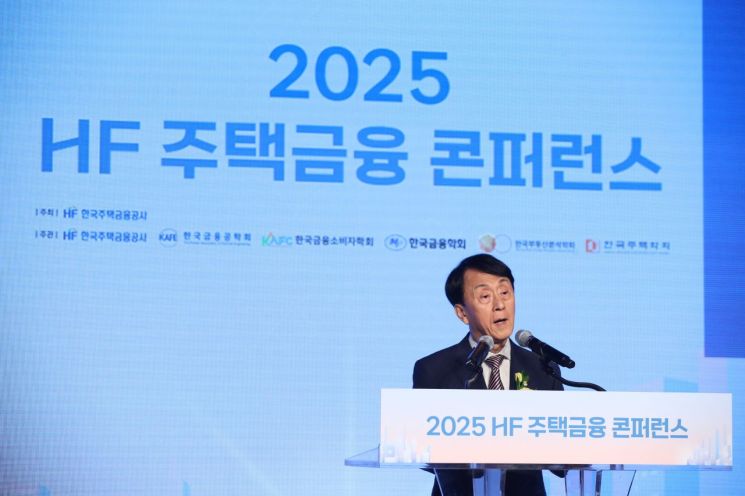 On the 30th of last month, Kim Kyunghwan, President of the Korea Housing Finance Corporation, is speaking at the '2025 HF Housing Finance Conference' held at the Bankers Hall in Myeongdong, Seoul. Provided by Korea Housing Finance Corporation.
According to proposals presented at the '2025 HF Housing Finance Conference' hosted by the Korea Housing Finance Corporation on June 1, participants agreed that Korea's housing finance system is currently facing a comprehensive crisis.
Nam Youngwoo, President of the Korea Housing Association, stated, "Until now, Korea's housing finance has played a role in expanding housing supply during periods of housing stock shortages and stabilizing the market by maintaining effective demand for housing during difficult times such as the foreign exchange crisis and the financial crisis." He added, "However, considering the increasingly aging population structure, the difficulties in raising funds for the housing and urban fund responsible for affordable housing finance, and the issue of PF insolvency, it is now time for changes in housing finance."
Kwak Noseon, President of the Korea Finance Association, also pointed out, "Social changes such as low birth rates and an aging population are changing the structure of housing demand, and these changes suggest that it is time to redefine the role of housing finance." He added, "The household debt problem, which has become a potential risk factor for our economy, is also a major issue that must be addressed."
According to statistics presented at the conference, the proportion of single-person households has now increased to 35.5%. Home buying patterns have changed, and demand for monthly rentals has also risen. High household debt remains a problem. The household debt-to-disposable income ratio stands at 187%, and the ratio to gross domestic product (GDP) is 92%, indicating oversaturation. Since 2022, demand for loans for home purchases has continued to increase, with this proportion rising from 56% in 2021 to 61.9% as of the third quarter of last year.
Cho Hoon, a professor at the KAIST College of Business, who participated in the conference discussion, pointed out that the rate of household debt growth outpacing income growth could lead to a long-term economic downturn. He explained that reduced consumption due to debt repayment could result in sluggish corporate investment, which in turn could create a vicious cycle of declining household income and weak consumption.
Given the risks associated with rising household debt and declining demand due to demographic changes, participants emphasized that the role of housing finance, which has so far been mainly used to leverage home purchases, must be redefined.
They stressed the need to moderate the pace of household lending, such as mortgage loans, to prevent a rapid increase in household debt, while also finding new roles such as revitalizing housing pensions. Professor Cho Hoon suggested, "A comprehensive policy framework should be established so that the scale of household debt can fluctuate in line with the pace of economic and financial development, without undermining economic growth and financial stability." He specifically proposed reducing exceptions to the debt service ratio (DSR), applying differentiated interest rates based on loan-to-value (LTV) ratios, and imposing additional interest rates on lump-sum repayment methods to control housing finance demand.
President Nam Youngwoo emphasized, "We need to expand housing pensions and design housing finance products tailored to different stages of the life cycle." He added, "Given the difficulties in raising funds for affordable housing finance products such as Bogeumjari Loan and qualified loans, there should be a selective and focused approach to the scope of support." He also stressed the need to reduce the role of public finance in areas that can be handled by the private financial sector. Proposals were also made to expand monthly rental loans, segment support recipients, and provide customized differentiated benefits, thereby redesigning the system to focus on actual demand.
Professor Cho Hoon pointed out, "We also need to devise ways to reduce the growing dependence on policy institution guarantees for Jeonse and PF." He noted, "The recent surge in subrogation payments for Jeonse deposit return guarantees and the high dependence on policy institution guarantees in real estate PF can lead to moral hazard and slow the enhancement of expertise in project feasibility assessment."
In particular, participants agreed that revitalizing housing pensions should be a key future role for housing finance, as it could not only address social issues such as elderly poverty but also become a new growth engine for the sector amid crisis. The conference also discussed ways to address the imbalance in housing pension enrollment, which is concentrated in the Seoul metropolitan area.
Kim Kwangwook, Head of the Policy Research Team at the Korea Housing Finance Corporation's Housing Finance Research Institute, said, "Regional imbalances are caused by differences in housing prices, financial accessibility, and awareness of the system." He emphasized, "We should expand preferential products for subscribers in regional metropolitan and small cities and introduce a differentiated monthly payment system to encourage enrollment." He added, "To address concerns about reverse discrimination in the Seoul metropolitan area, it is also necessary to adopt differentiated strategies that respond to individual needs, such as easing housing price criteria and expanding the allowance for individual withdrawals."
© The Asia Business Daily(www.asiae.co.kr). All rights reserved.
![Clutching a Stolen Dior Bag, Saying "I Hate Being Poor but Real"... The Grotesque Con of a "Human Knockoff" [Slate]](https://cwcontent.asiae.co.kr/asiaresize/183/2026021902243444107_1771435474.jpg)















