Korea Pharmaceutical and Bio-Pharma Association Holds 'Strengthening Overseas Expansion Capabilities' Webinar
South Korea's Pharmaceutical Exports to the U.S. Remain Relatively Small
MFN Implementation Expected to Have Direct and Indirect Impact on Domestic Drug Prices
There have been calls for strategies to minimize external risks, as the Trump administration's policy of increasing tariffs on pharmaceuticals is expected to inevitably impact South Korea's pharmaceutical and bio exports to some extent. If the United States significantly lowers the prices of prescription drugs through the 'Most Favored Nation (MFN)' drug pricing executive order, it is anticipated that South Korea's drug pricing policies will also be affected in succession.
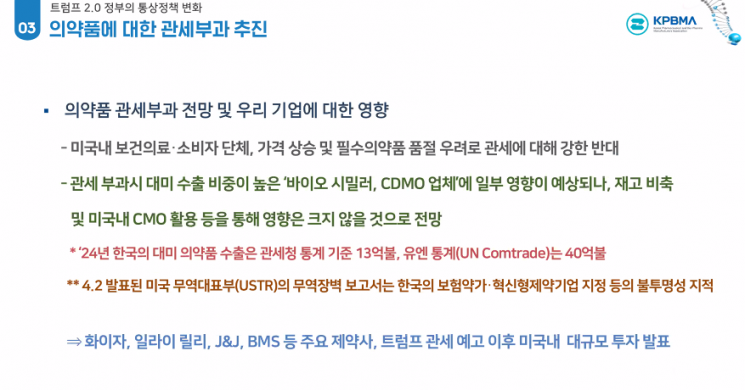
The Korea Pharmaceutical and Bio-Pharma Manufacturers Association held an online seminar on the 30th under the theme of 'Strengthening Overseas Expansion Capabilities in the Pharmaceutical and Bio Industry,' where it presented on current issues such as 'Changes in Trade Policy under Trump 2.0' and 'Changes in U.S. Drug Pricing Policy.'
Lee Hyunwoo, Executive Director of the Korea Pharmaceutical and Bio-Pharma Manufacturers Association, stated, "Since President Trump took office, the 'America First' policy has been fully implemented in the pharmaceutical sector." He explained, "If pharmaceutical tariffs become a reality, exports to the United States by our companies in the biosimilar and CDMO (Contract Development and Manufacturing Organization) sectors will inevitably be affected to some extent."
However, he predicted that the impact on domestic bio companies would be limited. Lee cited Korea Customs Service statistics showing that last year, South Korea's pharmaceutical exports to the United States accounted for only about 1% of the total U.S. pharmaceutical imports, and pointed out, "Our country's pharmaceutical exports to the United States are relatively low."
Given the growing internal and external uncertainties, he also urged the bio industry to engage in communication and cooperation. He said, "Domestically, the government, the association, and companies need to maintain close communication and cooperation," and added, "It is also necessary to strengthen networks within the United States to minimize external risks and protect market access."
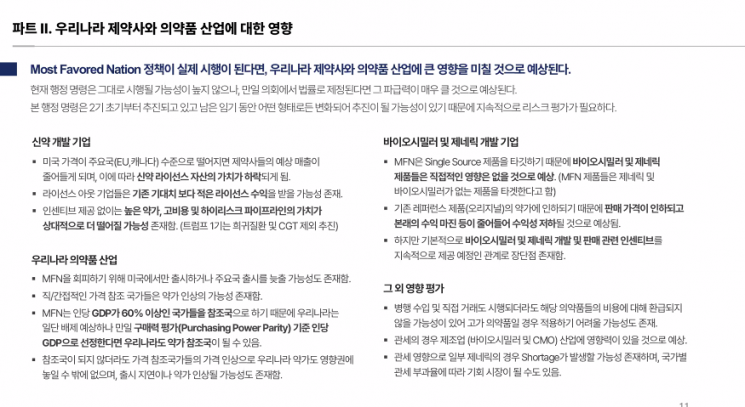
An Sejin, CEO of Arcadia, predicted, "It is unlikely that the MFN drug price reduction executive order will be implemented as it is." Although the MFN was announced in the form of an executive order with binding legal force on federal administrative agencies, An explained that if procedural flaws are recognized through lawsuits, there is a high possibility that its enforcement will be suspended. During the first Trump administration, a court ruling found procedural flaws in the MFN, resulting in the policy being scrapped, and when the Biden administration took office, the MFN system was officially abolished.
He also stated, "In the United States, the list price of drugs is significantly higher than the actual net price," and warned, "If the MFN causes a uniform reduction in list prices, there will be a structural problem in which all pharmaceutical-related businesses linked to these prices will be impacted."
However, if the MFN executive order is implemented, the domestic pharmaceutical industry will be significantly affected, and for new drug development companies, expected revenues will decrease, causing the value of new drug licenses to plummet. He predicted that the impact on biosimilar and generic drug development companies would not be significant, as the MFN itself targets products with only one brand, that is, 'single-source' products. An analyzed, "In the case of biosimilars and generics, they are 'multi-source' products, so they will not be directly affected."
There are also concerns that the launch of new drugs in the domestic pharmaceutical market may be delayed. He said, "If the MFN is applied, global pharmaceutical companies may delay launching products in major countries to avoid it," and added, "There is also the possibility of direct or indirect drug price increases."
Regardless of whether the drug price reduction executive order is implemented, he also advised that vigilance regarding the Trump administration's tariff and trade policies should not be relaxed. An emphasized, "Although the likelihood of the MFN being implemented is low, if it is legislated by Congress, its impact will be enormous," and stressed, "Ongoing risk assessment is necessary for domestic pharmaceutical companies and the pharmaceutical industry."
© The Asia Business Daily(www.asiae.co.kr). All rights reserved.
![Clutching a Stolen Dior Bag, Saying "I Hate Being Poor but Real"... The Grotesque Con of a "Human Knockoff" [Slate]](https://cwcontent.asiae.co.kr/asiaresize/183/2026021902243444107_1771435474.jpg)
















