"Considering the 1974 Trade Act"
Reusing Strategies from Trump's First Term
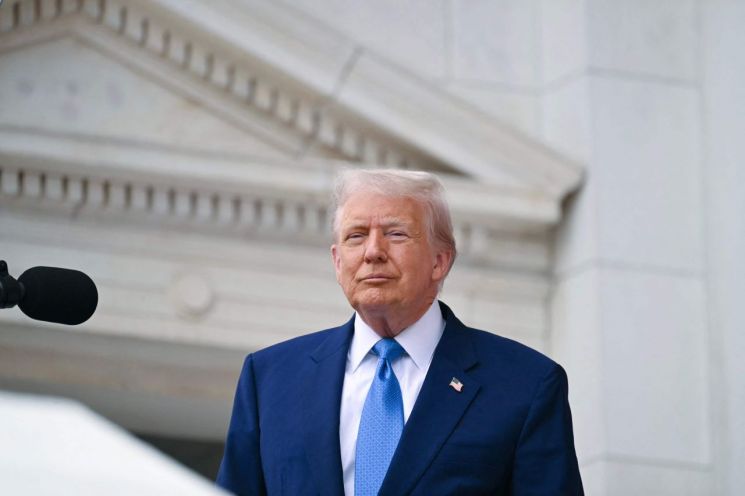
After a U.S. federal court blocked the "reciprocal tariffs" imposed by President Donald Trump on "Liberation Day" in April, citing insufficient legal grounds, it has been reported that his aides are considering using the 1974 Trade Act as part of a "Plan B."
WSJ: "Weighing Several Options"
The Wall Street Journal (WSJ) reported on the 29th (local time), citing multiple sources, that "U.S. officials are weighing several options in preparation for a situation where they need to find new legal authority to enable President Trump's high tariffs."
Previously, on the 28th, the U.S. Court of International Trade (CIT) issued a ruling that invalidated and prohibited the enforcement of the reciprocal tariffs imposed by President Trump on global trading partners under the International Emergency Economic Powers Act (IEEPA). The court found that the tariffs were actually "a response to trade imbalances," which falls under the narrower international balance-of-payments authority stipulated in Section 122 of the 1974 Trade Act. However, on the same day, the federal appeals court ordered a temporary suspension of the ruling while the appeal is under review.
The alternatives being considered by the Trump administration involve sequentially applying Sections 122 and 301 of the 1974 Trade Act. Section 122 allows for tariffs of up to 15% to be imposed for 150 days to address "large and serious U.S. balance of payments deficits." The administration's plan is to use this as a basis to buy time by imposing tariffs, and then apply Section 301 of the same law to impose individual tariffs on trading partners.
Section 301 authorizes broad retaliatory measures, including tariffs, against trading partners that engage in unfair and discriminatory trade practices against the United States. However, its implementation requires a period of notification and public comment. Section 301 was used as the basis for tariffs on China during the first Trump administration.
Trump Aides Maintain Composure... Global IBs: "Limited Impact"
President Trump's close aides are maintaining a calm public demeanor, saying that nothing will change despite the court ruling. Peter Navarro, White House trade adviser, said in an interview with Bloomberg TV, "We still have a strong legal basis," and emphasized, "We are confident in IEEPA, but even if that doesn't work, we have other options."
Kevin Hassett, Chairman of the National Economic Council (NEC), also expressed confidence in an interview with Fox Business, saying, "It is not yet time to implement alternative measures, and we can win on appeal." He added, "There are procedures approved by past administrations or currently in place, but for now, we will focus on the appeal."
The alternative mentioned by Navarro is the use of Section 122 of the 1974 Trade Act. However, this can only be applied temporarily for up to 15% tariffs and for 150 days, making its scope much narrower. He explained, "The reason we didn't use this measure from the start is because the duration is short."
Navarro also hinted at the possibility of using the 1930 Smoot-Hawley Tariff Act, which allows for tariffs on countries that discriminate against the United States. There is also a possibility that "national security" could be used as a basis for expanding tariffs. The WSJ reported, "All the options currently under consideration by the Trump administration were discussed during the first few weeks after the administration took office."
Global investment banks (IBs) such as Morgan Stanley and Goldman Sachs believe that the impact of this ruling on President Trump's policies will be limited. These IBs stated, "The ruling will have a limited impact on the Trump administration's trade negotiations," and added, "Even if IEEPA is blocked, there are various other tariff tools available, so the actual policy effect can be maintained."
Meanwhile, with the federal appeals court suspending the lower court's ruling and ordering a temporary reinstatement of the reciprocal tariffs on this day, the Trump administration has gained some breathing room for now.
© The Asia Business Daily(www.asiae.co.kr). All rights reserved.
![Clutching a Stolen Dior Bag, Saying "I Hate Being Poor but Real"... The Grotesque Con of a "Human Knockoff" [Slate]](https://cwcontent.asiae.co.kr/asiaresize/183/2026021902243444107_1771435474.jpg)















