Atto3 Delivers Over 1,000 Units in Just Six Weeks
Ranks Seventh in Imported Car Sales... Uncertainty Remains for Upcoming Models
GM Korea Faces Exit Rumors... Service Centers and Plant Up for Sale
Heavy U.S. Tariff Burden... Persistent Speculation Despite CEO's Explanation
Amid renewed speculation about GM Korea's potential withdrawal from the country, China's BYD electric vehicle model entered the domestic market and immediately ranked seventh in total imported car sales. This is the result of Chinese automakers actively targeting the domestic market, while the justification for maintaining overseas production bases has weakened due to the United States' strengthened automotive tariff barriers.
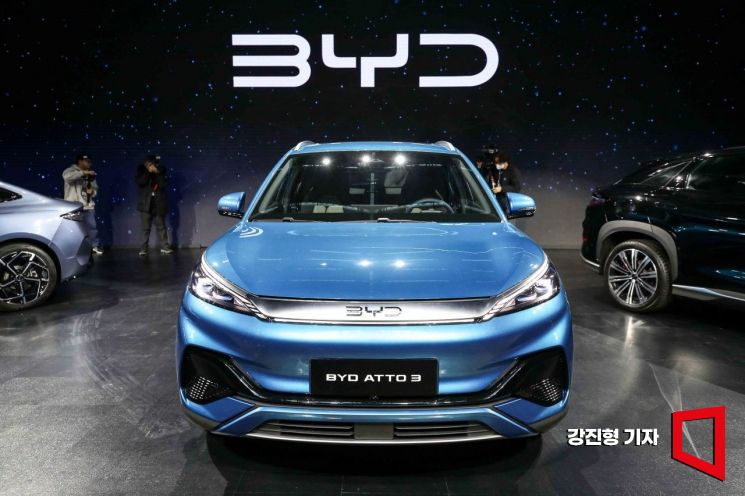
According to industry sources on May 30, BYD delivered more than 1,000 units of its compact electric SUV, the Atto3, just one and a half months after starting customer deliveries. Considering the generally negative perception of Chinese-made vehicles, this figure is seen as significant.
The Atto3 sold 543 units in its first month of release last month, instantly ranking seventh among all individual imported car models sold in Korea. An imported car industry official commented, "It is noteworthy that BYD, a newcomer to the Korean market, delivered more than 1,000 units in less than two months." The Atto3 also took first place among imported electric vehicles, surpassing Tesla's Model Y Long Range.
BYD attributes this success to a combination of price competitiveness and technological prowess. The entry-level trim of the Atto3 is priced at 31.5 million won, and with government subsidies, it can be purchased for under 30 million won. Built on BYD's proprietary e-Platform 3.0 for electric vehicles, the Atto3 reduces overall volume and weight, which enhances performance such as driving range. The Blade Battery installed in the Atto3 uses a cell-to-pack (CTP) structure that lowers the risk of overheating.
However, industry consensus is that it remains to be seen whether strong sales will continue with subsequent models. This is because the rapid pace of deliveries and sales may be temporary, given the long waiting period for the Atto3. The Atto3 was originally scheduled for release in February, but deliveries were delayed due to the late listing of the vehicle in the Ministry of Trade, Industry and Energy's eco-friendly vehicle notice and the delayed confirmation of electric vehicle subsidies by the Ministry of Environment. BYD plans to introduce the mid-size sedan Seal and the mid-size SUV Sea Lion 7 in the second half of the year, and is considering the introduction of other fuel types such as hybrids.
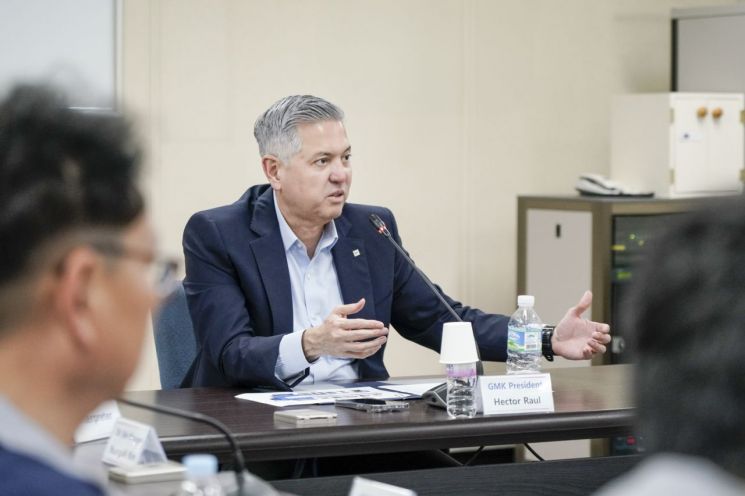 Hector Vizareal, President of GM Korea, visited the Changwon plant of GM Korea on the 15th to encourage employees and engage in on-site management. Photo by GM Korea
In contrast, GM, a representative American automaker, has been caught up in rumors of a potential withdrawal from the Korean market. The company has decided to sell off some assets of its directly operated service centers and the Bupyeong plant, prompting speculation that it may be taking preemptive steps with an exit in mind.
This decision is interpreted as a cost-saving measure in response to the United States imposing a 25% tariff on imported vehicles last month, which has significantly increased the burden on GM. Of GM Korea's sales last year (499,559 units), exports to the United States accounted for 418,782 units, making up 84% of total exports. After the announcement of the new tariffs, GM increased production at the Bupyeong plant by an additional 31,000 units.
However, despite explanations from top management, rumors of withdrawal persist. No new vehicles have been assigned for production yet. Notably, when GM Korea closed its Gunsan plant in 2018, it signed an agreement with the Ministry of Trade, Industry and Energy to maintain operations until 2027, receiving 810 billion won in support from Korea Development Bank. From 2028, GM will be free from this agreement, meaning it will no longer be obligated to maintain domestic plants three years from now.
Hector Vizareal, President of GM Korea, met with the labor union the previous day and stated, "This is an important decision for ensuring sustainability," and emphasized, "It is not for the purpose of withdrawal." Vizareal explained, "This was done for the future of GM Korea, and no employees will lose their jobs."
The industry believes that, in order to completely dispel withdrawal rumors, it is necessary to assign new eco-friendly vehicles for production after 2027, rather than simply increasing production of current models. However, if the U.S. tariffs continue for an extended period and the cost burden becomes unsustainable, there is a possibility that GM may pursue a complete withdrawal. Future renegotiations between GM and the Korean government are expected to be crucial.
© The Asia Business Daily(www.asiae.co.kr). All rights reserved.
![Clutching a Stolen Dior Bag, Saying "I Hate Being Poor but Real"... The Grotesque Con of a "Human Knockoff" [Slate]](https://cwcontent.asiae.co.kr/asiaresize/183/2026021902243444107_1771435474.jpg)
















