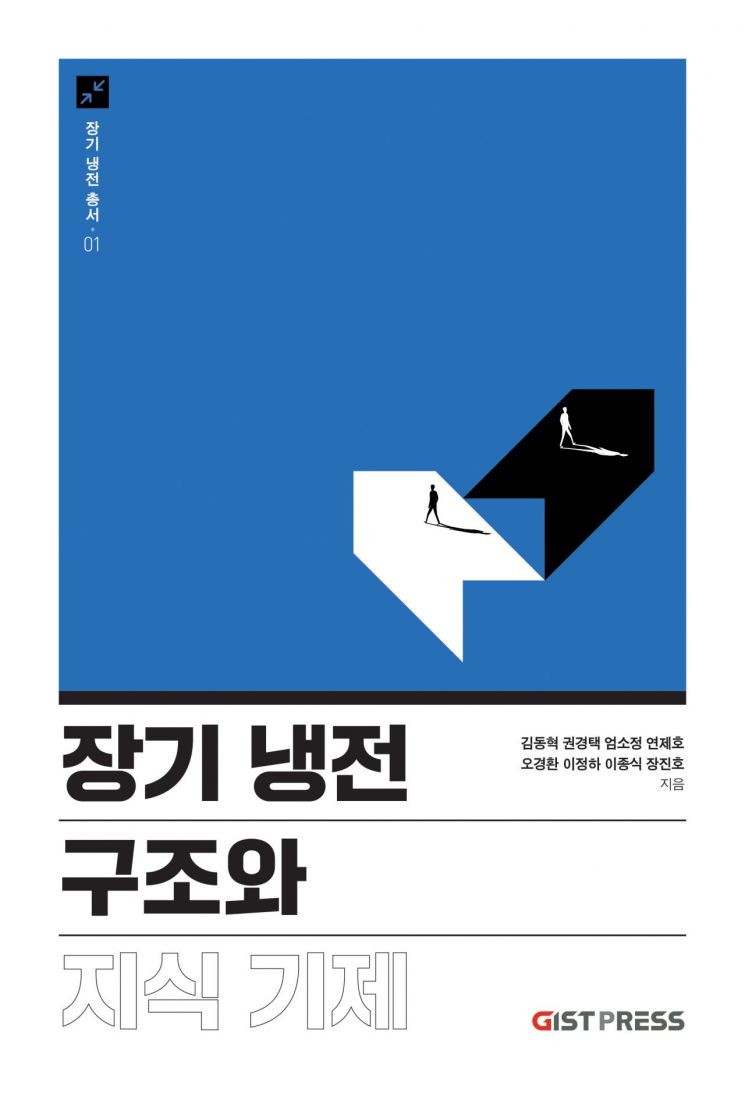
The Gwangju Institute of Science and Technology (GIST) announced on May 30 that the Center for Interdisciplinary Education and Research (CIER) has published the first volume of the "Long Cold War" series, titled "The Structure and Knowledge Mechanisms of the Long Cold War," through the university press, GIST PRESS.
The "Long Cold War" series compiles the main outcomes of the "Study on the Structure of the Long Cold War: Focusing on Knowledge, Emotions, and Life" project, which CIER conducted as part of the Humanities and Social Sciences Research Institute Support Program of the National Research Foundation of Korea. The series presents interdisciplinary research results that analyze the Cold War system not simply as an ideological conflict or a political event of the past, but as a long-term and structural phenomenon deeply rooted in the entire system of knowledge.
The first result of the project, Volume 1 of the "Long Cold War" series, "The Structure and Knowledge Mechanisms of the Long Cold War," examines the operation of "knowledge" that justified and sustained the Cold War system through various historical examples and analyzes how the Cold War became internalized as a knowledge structure in everyday life. The book consists of a total of eight chapters.
Chapter 1, written by researcher Yeon Jeho (GIST), interprets the process by which neoclassical economics combined with modernity to become the mainstream theory, through the perspectives of Veblen and Marxist theory. Chapter 2, by Professor Oh Kyunghwan (Sungshin Women’s University), reveals that development economics during the Cold War was a political and knowledge system formed amid the competition between the two blocs. In Chapter 3, Professor Kim Donghyuk (GIST) analyzes the process by which the Soviet planned economy shifted toward a focus on mathematical economics, while Chapter 4, by Professor Jang Jin Ho (GIST), explores the United States’ strategy for establishing a liberal international order and securing economic hegemony.
The lead author of the series, Professor Kim Donghyuk, is a researcher specializing in modern Russian history, the history of Soviet economics, and economic history. He is currently an associate professor at the School of Humanities and Social Sciences at GIST and serves as director of CIER.
Professor Kim’s research focuses on the rise of global neoclassical economics during the Cold War, the spread of influence of Soviet mathematical economics, and issues related to Soviet foreign trade and the world capitalist system during the Cold War.
Professor Kim stated, "With this series, we aimed to highlight that the Cold War is not merely a political conflict of the past, but a legacy of knowledge structures deeply embedded throughout society to this day. Through various examples such as Soviet economics, the United States’ hegemony strategy, and China’s science policy, we seek to elucidate how the Cold War functioned as 'knowledge.'"
© The Asia Business Daily(www.asiae.co.kr). All rights reserved.
![Clutching a Stolen Dior Bag, Saying "I Hate Being Poor but Real"... The Grotesque Con of a "Human Knockoff" [Slate]](https://cwcontent.asiae.co.kr/asiaresize/183/2026021902243444107_1771435474.jpg)















