Restoration to Continue Until June 2026
Restricted Public Access to the Area
Heungbokjeon Hall at Gyeongbokgung Palace, where King Gojong of the Joseon Dynasty received foreign envoys, will be restored to its original appearance.
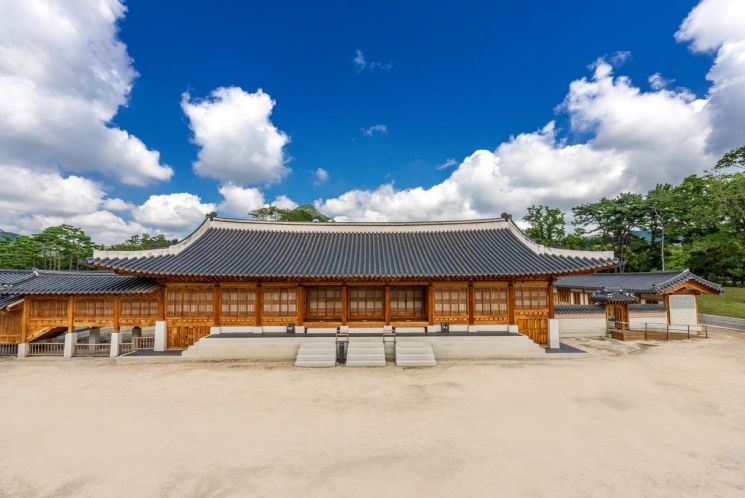
The Royal Palaces and Tombs Center of the Cultural Heritage Administration announced on May 29 that it will begin restoration work on the dancheong (traditional decorative coloring on wooden buildings) in the Heungbokjeon area starting June 19. The project is expected to last for about one year, until June 2026. Dancheong is a decorative technique in which various patterns are painted in multiple colors?based on the five traditional colors of red, blue, yellow, black, and white?on wooden structures.
As a result, public access to this area will be restricted. Notices regarding restricted entry will be posted at four gates, and screens will be installed around parts of the Donghaenggak, Bukhaenggak, and Seohaenggak corridors.
Located between Gyotaejeon Hall and Hamhwadang Hall, Heungbokjeon Hall was constructed during the reconstruction of Gyeongbokgung Palace in the 1860s. Historical records indicate that King Gojong received foreign envoys from countries such as Germany, Japan, Italy, and France here. It is also known as the place where Queen Dowager Sinjeong, mother of King Heonjong and the woman who adopted Heungseon Daewongun's son to the throne, passed away in 1890.
The Cultural Heritage Administration restored the building in 2018?using about 75,000 roof tiles and over 50 pine trees?after it had been dismantled during the Japanese colonial period, but was unable to complete the dancheong at that time. The Royal Palaces and Tombs Center recently finished the dancheong design based on major historical documents such as the "Yeonggeon Ilgi" (Construction Diaries), the "Annals of the Joseon Dynasty," and the "Seungjeongwon Ilgi" (Diaries of the Royal Secretariat), which were compiled during the reconstruction of Gyeongbokgung Palace. The columns of Heungbokjeon Hall and the surrounding corridors will be painted with seokganju, a reddish clay pigment, while the eaves and rafters will be decorated using the saekgeutgi dancheong technique, in which lines are drawn over a base color to complete the design.
© The Asia Business Daily(www.asiae.co.kr). All rights reserved.
![Clutching a Stolen Dior Bag, Saying "I Hate Being Poor but Real"... The Grotesque Con of a "Human Knockoff" [Slate]](https://cwcontent.asiae.co.kr/asiaresize/183/2026021902243444107_1771435474.jpg)















