"Cannot Lower H20 Further... Huawei Is Powerful"
Repeal of 'AI Proliferation Rules' Seen as Positive
"Meeting European Leaders"... Large-Scale Deal Expected
Jensen Huang, CEO of Nvidia, has warned that if American companies are unable to export competitive artificial intelligence (AI) chips to the Chinese market, Chinese companies will fill the gap.
In an interview with Bloomberg TV on the 28th (local time), Huang stated, "Regardless of short-term sales, the Chinese market is extremely important."
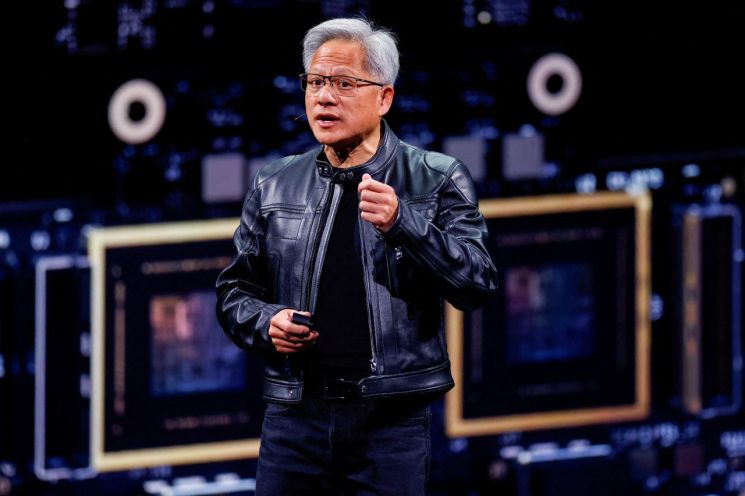
He said, "China is the world's second-largest AI market and home to the largest number of AI researchers globally. We want all AI researchers and developers around the world to develop on American platforms."
Nvidia has been selling the H20 chip, a lower-performance version designed to comply with U.S. semiconductor export restrictions to China. However, since last month, the Trump administration has also restricted the export of the H20 chip to China. Subsequently, the Wall Street Journal (WSJ) reported that China's Huawei is developing a high-performance chip comparable to Nvidia's H100.
Huang said he is considering whether to release a chip with even lower performance than the H20 for the Chinese market. He explained, "The H20 is limited to the lowest level of the Hopper architecture, and at the moment, I do not know how to further reduce its performance." He added, "Chinese competitors have made tremendous progress over the past year, with their capabilities doubling or quadrupling each year. If there is no American technology, Chinese technology will fill the market. Therefore, whatever we offer must at least be competitive."
When asked whether Huawei has a product similar in performance to the H20, Huang replied, "It is probably similar to the H200," and added, "Huawei is quite powerful."
During a conference call, Huang did not hesitate to directly criticize the Trump administration's policies regarding semiconductor export controls. He emphasized that China's AI is advancing even without American AI chips, stating, "The regulations only serve to strengthen Chinese semiconductor companies." He also warned, "American leadership is at risk," and pointed out, "U.S. policy is based on the assumption that China cannot develop AI on its own, but this assumption is clearly wrong."
However, in the interview, he evaluated some of the Trump administration's policies positively. Regarding tariff policy, he said, "It could be a transformative idea for the next century," and on the repeal of the previous Joe Biden administration's 'AI proliferation rules,' he commented, "It accelerates the spread of the U.S. stack." The rule divided countries into three tiers and controlled the volume of high-performance AI chip exports. As a result, Nvidia's exports to regions such as the Middle East were restricted. However, the Trump administration abolished this regulation, and Huang recently accompanied President Trump on a Middle East tour, signing a large-scale AI chip supply contract with a Saudi Arabian company.
During the interview, U.S. Secretary of State Marco Rubio issued a statement announcing the cancellation of visas for some Chinese students. When asked about the impact of U.S. government restrictions on foreign student visas on technology companies like Nvidia, Huang said, "I am an immigrant," and emphasized, "Many immigrants who came to the U.S. to build a better life have made significant contributions to the technology industry. This should continue in America."
In a previous conference call, Huang revealed plans for a business trip to Europe. He said, "I will meet with many leaders and visit France, the United Kingdom, Germany, Belgium, and more. Every country recognizes that AI is a national infrastructure, like electricity or the internet. I am truly pleased that we can work with Europe to build AI infrastructure."
Nvidia announced that in this quarter (February to April), it recorded sales of $44.06 billion and earnings per share of $0.96. These figures exceeded Wall Street expectations, as compiled by market research firm LSEG, which predicted sales of $43.31 billion and earnings per share of $0.93.
However, the impact of the Trump administration's semiconductor export controls was reflected in the results. Nvidia stated that, due to H20 inventory in the current quarter of the 2026 fiscal year, it incurred $4.5 billion in costs in the first quarter, and that if there had been no restrictions on H20 exports, it would have recorded an additional $2.5 billion in revenue.
For the next quarter (May to July), Nvidia expects sales of $45 billion, which is below LSEG's forecast of $45.9 billion. The company stated that, without the H20 chip export restrictions, next quarter's revenue projections would have been approximately $8 billion higher.
Cress Collett, Nvidia's Chief Financial Officer (CFO), said, "The bigger problem is that the size of the market Nvidia cannot address is growing," and added, "The size of the Chinese market will increase to $50 billion, and we have lost a $50 billion opportunity." He also commented, "The new (semiconductor export) regulations will have a substantial impact on Nvidia and benefit overseas competitors."
© The Asia Business Daily(www.asiae.co.kr). All rights reserved.
![Clutching a Stolen Dior Bag, Saying "I Hate Being Poor but Real"... The Grotesque Con of a "Human Knockoff" [Slate]](https://cwcontent.asiae.co.kr/asiaresize/183/2026021902243444107_1771435474.jpg)















