Yeongsangang River Basin Environmental Office Releases Measurements for 59 VOCs
"Standards Applied Only to Key Substances Like Carbon Disulfide and Benzene"
The Yeongsangang River Basin Environmental Office has released air quality data measured after the fire at Kumho Tire's Gwangju factory. However, for some chemicals, there are no established safety standards, making it impossible to determine their potential health risks.
The Yeongsangang Office measured 59 types of volatile organic compounds (VOCs) in the air near the factory at one-hour intervals using a mobile monitoring vehicle from May 17, the day the fire occurred, through May 26. The results were made public on May 28.
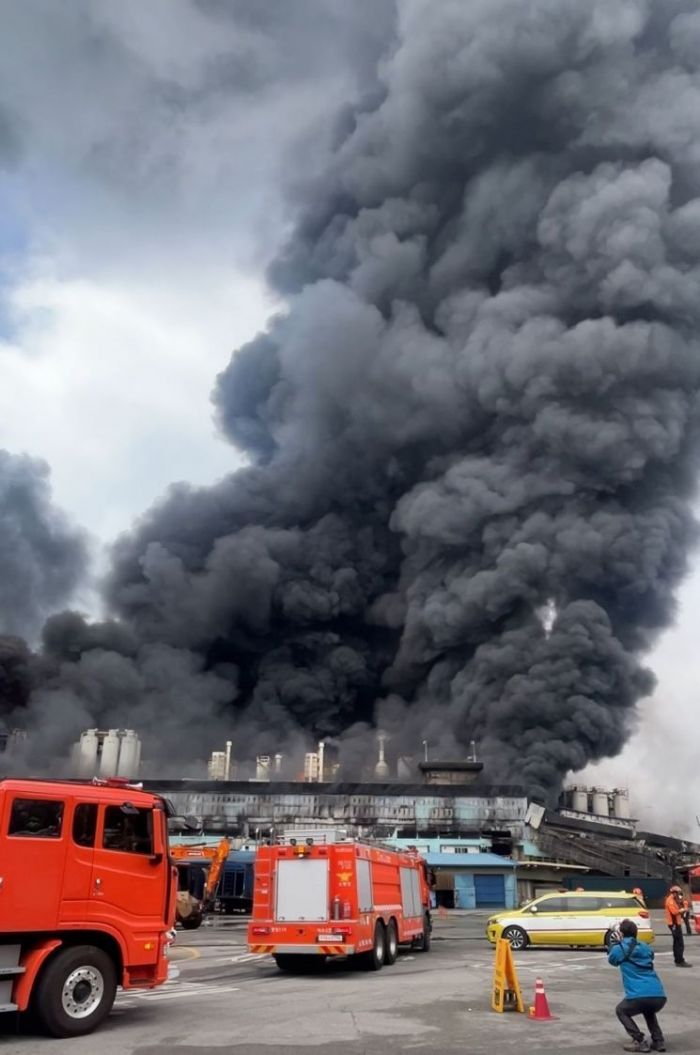 Black smoke is billowing from Kumho Tire's Gwangju factory due to a fire that occurred on the morning of the 17th. Photo by Song Bohyun
Volatile organic compounds are organic substances with low boiling points that exist as gases at room temperature. They can cause unpleasant odors or contribute to ozone formation.
The Yeongsangang Office explained that 33 of these substances were analyzed based on existing concentration standards such as TWA (Time-Weighted Average) and AEGLs (Acute Exposure Guideline Levels). However, for the remaining 26 substances, the lack of standards made it difficult to assess their potential hazards.
Some of these 26 substances were actually detected during the monitoring process. On May 17, the day of the fire, ethene and ethane were measured at 0.032 ppm around 2 p.m., n-nonane was measured at 0.007 ppm at 4 p.m. the same day, and methylhexane and dimethylpentane were measured at 0.336 ppm at 11 a.m. the following day. However, since there are no relevant standards for these substances, it is not possible to determine whether they are harmful to human health.
Previously, on May 24, the Yeongsangang Office had disclosed measurement results for four representative hazardous substances with established standards (carbon disulfide, ethylene oxide, benzene, and hydrogen sulfide), announcing that all were within permissible limits.
However, as reports of resident complaints such as odors, vomiting, and fallout continued, the office released the measurement results for all 59 substances.
An official from the Yeongsangang Office stated, "We initially disclosed only the four representative substances because it is difficult to interpret data for substances without standards or that were not detected, but decided to release all the data in consideration of the public's right to know."
© The Asia Business Daily(www.asiae.co.kr). All rights reserved.
![Clutching a Stolen Dior Bag, Saying "I Hate Being Poor but Real"... The Grotesque Con of a "Human Knockoff" [Slate]](https://cwcontent.asiae.co.kr/asiaresize/183/2026021902243444107_1771435474.jpg)
















