A Decrease of 3,466 Students, Down 2.0% from the Previous Year
Nursing and Health Fields Recruit the Most with 45,760 Students (27.5%)
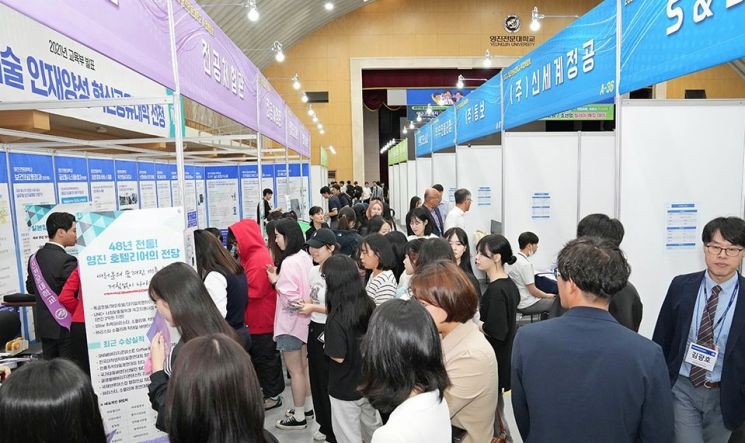 A reference photo from the job fair at Yeungjin College in Daegu, which recorded the highest employment rate. This image is unrelated to the specific content of the article. Yeungjin College
For the 2027 academic year college admissions, junior colleges will recruit a total of 166,474 students. Of these, 152,454 students will be selected through early admissions, accounting for 91.5% of the total.
On May 28, the Korea Council for College Education (KCCE) announced the main details of the "2027 Academic Year Admissions Plan" established by 128 junior colleges nationwide. The total number of students to be admitted for the 2027 academic year (166,474) has decreased by 3,466 (2.0%) compared to the 2026 academic year (169,940).
The number of students to be recruited within the regular quota is 131,031 (78.7% of the total), a decrease of 3,087 (2.3%) compared to the 2026 academic year. The number of students to be recruited outside the quota (35,443) has also decreased by 379 (1.1%).
By admission period, early admissions will account for 152,245 students (91.5%), a decrease of 1,950 (1.3%) from the 2026 academic year (154,195). Regular admissions will be 14,229 students, a decrease of 1,516 (9.6%) from the previous year. By admission type, the general admissions track will recruit 52,755 students (31.7%), while the special admissions track will recruit 113,719 students (68.3%).
By selection method, the majority will be chosen based on the "school record-based" method, with 114,847 students (69.0%). The interview-based method will select 21,888 students (13.1%), the document-based method will select 18,291 students (11.0%), and the practical skills-based method will select 7,496 students (4.5%). In contrast, the College Scholastic Ability Test (CSAT)-based method will select 3,952 students (2.4%).
By major, the nursing and health fields will recruit the largest number of students, with 45,760 (27.5%). This is followed by the machinery and electrical/electronics fields with 25,120 students (15.1%), hotel and tourism with 22,569 students (13.6%), theater, film, broadcasting, and applied arts with 11,537 students (6.9%), and food service and culinary arts with 10,921 students (6.6%).
While most fields will reduce the number of students recruited, the "other" category, which includes interdisciplinary or convergence majors, will recruit 4,234 students, an increase of 313 (8.0%) compared to the 2026 academic year (3,921). The "physical education" field will recruit 6,009 students, an increase of 1,080 (19.2%).
The admissions schedule will remain the same as the previous year, with up to two rounds for early admissions and one round for regular admissions. There are no restrictions on the number of applications or the number of colleges an applicant can apply to. However, if a student is accepted (either initially or through additional rounds) to any one college (general university, industrial university, college of education, or junior college) during early admissions, they are prohibited from applying for regular admissions, regardless of whether they register or not.
If a student is accepted to two or more colleges for the same semester, they must register at only one college. If a student violates the application rules, their admission will be invalidated upon verification through a computerized data search. The KCCE plans to post the main details of the 2026 academic year admissions plan and various career and admissions resources on the junior college portal "Procollege" and its official website.
© The Asia Business Daily(www.asiae.co.kr). All rights reserved.
![Clutching a Stolen Dior Bag, Saying "I Hate Being Poor but Real"... The Grotesque Con of a "Human Knockoff" [Slate]](https://cwcontent.asiae.co.kr/asiaresize/183/2026021902243444107_1771435474.jpg)















