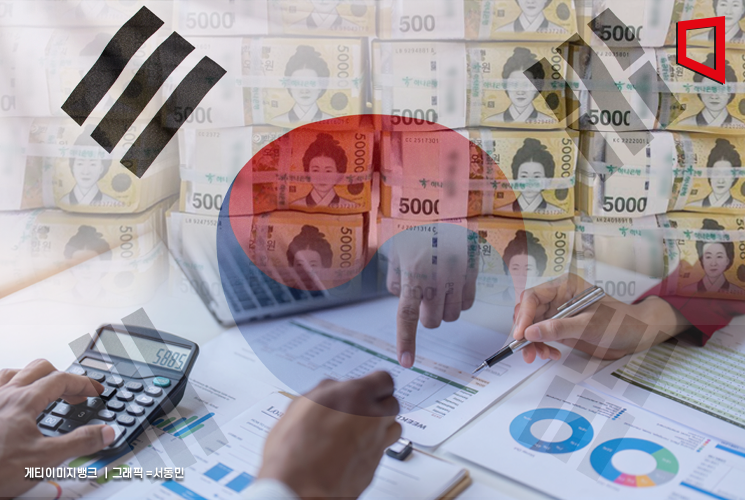
As foreigners purchased Korean bonds such as government bonds, the country's external debt increased by more than $10 billion over the past three months. However, the government has assessed that debt soundness indicators, including the short-term external debt ratio, remain at healthy levels.
According to the "Q1 External Assets and Liabilities Trends" released by the Ministry of Economy and Finance on May 28, Korea's external debt in the first quarter of this year stood at $683.4 billion, an increase of $10.5 billion compared to $672.9 billion at the end of the previous quarter.
Short-term external debt with a maturity of one year or less was $149.3 billion, up $2.8 billion from the previous quarter, while long-term external debt (maturity exceeding one year) increased by $7.7 billion to $534.1 billion.
Specifically, external debt increased by $9.5 billion in the government sector and by $3.2 billion in other sectors (non-bank, public, and private companies), while it decreased by $800 million in the central bank and by $1.3 billion in banks.
External assets totaled $1.0513 trillion, a decrease of $8.7 billion from $1.0600 trillion at the end of the previous quarter. Net external assets, calculated by subtracting external debt from external assets, stood at $367.9 billion, down $19.2 billion from $387.1 billion at the end of the previous quarter.
The government explained that the increase in external debt was largely due to expanded investment (capital inflow) by foreigners and other non-residents in Korean bonds such as government bonds.
The proportion of short-term external debt to total external debt was 21.9%, up 0.1 percentage point from 21.8% at the end of last year. The ratio of short-term external debt to foreign exchange reserves rose slightly to 36.5%, compared to 35.3% at the end of last year. The Ministry of Economy and Finance stated that although external debt soundness indicators have deteriorated slightly, they remain at lower levels compared to previous years.
The foreign currency liquidity coverage ratio (LCR), which reflects domestic banks' ability to repay external debt, was 152.9% at the end of the first quarter, far exceeding the regulatory requirement of 80%.
A Ministry of Economy and Finance official said, "Given that external sector uncertainty may increase depending on developments in the global trade environment, capital flows, shifts in major countries' monetary policies, and interest rate movements, the government will continue to closely monitor external debt trends along with the situation in the international financial markets."
© The Asia Business Daily(www.asiae.co.kr). All rights reserved.
![Clutching a Stolen Dior Bag, Saying "I Hate Being Poor but Real"... The Grotesque Con of a "Human Knockoff" [Slate]](https://cwcontent.asiae.co.kr/asiaresize/183/2026021902243444107_1771435474.jpg)















