Starting next year, an artificial intelligence (AI) system will be integrated and utilized to block the import of illegal goods through overseas direct purchases. This initiative aims to address the rapidly increasing volume of overseas direct purchases and to enhance the efficiency of customs field personnel deployment and operations.
On May 28, the Korea Customs Service announced that it has begun developing the "AI Risk Management System for Express Cargo and International Postal Items" (hereinafter referred to as the Risk Management System) for this purpose.
The development of the Risk Management System is scheduled to be completed by the end of this year, and it will be actively deployed at customs clearance sites starting in January next year.
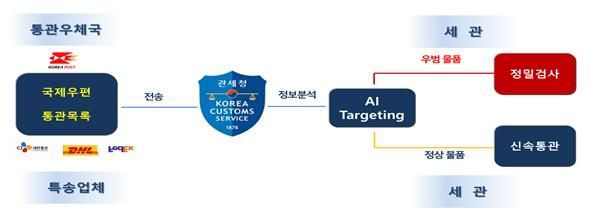
This system will utilize various declaration information and detection data accumulated by the Korea Customs Service to statistically analyze risk patterns involving companies, goods, and supply chains. Based on this analysis, an AI algorithm will be created to assess and evaluate the risk levels of express cargo and international postal items in real time.
In particular, by leveraging its automatic learning function, the system will continuously update (categorize) new risk types associated with goods. Additionally, through its data refinement function, it will accurately identify risk factors even within missing or inaccurate declaration information.
Once the development of the AI Risk Management System is completed and implemented in the field, it is expected to enable rapid customs clearance by precisely screening and quickly classifying high-risk and regular items.
Above all, the Korea Customs Service explained that the system is expected to serve as an effective tool for blocking the import of illegal goods such as narcotics, especially given the recent surge in overseas direct purchase volumes.
According to the Korea Customs Service, the total number of items imported through overseas direct purchases last year reached 180 million, marking an 88% increase compared to 2022. As the volume of overseas direct purchases has surged, cases of importing illegal goods such as narcotics via express cargo and international postal items are also on the rise.
In fact, last year, there were 655 cases of attempted narcotics importation via express cargo and international postal items that were detected, representing a 25.6% increase from the previous year. As a result, there has been a growing need for more precise risk management of express cargo and international postal items in the field. This is the background behind the Korea Customs Service's development and implementation of the AI Risk Management System.
Previously, to advance risk management, the Korea Customs Service has sequentially developed and implemented AI-based risk management systems in the areas of general imports, cargo, travelers, and personal imports since 2021, thereby demonstrating their effectiveness in actual field operations.
A Korea Customs Service official stated, "The Risk Management System is a core pillar of digital customs administration that protects public safety," adding, "The Korea Customs Service will continue to utilize new technologies such as AI and big data to create a rapid and secure customs clearance environment."
© The Asia Business Daily(www.asiae.co.kr). All rights reserved.
![Clutching a Stolen Dior Bag, Saying "I Hate Being Poor but Real"... The Grotesque Con of a "Human Knockoff" [Slate]](https://cwcontent.asiae.co.kr/asiaresize/183/2026021902243444107_1771435474.jpg)















