Strike Begins from First Bus on the 28th
Labor and Management Remain at Odds over Wage Negotiations
Seoul City to Immediately Deploy Alternative Transportation
The Seoul city bus union will begin a strike starting from the first bus on the 28th. The labor and management were ultimately unable to overcome their differences in wage negotiations. The Seoul Metropolitan Government has decided to immediately deploy alternative transportation.
According to the Seoul Metropolitan Government and other sources on the 28th, the management, represented by the Seoul City Bus Transport Business Association, declared the breakdown of negotiations with the Seoul City Bus Labor Union under the Federation of Korean Trade Unions at around 12:10 AM on this day.
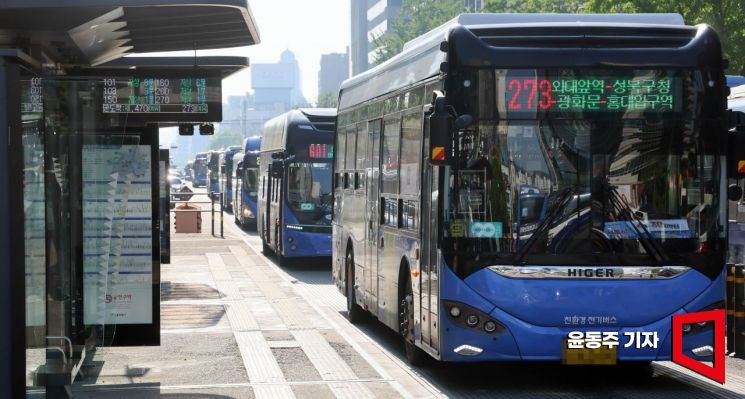 The Seoul city bus union will go on strike starting from the first bus on the 28th. The Seoul City Bus Transport Business Association declared the breakdown of negotiations with the Seoul City Bus Labor Union under the Federation of Korean Trade Unions at around 12:10 AM on the 28th. The photo shows a bus stop in downtown Seoul. Photo by Yoon Dongju
Labor and management held last-minute negotiations at the Seoul Regional Labor Relations Commission in Yeongdeungpo-gu from around 3 PM on the 27th, but even after approximately seven hours of marathon talks, they failed to reach an agreement.
The two sides have been in sharp conflict over the issue of ordinary wages. The union maintained its position that regular bonuses should be included in ordinary wages and that wages should be increased by up to 8.2%. Their argument is that regular bonuses are considered ordinary wages under the Labor Standards Act and Supreme Court rulings, and that both the employer and the Seoul Metropolitan Government have already acknowledged this.
However, management argued that if regular bonuses were included in ordinary wages and all of the union's wage increase demands were accepted, the overall wage level would rise, making it necessary to restructure the wage system to lower the level of ordinary wages. The Seoul Metropolitan Government, which operates a quasi-public bus system, also supported the need for wage system restructuring.
With negotiations breaking down, the union will proceed with a general strike as scheduled from 4 AM on this day. In Seoul, a total of about 7,000 city buses operate on 389 routes. Sixty-four companies participate in the union, and among these, 61 companies are eligible for collective bargaining and can participate in industrial action.
In response to the breakdown of labor-management negotiations and the union's full-scale bus strike, the Seoul Metropolitan Government will implement emergency transportation measures from the first bus at 4 AM on this day to minimize inconvenience for citizens commuting to and from work, deploying alternative transportation. Subway service will be extended by one hour during rush hours and late-night operations will also be extended by one hour until 2 AM the following day. In addition, to connect with subway stations, all 25 districts of Seoul will provide free shuttle buses to minimize inconvenience for citizens.
Subway congestion hours will be adjusted to 7 AM to 10 AM and 6 PM to 9 PM, with additional trains deployed during these times. The last train will be extended to 2 AM the next day at terminal stations, with a total of 189 additional train operations. For connections to the subway, a total of 117 free shuttle bus routes with 625 vehicles will be operated by the districts. Information about the district free shuttle buses can be found on the Seoul Metropolitan Government website. Buses not participating in the strike can be used free of charge.
Additionally, to prepare for increased taxi use and transportation inconvenience, enforcement of the taxi ride-sharing ban will be temporarily suspended from 4 AM on the day the strike begins until the strike ends. As a result, ride-sharing will be permitted if passengers agree, and on-site guidance will be provided to ensure that excessive taxi fares are not charged to ride-sharing passengers. Real-time traffic information will also be provided through the Dasan Call Foundation, the TOPIS Transportation Information Center, Seoul city media, and bus information terminals at bus stops. Yeo Jangkwon, head of the Seoul Metropolitan Government's Transportation Bureau, stated, "We will mobilize all available transportation means to minimize inconvenience for citizens."
Meanwhile, the Seoul city bus union also went on strike last year after wage and collective bargaining negotiations broke down. However, with the city's mediation, an agreement was reached on wage negotiations, and the strike was completely withdrawn after 11 hours, with normal operations resuming.
© The Asia Business Daily(www.asiae.co.kr). All rights reserved.
![Clutching a Stolen Dior Bag, Saying "I Hate Being Poor but Real"... The Grotesque Con of a "Human Knockoff" [Slate]](https://cwcontent.asiae.co.kr/asiaresize/183/2026021902243444107_1771435474.jpg)















