Videos of two suicide attempts that occurred this month near Gangnam Station in Seoul have spread as Shorts on YouTube. After citizens took photos and videos at the scene and these were reported by the media, so-called "cyber leakers" re-edited and disseminated the content. Some videos were compilations of photos and footage from news outlets, while others simply uploaded live streams from social media, vividly showing the situation as it unfolded. There were also videos posted with false titles such as "jumped after refusing rescue," even though the individuals were safely rescued.

Despite the absurdity of these occurrences, there is little that can be done to stop them. According to data from the office of Democratic Party lawmaker Seo Mihwa, the Ministry of Health and Welfare's Suicide-Inducing Information Monitoring Team received 400,136 reports of "suicide-inducing information" last year. This is about ten times the 90,772 reports made in 2020. In 2024, 61,598 pieces of suicide-inducing information were deleted, meaning only about 15% of reported cases were removed.
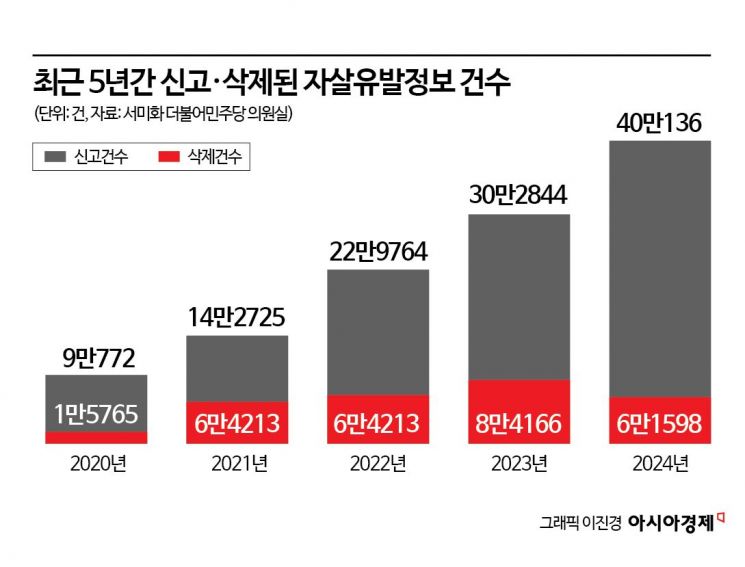
As a result, there are increasing calls for legislation that would allow for the deletion of suicide-inducing information online, including on one-person media platforms. An amendment to the law that would establish a Suicide-Inducing Information Monitoring Center and empower it to delete or block such content was proposed in January 2025.
However, neither the National Assembly nor relevant government ministries appear to be proactive. The Korea Suicide Prevention Center requested cooperation from the Korea Communications Commission for public complaints and from the Press Arbitration Commission for corrective recommendations, but both agencies responded that suicide-inducing information on one-person media platforms does not fall under their jurisdiction.
Yoo Hyunjae, a professor in the Department of Communications at Sogang University, stated, "Progress in the discussion can only be made if there are more laws specifically addressing suicide and media issues unique to Korea," adding, "It is now time to communicate the seriousness of suicide clearly and strongly to the public, and to increase the number of related laws."
Some experts point out that a careful approach is needed to avoid infringing on freedom of expression when legislating. Lee Dongjin, a professor at Seoul National University School of Law, said, "A simple approach of deleting all problematic content indiscriminately could violate freedom of expression," and added, "The issue of granting the monitoring center director primary authority for judgment and censorship also needs to be carefully examined."
© The Asia Business Daily(www.asiae.co.kr). All rights reserved.
![Clutching a Stolen Dior Bag, Saying "I Hate Being Poor but Real"... The Grotesque Con of a "Human Knockoff" [Slate]](https://cwcontent.asiae.co.kr/asiaresize/183/2026021902243444107_1771435474.jpg)
















