Korea Exchange Holds 1st Anniversary Value-Up Program Ceremony on May 27
Kim Byunghwan, Financial Services Commission Chairman: "The Initiative Should Continue in the Next Administration"
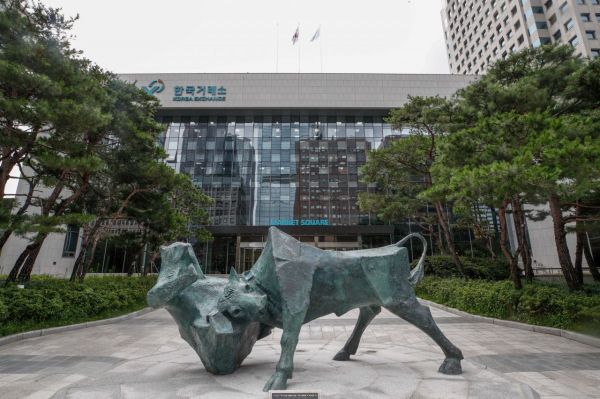
On May 27, the Korea Exchange held the '1st Anniversary Value-Up Program Ceremony' and awarded commendations to ten companies, including HD Hyundai Electric and KB Financial Group, recognizing them as outstanding value-up (corporate value enhancement) companies.
The Value-Up Program is a government-led initiative launched last year to address the so-called Korea Discount (the undervaluation of the Korean stock market). On this day, the Korea Exchange announced that it had recognized ten outstanding companies for their efforts and achievements in enhancing corporate value over the past year, as well as for their contribution to spreading a value-up culture.
First, HD Hyundai Electric, which achieved excellent value-up results based on growth, and KB Financial Group, which actively implemented shareholder returns, were honored with the Deputy Prime Minister’s Award. Meritz Financial Group, Samyang Foods, and KT&G received the Financial Services Commission Chairman’s Award, while Samsung Fire & Marine Insurance, Shinhan Financial Group, Hyundai Glovis, KT, and SK Hynix were awarded the Korea Exchange Chairman’s Award. The winning companies will receive eight types of incentives in areas such as tax and accounting, listing, and disclosure.
In his opening remarks, Korea Exchange Chairman Jeong Eunbo stated, "Since the implementation of the Value-Up Program, companies representing half (49%) of the KOSPI’s market capitalization have participated in disclosures, leading to meaningful changes such as expanded shareholder returns and greater respect for shareholder value. Going forward, the Exchange will continue to support the establishment of a shareholder value-oriented culture in our capital market with a long-term perspective." Financial Services Commission Chairman Kim Byunghwan also emphasized in his congratulatory remarks, "As the Value-Up initiative is a task that has garnered national consensus, I believe it will continue to be a major policy in the next administration as well."
The 'Corporate Value-Up Program White Paper' released by the Exchange on this day highlighted that companies participating in value-up disclosures recorded an average stock return more than 21 percentage points higher than non-disclosing companies last year. The average stock return for value-up disclosure companies last year was 4.5%, which is 21.4 percentage points higher than the -16.9% average for non-disclosing companies.
The Exchange explained, "As of March, 125 companies had participated in value-up disclosures, representing 46% of the KOSPI market capitalization. In the financial sector, value-up disclosure companies recorded a stock return of 25.3% last year, and their price-to-book ratio (PBR) increased by 25% from 0.4 to 0.5, partially alleviating the undervaluation."
As a management trend centered on shareholder value has spread, the scale of cash dividends and share buybacks and cancellations has also increased. Last year, cash dividends rose by 10.8% year-on-year to 32.7 trillion won, with the total dividends of KOSPI value-up disclosure companies (18 trillion won) accounting for 59.2% of the total. During the same period, the value of share buybacks reached 18.7 trillion won, an increase of nearly 130%, while the amount of share cancellations expanded by about 190% from 4.8 trillion won to 13.9 trillion won.
Experts in the financial investment industry have generally given positive evaluations regarding the goals and contributions of the Value-Up Program. According to a survey of 95 domestic and foreign institutional investors, 90% positively assessed the goal of addressing the 'Korea Discount,' and 57% responded that the Value-Up Program contributed to this objective. However, areas for improvement were also identified, such as insufficient participation by KOSDAQ and small- to mid-cap companies, and the relatively low proportion of disclosure companies among those included in the value-up index.
The Exchange plans to expand support, including education and consulting, so that more companies can participate in the Value-Up Program, thereby fostering a culture of respect for shareholder value and upgrading the capital market. Chairman Kim stated, "Companies should not wait for the market or supervisory authorities but should proactively seek change by listening to the market’s voice, and pursue value-up in various ways, not only through shareholder returns but also by expanding investment according to their individual characteristics. The market, in turn, should move beyond a uniform perspective and evaluate companies’ efforts from the standpoint of 'sustainable corporate value enhancement.'"
© The Asia Business Daily(www.asiae.co.kr). All rights reserved.
![Clutching a Stolen Dior Bag, Saying "I Hate Being Poor but Real"... The Grotesque Con of a "Human Knockoff" [Slate]](https://cwcontent.asiae.co.kr/asiaresize/183/2026021902243444107_1771435474.jpg)















