Participated in the Korean War as a Member of the U.S. 2nd Infantry Division in the Early Days
Distinguished Service at the Battle of Kunu-ri... Recalled in His Memoir
Passed Away at 94 Without Seeing Korean Reunification
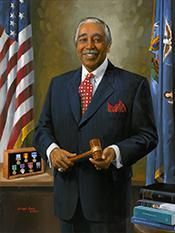 Charles Rangel, Former U.S. Congressman. United States Congress
Charles Rangel, a Korean War veteran and one of the most prominent pro-Korean figures in the United States, passed away at the age of 94 on the 26th (local time), according to the Washington Post (WP).
WP, citing a statement from the City College of New York, reported that former Congressman Rangel died at a hospital in Manhattan, New York, on the morning of Memorial Day in the United States. The City College of New York is where he served as a political scientist during his lifetime.
After volunteering for military service in 1950, Rangel fought in the early stages of the Korean War as a member of the U.S. 2nd Infantry Division. During the Battle of Kunu-ri, where his unit was ambushed by Chinese forces, he led 40 soldiers to safety. For this achievement, he was awarded the Purple Heart and the Bronze Star, and in 2007, he received the Gwanghwa Medal of the Order of Diplomatic Service Merit from the South Korean government.
He later recounted this dramatic escape and the turning point it marked in his life in his memoir, "And I Haven't Had a Bad Day Since." He maintained an optimistic outlook on life, considering his wartime experiences as a reference point for his entire life.
Owing to his deep ties with Korea, in 1977, he strongly opposed then-President Jimmy Carter’s plan to withdraw U.S. troops from South Korea. At the time, Carter, also a Democrat, had pledged the withdrawal as a campaign promise and pursued it as an official policy after taking office. The South Korean government, as well as the U.S. Congress and military, voiced strong opposition, citing concerns about a possible North Korean attack. Nevertheless, President Carter went ahead with a partial withdrawal of U.S. troops from South Korea.
In the U.S. Congress, Rangel introduced several resolutions related to the Korean Peninsula, including the "Korean Peninsula Peace and Reunification Resolution" (2013), the "Resolution Urging Reunions of Separated Families" (2014), and the "Korean War Armistice Resolution" (2015). Although he was generally critical of free trade agreements as a Democratic lawmaker, he took the lead in supporting and contributing to the conclusion of the Korea-U.S. Free Trade Agreement (FTA). He was also a founding member of the Korea Caucus, a group of pro-Korean lawmakers in Congress. The Korea Caucus was first established in the U.S. House of Representatives in 2003 and was launched in the Senate in 2023 to commemorate the 70th anniversary of the Korea-U.S. alliance.
Rangel also actively supported Korea on historical issues with Japan. In June 2014, when then-Prime Minister Shinzo Abe’s cabinet in Japan initiated a review of the Kono Statement, which acknowledged and apologized for the issue of "comfort women," he joined in sending a letter to the Japanese government condemning the move as inappropriate. The following year, when Abe visited the United States, Rangel also participated in issuing a letter urging Abe to apologize for historical wrongdoings during his address to Congress.
In 2021, upon receiving the "Paik Sunyup Korea-U.S. Alliance Award," he expressed his affection for Korea. "When I was wounded and left the Korean Peninsula during the Korean War, it was like a nightmare. I am immensely proud that Korea has risen from the devastation of war to become America’s seventh-largest trading partner and a global powerhouse. Korea will always have a place in my heart. As we promote peace between North and South Korea, I hope our two countries (the U.S. and Korea) will grow even closer, and I wish to see a unified Korean Peninsula in my lifetime." Although he longed for Korean reunification, he passed away without seeing it come to fruition.
© The Asia Business Daily(www.asiae.co.kr). All rights reserved.
![Clutching a Stolen Dior Bag, Saying "I Hate Being Poor but Real"... The Grotesque Con of a "Human Knockoff" [Slate]](https://cwcontent.asiae.co.kr/asiaresize/183/2026021902243444107_1771435474.jpg)














