7-Day Training Program for Mongolian Urban Development Practitioners
20 Practitioners from 7 Mongolian Organizations Participate
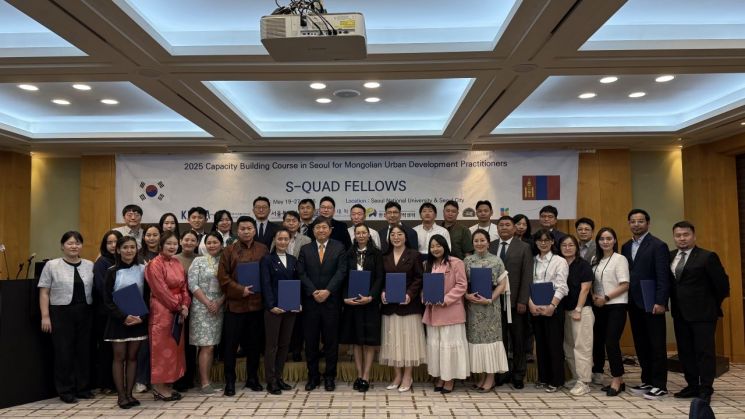 Participants are taking a commemorative photo at the completion ceremony of the "2025 2nd Phase Mongolia Urban Development Practitioners Capacity Building Training" held on the 26th. Seoul City
On May 27, the Seoul Metropolitan Government announced the completion of the "2025 2nd Phase Mongolia Urban Development Practitioners Capacity Building Training," a cooperation program designed to apply Seoul's urban development experience to current urban issues in Mongolia.
This event was held over seven days, from May 19 to May 25. The Mongolia practitioners training is a core implementation project of the Mongolia Urban Development Professional Training Program, which is jointly promoted by KOICA (Korea International Cooperation Agency), the Korea-Mongolia Urban Cooperation Center at Seoul National University, and the Mongolian University of Science and Technology. Following last year, the city has continued this training program in 2025, further expanding the possibilities for a sustainable international urban cooperation model.
This year's event brought together 20 practitioners specializing in urban planning, architecture, and environment from seven organizations, including the Ministry of Construction and Urban Development of Mongolia, Ulaanbaatar City Hall, and the Mongolian University of Science and Technology. Building on the achievements of the first training phase, where some policy ideas proposed during the program were partially implemented in Mongolia, this year's training further strengthened the program’s continuity by focusing on increasing the applicability of such policies.
The program included expert lectures on Seoul's advanced transportation systems, environmental policies, and urban development strategies, as well as site visits and hands-on experiences at locations such as the Seonam Water Recycling Center, the Cheong Wa Dae autonomous bus, TOPIS (Transport Operation and Information Service), the Gangnam Complex Transfer Center construction site, and the Sanggye Station subway construction site.
In addition, the trainees participated in a boat tour on a Han River government vessel, where they directly experienced examples of waterfront space utilization. While viewing the cityscape and major landmarks along the waterfront, they deepened their understanding of the harmony between Seoul's landscape design and urban planning.
Cho Namjun, Director General of the Urban Space Headquarters at the Seoul Metropolitan Government, stated, "The significance of this training program lies in the fact that Seoul's urban policies are being applied in overseas urban settings," adding, "Going forward, Seoul will continue to expand opportunities for international cooperation where talents in the field of urban development can learn from and grow with each other."
© The Asia Business Daily(www.asiae.co.kr). All rights reserved.
![Clutching a Stolen Dior Bag, Saying "I Hate Being Poor but Real"... The Grotesque Con of a "Human Knockoff" [Slate]](https://cwcontent.asiae.co.kr/asiaresize/183/2026021902243444107_1771435474.jpg)















