"Transitioning to a Hospital Focused on Severe and Intractable Diseases and Research"
Utilizing State-of-the-Art Equipment and Providing Ultra-Personalized Medicine
Korea University Medical Center has announced its ambition to become a Fourth Medical Institution, a type of hospital that does not yet exist in the world, and to rank among the world's top 30 hospitals as it approaches its 100th anniversary. To achieve this, the center plans to shift its focus toward treating highly complex diseases and becoming a research-driven institution.
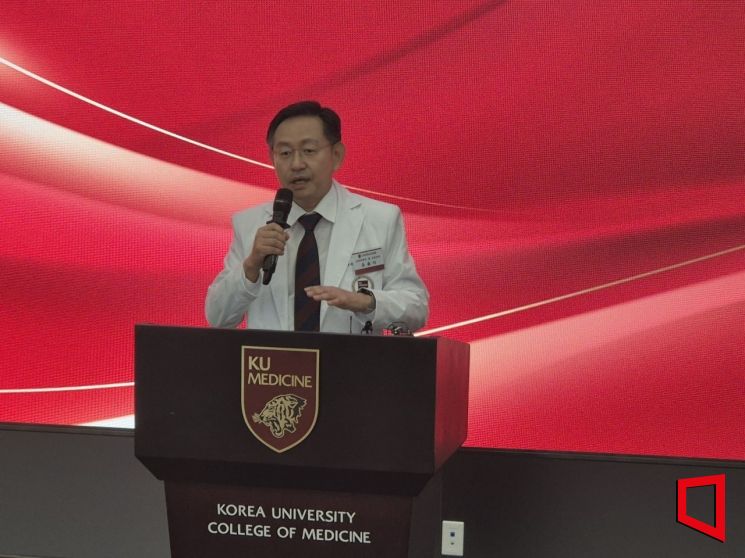 Eunsik Yoon, Director of Korea University Medical Center (Vice President for Medical Affairs at Korea University), held a press conference on the 26th at Korea University College of Medicine in Seongbuk-gu, Seoul, to present the "Master Plan for Future Medical Innovation" and expressed his aspirations for the Fourth Medical Institution Leap. Photo by Taewon Choi
On May 26, Eunsik Yoon, Director of Korea University Medical Center (Vice President for Medical Affairs at Korea University), held a press conference at Korea University College of Medicine in Seongbuk-gu, Seoul, to present the "Master Plan for Future Medical Innovation." He stated, "By 2028, the 100th anniversary of our founding, we will transition to a focus on severe and intractable diseases and become a 'Fourth Medical Institution,' a future hospital that has never existed before, by applying smart, ultra-precision medicine."
Korea University Medical Center plans to achieve these goals by introducing state-of-the-art medical equipment, such as the latest robotic surgery devices and proton therapy machines, and by building a smart hospital equipped with IT technologies.
◆ Transition to a focus on severe and intractable diseases... Establishing a new model for advanced general hospitals = Korea University Medical Center intends to serve as a "final treatment institution" for severe and rare intractable diseases, aiming to realize a higher-level model of advanced general hospitals. The center has already developed the nation's first cloud-based medical information system and has led cancer genome profiling among Asian medical institutions for the first time.
In addition, the center plans to further advance its smart medical environment by enhancing its Data Safe Utilization Center, personal information lifecycle management, and mobile EMR (Electronic Medical Record) system. It also aims to conquer intractable diseases by combining cutting-edge ICT (Information and Communication Technology), artificial intelligence, and big data.
Recently, Korea University Anam Hospital became the first in Asia to introduce the latest robotic surgery device, "Da Vinci 5." Anam Hospital is currently operating a total of four robotic surgery devices and has surpassed 10,000 robotic surgeries. Its affiliated Guro Hospital has also performed more than 2,000 complex single-port robotic surgeries.
One of the three affiliated hospitals will also introduce a proton therapy machine. Eunsik Yoon explained, "Proton therapy and carbon ion therapy each have their own advantages and disadvantages, but proton therapy is more cost-effective. In Japan, the effectiveness of proton therapy has been proven for lung cancer, prostate cancer, and liver cancer."
The blueprint for the so-called "future hospital," or Fourth Medical Institution, is also taking shape. Korea University Medical Center has selected the Dongtan area in Hwaseong, Gyeonggi Province, as the candidate site for the new hospital and is preparing for a related public offering. The goal is to build a hospital equipped with the latest medical technologies and smart systems, providing an ideal patient-centered future medical experience through excellent infection control.
Korea University Medical Center describes the Fourth Medical Institution as a research-oriented hospital that utilizes cutting-edge equipment such as proton therapy machines and CAR-T therapy, and provides data-driven, ultra-precision, and ultra-personalized medicine. To this end, it is also expanding cooperation with ICT companies. Hoseong Son, Director of Medical Planning at Korea University Medical Center, stated, "ICT technologies must be integrated into hybrid operating rooms equipped with imaging devices and other equipment. Korea University Medical Center is currently developing and testing various technologies in collaboration with numerous ICT companies. We believe that preventing human errors and reducing the workload of medical staff is the path that the Fourth Medical Institution should pursue."
◆ Full-scale transition to a research-driven hospital... 'Chung Mong-koo Future Medical Science Center' to open in September = The center is also taking the lead in transitioning to a research-driven hospital. In September, the "Chung Mong-koo Future Medical Science Center," named after Chung Mong-koo, Honorary Chairman of Hyundai Motor Group, who donated 10 billion KRW for vaccine development, will open as a medical science park.
The Chung Mong-koo Future Medical Science Center is expected to be equipped with state-of-the-art facilities. It will house a large-scale Biosafety Level 3 facility for safely handling and researching dangerous emerging pathogens, a massive central laboratory where researchers can comprehensively study various types of new pathogens, an IVIS optical imaging system, ultra-fast cell analysis equipment based on imaging, a G3 robotic workstation, and other high-value advanced equipment.
The center will also be equipped with a GCLP (Good Clinical Laboratory Practice) facility, which is the government's official certification for clinical trial specimen analysis.
Korea University Medical Center is already recognized as one of Korea's leading research-driven hospitals. Previously, in March, the Ministry of Health and Welfare included all three of its affiliated hospitals?Anam, Guro, and Ansan?in its announcement of the "First Certified Research-Driven Hospitals."
© The Asia Business Daily(www.asiae.co.kr). All rights reserved.
![Clutching a Stolen Dior Bag, Saying "I Hate Being Poor but Real"... The Grotesque Con of a "Human Knockoff" [Slate]](https://cwcontent.asiae.co.kr/asiaresize/183/2026021902243444107_1771435474.jpg)















