Request for Increase in Standard Financial Support and Fare
Withdrawal from Transfer System if No Meeting with Mayor
Labor-Management Conflicts Continue in Seoul City Buses and Subways
Seoul's village bus companies have hinted at the possibility of withdrawing from the city’s transfer system, demanding that the city government provide more realistic financial support. This suggests that conflicts are spreading beyond city buses and subways to include village buses as well.
According to the Seoul Village Bus Transportation Business Association on May 23, the association held an emergency general meeting in Incheon on May 22. At the meeting, members approved a series of response measures to the delay in financial support from the city, as well as a proposal to request an adjustment to the fare settlement ratio under the integrated distance-based fare system for public transportation transfers. The association decided to sequentially proceed with the following actions: requesting a meeting with the mayor regarding the delay in financial support, holding a press conference in front of City Hall, staging one-person protests, operating village buses with protest banners attached, strictly complying with regulations, and ultimately withdrawing from the public transportation transfer agreement. If village buses withdraw from the transfer system, passengers will have to pay separate fares when transferring from a city bus to a village bus.
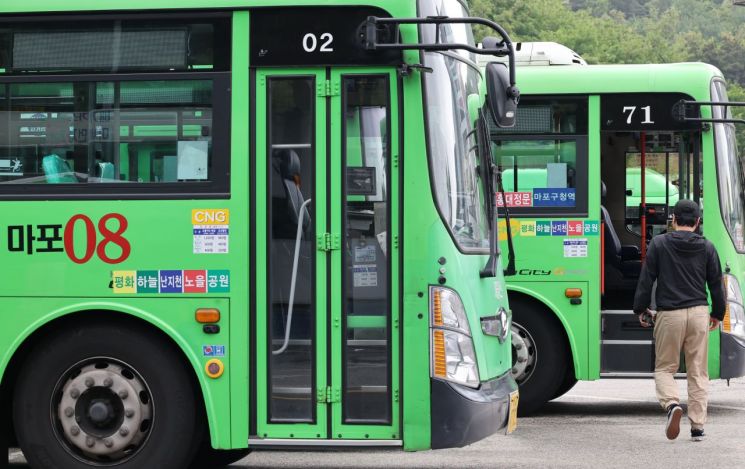
Previously, the association had demanded that the city raise the standard amount for financial support?which should have been set at the beginning of the year?above last year’s level, and increase the village bus fare from 1,200 won to 1,500 won, the same as city buses. Although village buses are privately operated and not part of the semi-public system, the Seoul Metropolitan Government provides partial compensation for operational losses in consideration of their public service role. Subsidies are paid annually based on the standard support amount, and the association has proposed 509,000 won. However, the city is insisting on around 490,000 won, similar to last year’s standard of 486,098 won.
Additionally, the association argues that Seoul’s village bus fare is the lowest in the country at 1,200 won, and insists it should be raised to 1,500 won, the same as city buses. The association also maintains that the transfer settlement ratio should be adjusted to match that of city buses. Currently, when a passenger pays 1,500 won and transfers from a city bus to a village bus, 833 won goes to the city bus and 667 won goes to the village bus.
The association’s decision to take such a strong stance reflects the challenging situation facing the village bus industry. An association official stated, “Unlike city buses and subways, village buses have not recovered their pre-COVID-19 passenger numbers, so difficulties persist. There have also been increases in consumer prices, and we have already raised wages by about 3 percent. If the standard amount for financial support does not increase, it will be difficult to continue operations.”
Disputes continue across all sectors of Seoul’s public transportation, including village buses, city buses, and subways. City bus labor and management remain at odds over the issue of ordinary wages, and the union has announced a nationwide general strike for May 28. In addition, when the Seoul Metropolitan Government announced plans to move up the first and last subway train times by 30 minutes, unions affiliated with Seoul Metro collectively protested, saying the decision was made without consultation.
© The Asia Business Daily(www.asiae.co.kr). All rights reserved.
![Clutching a Stolen Dior Bag, Saying "I Hate Being Poor but Real"... The Grotesque Con of a "Human Knockoff" [Slate]](https://cwcontent.asiae.co.kr/asiaresize/183/2026021902243444107_1771435474.jpg)















