Producer Price Index Falls 0.1% in April from Previous Month
Drop Driven by Lower International Oil Prices and Increased Agricultural Shipments
Continued Oil Price Decline in May Raises Prospects for Consumer Price Stabilization
The producer price index (PPI) has turned downward for the first time in six months. This decline was driven by falling international oil prices, which led to lower prices for coal and petroleum products as well as chemical products. Agricultural products also saw a drop in prices due to increased shipments. With both import prices and the PPI showing a downward trend, there is a growing possibility that consumer prices will also stabilize in the future.
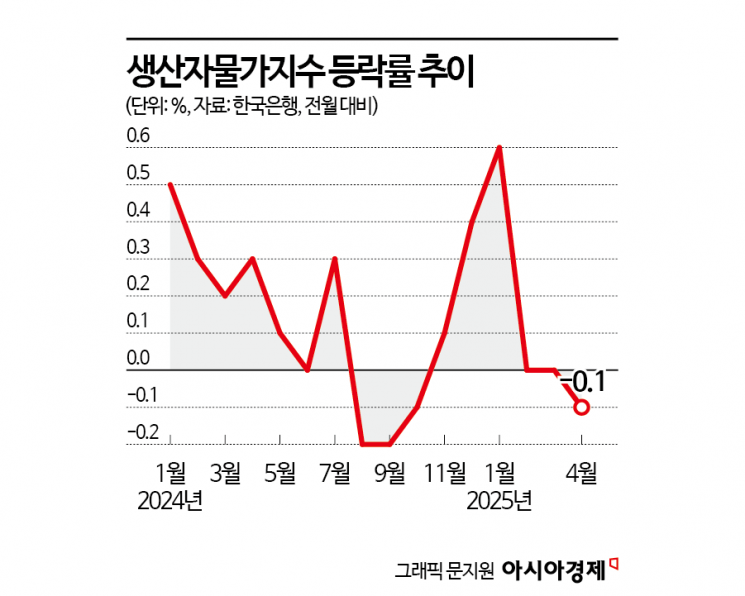
According to the "Provisional Producer Price Index for April 2025" released by the Bank of Korea on the 23rd, last month's PPI stood at 120.24 (2020=100), down 0.1% from the previous month. This is the first negative figure in six months since a 0.1% drop in October last year. After October last year, the PPI rose for three consecutive months?by 0.1% in November, 0.4% in December, and 0.6% in January this year?before remaining flat (0.0%) in both February and March. Compared to the same period last year, the April PPI rose by 0.9%, mainly due to increases in industrial electricity, information and communication, and broadcasting services.
The decline was largely influenced by falling prices in both manufactured goods, which have a high weighting, and agricultural, forestry, and fishery products. Lee Moonhee, head of the Price Statistics Team 1 at the Bank of Korea's Economic Statistics Department, explained, "Manufactured goods fell by 0.3% from the previous month, mainly due to the impact of lower international oil prices, which led to a 2.6% drop in coal and petroleum products and a 0.7% drop in chemical products." The won-dollar exchange rate also fell by 0.9% from the previous month in April, contributing to the price declines in these products.
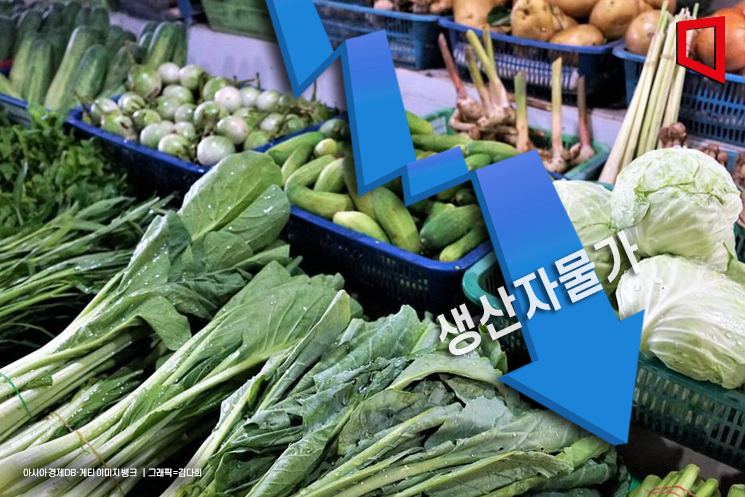
For agricultural, forestry, and fishery products, increased shipments led to a 5.8% decline in agricultural products and a 0.7% decline in fishery products, resulting in an overall 1.5% drop from the previous month. Lee explained, "The prices of cucumbers (-35.1%) and onions (-15.8%) fell from the previous month as growing conditions such as temperature, sunlight, and rainfall improved." Electricity, gas, water, and waste management rose by 0.4% from the previous month, mainly due to a 5.2% increase in industrial city gas. The service sector rose by 0.2% from the previous month, with restaurant and accommodation services up 0.6% and transportation services up 0.1%.
By special classification, food products?including edible agricultural, forestry, and fishery products and processed foods?fell by 0.5% from the previous month, while energy products, including petroleum products, declined by 0.2%. Items excluding food and energy also fell by 0.1% from the previous month.
The PPI for May is also expected to face downward pressure due to continued declines in international oil prices, increasing the likelihood that consumer prices, which lag behind producer prices, will stabilize in the future. The PPI is considered a leading indicator for consumer prices, as changes in producer prices are reflected in final consumer goods prices with a time lag. Lee stated, "The average price of Dubai crude oil from the beginning of May to the 21st has fallen by about 6% compared to the previous month's average," adding, "If this trend continues through the end of the month, it will continue to exert downward pressure on the PPI in May as well."
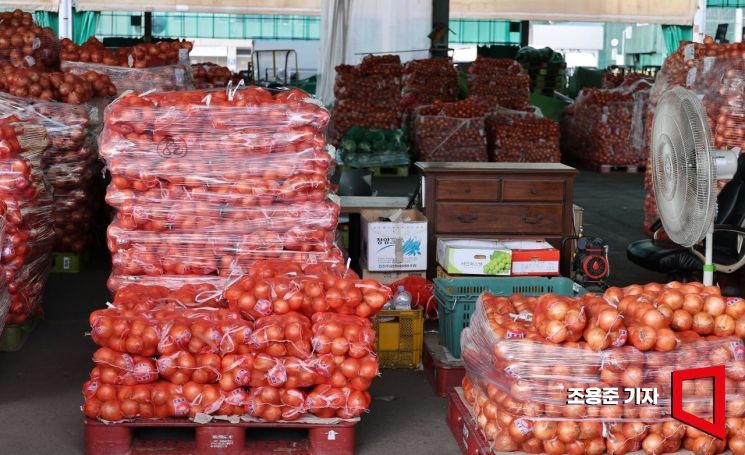 Onions are piled up at the vegetable collection center of Garak Wholesale Market in Songpa-gu, Seoul.
Last month, domestic supply prices fell by 0.6% from the previous month as both domestic shipments and imports declined. Compared to the same month last year, domestic supply prices rose by 0.7%. The domestic supply price index measures price changes for goods and services supplied domestically (including both domestic shipments and imports) to track the transmission of price changes. By stage of production, raw materials fell by 3.6% from the previous month, mainly due to a 4.4% drop in imports such as crude oil, while intermediate goods declined by 0.4%. Final goods fell by 0.1%, with both capital goods and consumer goods down 0.4%. Compared to the same month last year, raw materials fell mainly due to lower imports, but intermediate and final goods rose, resulting in a 0.7% increase overall.
The total output price index, which measures price changes for goods and services including exports as well as domestic shipments to capture overall price fluctuations of domestic products, fell by 0.3% from the previous month as both domestic shipments and exports declined. By item, services rose by 0.2%, but agricultural, forestry, and fishery products fell by 1.4% mainly due to lower domestic shipments, and manufactured goods fell by 0.6% as both domestic shipments and exports declined. Compared to the same month last year, agricultural, forestry, and fishery products decreased, but manufactured goods, electricity, gas, water and waste management, and services increased, resulting in a 1.0% rise overall.
© The Asia Business Daily(www.asiae.co.kr). All rights reserved.
![Clutching a Stolen Dior Bag, Saying "I Hate Being Poor but Real"... The Grotesque Con of a "Human Knockoff" [Slate]](https://cwcontent.asiae.co.kr/asiaresize/183/2026021902243444107_1771435474.jpg)


















